- Details
-
Written by Rob Bernshteyn |
-
May 23rd, 2013
In the past 30 days, Coupa did two things. The first one I’m not so proud of because it smacks of old school, outdated software business processes. The second one I’m very proud of, because I think it’s the future of the software business, or any business really. But let’s start with the first one.
In May, Coupa exhibited at SuiteWorld, NetSuite’s big user conference. Great. NetSuite is a partner of ours and together we’re working with some interesting brands to help them save money: Atlassian, Square, Blue Origin and Intermedia to name a few. No problem there—I’m proud of that.
The problem is, we sent out a press release, which I approved, that says we’re going to be at SuiteWorld. It says, in quotes: Coupa provides this type of stuff, and on the other side we have NetSuite saying, we have a common vision to help businesses save money.
Oh, I better hurry up and get a pass and go? Who cares? I don’t care, much less somebody else. It’s all wonderful, it’s all true, but if I’m a prospective customer, or an existing customer, I really don’t
Companies need to embrace transparency to create authentic relationships with customers.care. Tell me about something Coupa and Netsuite have done together that’s delivered savings such that I should want to stop at that booth and see if it would work for me. That’s what’s missing for me.
What I’m struggling with is that a lot of us in software field follow norms set over decades and launch press releases announcing things that may or may not have anything to do with delivering real results. We’re all following so many processes—gotta get permission, gotta protect the brand, be careful what you say.
But what is it that people really care about if you dig underneath? They care about themselves. If we want to be heard, we should focus on real examples that are highly applicable to real people and get into that kind of dialog. This press release we sent out is not a conversation starter. This is nonsense from 1980. It’s a waste of time.
I think a lot of companies are held back because there’s no steak underneath the sizzle, and they’re scared of the transparency. They’re getting value out of the lack of transparency so they try to buffer it with PowerPoint and people and logos and press releases. They’re holding back from being exposed.
Forward thinking companies aren’t nervous about transparency. Or maybe they are nervous but they’re doing it anyway. They’re trying to make something happen, while other companies are trying to hold on to something.
Virgin America is a great example of a company that is not stuck to process. The whole airline industry is hyper-competitive and price driven, which makes it a great lens into what will happen in any industry as it gets more competitive. In the airline industry, if the price point for a particular flight is $499, you can go on any airline for that price. There’s no buffer there; there’s no fat. They’re all equal until someone does something different.
At Virgin America, they’re doing something different. They’re being more authentic, they’re being more real with everything. Take the whole food thing. Traditional airline, they have a schedule, they have a couple items, they go up and down, they block the aisle with the cart so you can’t go to the bathroom and they hand out this package with 11 peanuts in it whether you want it or not. Virgin America, you sit in your seat and look at a menu and order what you want from a touch screen and they bring it to each person when they want it, forget the cart.
The software industry still has a lot of fat, and it’s being held down by a handful of big players. These guys set up an industry where you show up with a big PowerPoint and you announce that you’re gonna do this and that, and the small companies are just channeling that, just going out and doing the same thing on a smaller scale.
It’s companies that are embracing this transparency that are going to have a chance to be successful. The challenge is that you have to expose more information about what’s really going on at accounts. If we could expose the fact that per employee operating expenses were $20,000 a year, and on our platform they went to $15,000 a year any company that’s similar ought to be interested in that.
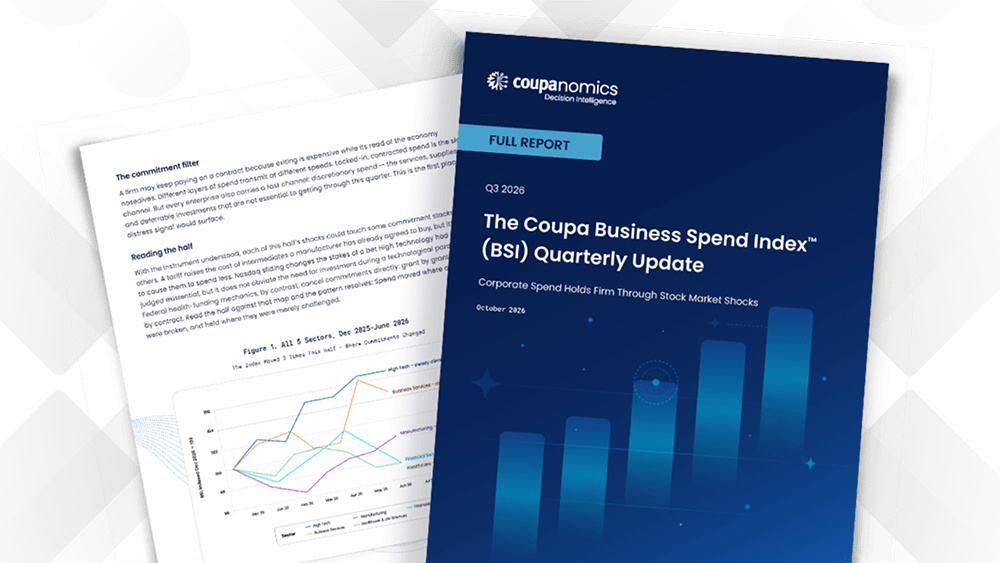
Which brings me to the second thing we did this month, the one I’m really proud of: at the end of April, we published the Coupa Benchmark. The Benchmark is about transparency, both for procurement and for the software industry.
Part of the challenge we have in software with exposing the kind of information customers would really care about is getting it quantified to begin with. The Benchmark does that for key procurement and financial ops performance metrics across companies of different sizes and different industries. This is aggregated, sanitized data from real Coupa customers. Aggregated, so you don’t know what any one company is doing, and sanitized so you don’t know whose data it is and there’s nothing that could help you deduce that.
This is not one of these industry reports that are based on surveys and tabulated and everyone on Wall Street waits for it because it’s only published once a year. But don’t get stuck on the often. The problem with that kind of report that we’re used to is that’s a lagging indicator. It’s collecting someone’s data about something that already happened, then somebody called you, could I do a survey, then we assessed what they thought happened. It’s like a game of telephone, and by the time it’s published the world could have already changed. It’s all lagging indicators.
Our benchmarks are leading indicators. You can see what’s going on, right now. We can tell you, this is how much people on average are spending per night on hotels. We can tell you how long it takes to get things approved at different size companies. We can tell you how quickly processes are happening at companies as it pertains to spending money. This is valuable information you can use to optimize your processes.
We’ve published 6 of what we think are the most important benchmarks for procurement and finance peope, but we actually track over 50 benchmarks and our customers that have a subscription to that part of the platform can look at that data any time they want because it’s all there in real time on our cloud platform.
We’ve been gratified to see that hundreds of people have already downloaded the benchmark, so we think we’re on the right track providing information that really matters.
Press releases, trade shows, they’re not going to go away any time soon, and I’m not saying, cancel these distribution channels. I’m saying, let's change the content that flows through them. The drive toward greater market efficiencies is affecting every part of our way of life. Companies that embrace transparency and promote information efficiency, actually exposing real, actionable information instead of hiding behind corporate approved, non-information press releases are likely to be in a better position to build lasting, successful relationships with their customers and become big businesses to boot.