










Key Takeaways
- Resistance to new tools usually stems from budget constraints, implementation fatigue, or fear of disrupting supply lines.
- Choosing to stick with legacy processes is a choice that puts companies at a competitive disadvantage. The gap between “wait-and-see” companies and their tech-forward competitors compounds quickly.
- Traditional sourcing often fails to make value stick because strategy (intent), execution (real-world bidding), and operations (negotiated items are actually bought) are siloed.
- The transition from manual to AI-powered models moves sourcing from reactive to proactive, turning the entire source-to-pay process into a data-informed loop.
With so much ink being spilled over how AI and technology are going to reshape sourcing, it’s easy to lose sight of just how well the function can adapt to disruption. The environment we’re in right now is hardly the first time sourcing teams have faced upheaval and grappled with challenges beyond finding the cheapest supplier. A few examples from my decades of experience as a sourcing practitioner and advisor:
- Embedding ESG targets: Food and beverage companies distributing in large markets like China needed to report a step-change in their CO2 footprint, so they took steps to ensure the optimal vehicle (never overloaded) and emission type.
- Ensuring good corporate citizenship: I’ve seen companies in the mining sector help strengthen communities by ensuring local labor is used. Specifically, this meant building a scenario that favored talent pools closer to the mine.
- Building resilience: During COVID-19, the companies that thrived had sourcing teams which could balance the urgent need for high-quality PPE while working with supply chain teams to split production of critical components away from high-risk areas.
In these scenarios and others like them, the big question facing sourcing teams was:
Do we stick with what we know, and make it work, or embrace change, believing we can effect big changes but staying wary of overpromising and underdelivering?
In the past, sourcing teams could get away with a degree of inaction, solving for the challenges with their existing toolkit. Legacy processes were “good enough” because the pace of market change was manageable, and manual oversight — while tedious — could still plug the gaps between strategy and execution.
What used to be a missed opportunity in sourcing is now an active choice to put a company at a competitive disadvantage. AI, and agentic AI, are certainly a driving force behind how teams are working faster and better in specific areas of sourcing, especially in optimizing decisions (execution) and bringing the benefits of those decisions into the business (operationalization). But AI itself isn’t the whole story. The platform on which the AI runs is crucial. If sourcing teams can’t connect strategy, execution, and operations to their best work, even the largest and most ethically-sourced dataset informed by source-to-pay practices will only get them so far.
The impact of settling for the sourcing status quo
It sounds counterintuitive, but sourcing teams which have been operating at a company for a while are often hesitant to quickly adopt new technology and practices. The reasons for this are understandable on the surface:
- Budget constraints. Sourcing teams aren’t given the funds they need to help the company act strategically when sourcing (and procurement as a function) is viewed as a cost center.
- Implementation fatigue from previous ERP rollouts and upgrades. The promised sourcing benefits that should materialize right after go-live feel distant when teams are overwhelmed by constant technology upgrades, high-pressure environments, tool overload, and mountains of ESG surveys and audits sent to suppliers.
- Fear of disrupting established supply lines. These supply lines are the beating heart of production processes. If there are breaks, products don’t get made or don’t make it to market. Both are significant risks for companies.
There’s a quiet but real risk that doesn’t show up in quarterly reports: the cost of waiting. When sourcing teams delay investment in new approaches or capabilities, they rarely stand still relative to the market. They actually fall behind it. Competitors continue to experiment, adopt new technologies, and learn how to use advances such as AI to analyze markets faster, evaluate more scenarios, and make better-informed decisions. Even new adopters benefit from these aspects.
Because these technologies improve at an exponential pace, the gap compounds over time. What might feel like a cautious decision to “wait and see” can quickly become a structural disadvantage, leaving teams trying to catch up just as the pace of change accelerates again.
What business leaders are saying
Source: The Coupa Clarity AI Impact Report: Turning AI Intent into Real ROI, December 2025
Research partner: INCISIV
Why traditional sourcing can’t deliver on corporate strategy
Despite their reasons for delaying a technology investment, sourcing teams have ambitious goals they want to meet using the capabilities they already have: align decisions to corporate strategy, manage complexity, and deliver value beyond short-term savings. These goals move the needle on margins, and when it comes to sourcing, the quickest way to impact profitability is by making sure that category strategy is connected to sourcing execution and operations.
Before we get into why establishing that connection was so difficult in the past, let’s define these three key areas of activity within sourcing:
| Strategy: Start with intent | Execution: Optimize real-world decisions | Operations: Make value stick | |
| What happens | Effective sourcing begins with a clear category strategy. It goes beyond market analysis to cover explicit decisions around objectives and trade-offs: cost, resilience, sustainability, risk, and supplier roles. | Strategic sourcing allows teams to model sourcing complexity rather than simplify it away, capturing constraints, multiple award scenarios, and competing objectives. | By connecting optimization awards directly into contracts and enabling compliant purchasing within a single solution, organizations reduce leakage and turn one-off events into sustained value. |
| Why it matters | Strategy provides a structured way to define intent, ensuring sourcing events are designed to deliver against agreed outcomes, not just lowest price. | Category strategy only creates value if it can be executed in the real world. The result isn’t just improved savings, but transparent, defensible decisions that stay aligned to the original strategy. | Too often, negotiated outcomes erode once sourcing events are complete. With operations connected to strategy and execution, what was agreed is what gets bought and performance can be tracked against strategic intent. |
While digital procurement ecosystems excel at analyzing past spend and managing execution, they often lack a structured, scalable approach to category strategy: the critical missing bridge to close the gap between strategic planning and day-to-day operations. Without the right technology to build that bridge, category strategy plans tend to be developed in isolation, remaining static and disconnected from teams in charge of buying.
Advances in AI and technology have done away with this fragmentation. A quick, generalized example: Instead of a human manually checking if a bid aligns with a three-year category plan, an AI agent can monitor the process as it happens. It can flag when a proposal deviates from sustainability goals or suggest shifts in category tactics based on sudden market volatility. Today’s category managers and sourcing teams can also take advantage of an AI-powered category strategy engine that connects strategy development and sourcing execution and operations on a single platform. All from one place, these professionals can develop and share a best-in-class framework, get strategic recommendations, produce strategic objectives and an implementation plan, and generate executive summaries.
Companies which hold off on sourcing capability investments force their sourcing teams to stay in reactive mode, grappling with questions like:
- We’ve reported millions in negotiated savings on paper, so why is our actual departmental spend still trending upward?
- Why do our internal stakeholders only call us when they need a signature?
- Why are we re-tendering contracts for savings based on when they expire?
instead of empowering them to do higher-order work.
Inaction reinforces the value leak between sourcing and procure-to-pay
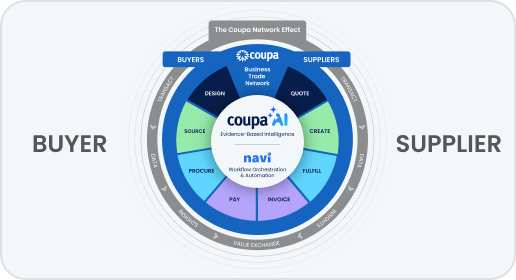
Legacy systems have made some headway in connecting upstream and downstream procurement activities, preventing some of the handoffs where siloes form and data and agreements become trapped and invisible. But what turns the source-to-pay process from a loosely connected chain to bi-directional, continuous loop is an operating model powered by AI. Here, the reality of what actually happens during the procure-to-pay lifecycle flows into and informs sourcing events.
Leading sourcing teams are making this shift:
| Static sourcing | Continuous, AI-powered sourcing |
| Teams negotiate a price and abide by it for the duration of the contract. | AI constantly listens to the market, cross-referencing signals with P2P invoices and suggesting triggered re-negotiations. |
| Awards are based on promises made during the RFP. | AI monitors proof generated in the P2P lifecycle and adjusts rankings accordingly. |
| A sourcing event is triggered by a supply shortage or an expiring contract. | AI analyzes P2P spend patterns and pre-emptively makes recommendations to the sourcing team. |
| A supplier suddenly fails to deliver, and a human is needed to find an alternative. | AI immediately reviews the database of vetted suppliers and suggests where to shift volume. |
With AI and a unified platform for spend management, sourcing teams can ensure that every dollar spent in procure-to-pay provides the data they need to negotiate a better dollar in the next sourcing event.
Is your sourcing strategy still fit-for-purpose?
How much can your sourcing approach afford to stay the same? By the time teams are burned out and every supplier relationship is tactical, your company’s margins might be so eroded that the business will never pull ahead of the competition. Your sourcing team is probably already wondering what happens if your company does nothing:
- How many hours per week are our high-level strategic leads spending on data entry or fixing broken spreadsheets?
- What is the cost of a 1% missed saving over three years?
- How many duplicate contracts or unmanaged tail-spend leaks will occur before we notice?
- While we manually vet a new vendor, is our faster-moving competitor already signing them?
- Will it take us weeks or hours to respond to the next disruption?
- Will the next generation of top talent want to work here with the sourcing tools we have?