









Stage 1 Organizations: Tactical & Operational
Recent global events have exposed how fragile supply chains become when they lack visibility. In the world of direct spend, the stakes are high: If procurement fails, production stops. You cannot sell a product until it is manufactured, meaning every unexpected delay or unmanaged expense creates a damaging ripple effect across the entire enterprise.
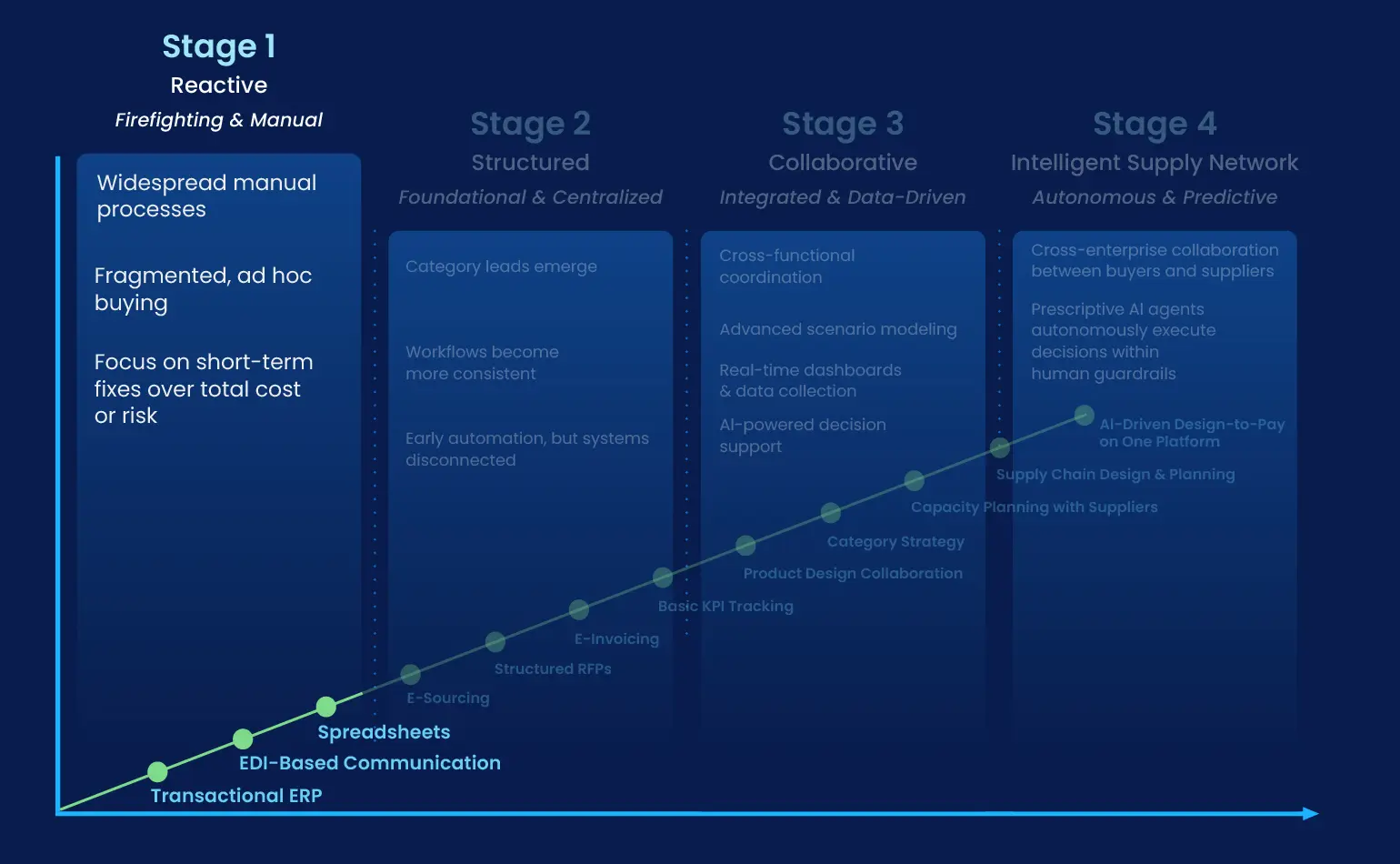
Many organizations currently operate in a reactive state, often lacking a clear map to evolve beyond manual hurdles. Understanding where your journey begins is the first step toward building a resilient, intelligent supply network.
The financial cost of standing still
The price of remaining in a reactive state is measurable and steep. Hackett Group research shows that Digital World Class procurement organizations adopting advanced tools and generative AI (GenAI) see significant performance advantages over less mature peers:
These numbers are compelling and suggest that transitioning to a more structured approach is a financial necessity, not just an operational goal.
Uncoordinated survival isn’t enough
In many Stage 1 organizations, procurement exists in a state of uncoordinated survival. Buying often happens via fragmented emails and unrecorded conversations. Because there is no cohesive framework linking supply chain design, sourcing, or supplier management, work remains siloed and reactive.
The primary challenge is that fragmented data means you often don’t truly know who all your suppliers are or exactly what you are paying them. In direct spend, this lack of visibility can lead to reactive scrambling for parts, especially when engineering makes design changes without consulting procurement on lead times or material availability. This operational isolation means you may be frequently solving the same problems repeatedly rather than building a scalable strategy.
Get out of the reactivity trap
At this tactical phase, your network exists, but it is effectively invisible and unmanaged. Stage 1 is defined by high manual effort and after-the-fact accounting where you react to disruptions only after they have already impacted the production line.
- Small and stretched thin: Teams juggle multiple roles — buyer, planner, and problem solver — focused solely on keeping production running.
- Reliance on institutional knowledge: Collaboration relies on personal relationships and unrecorded expertise rather than formal, scalable structures.
- Manual sourcing: Typically sourcing is run on a single-source basis with a primary focus on unit cost rather than total cost of ownership (TCO).
- Invisible disruptions: Issues like late deliveries or quality problems are often noticed only when they become severe.
- Disconnected systems: While a transactional ERP might handle orders, it fails to provide the data needed to establish performance baselines.
Digitize procurement foundations for AI advantages and quick wins
You cannot collaborate with a network you cannot see. A good first step in breaking out of the manual loop is moving from buying first to requesting first by establishing basic digital foundations. While Stage 1 organizations typically have limited AI capabilities, the transition to Stage 2 is built on cleaning the records that will eventually fuel intelligent systems.
A key AI quick win as you move toward Stage 2 is AI-guided data preparation and RFP creation. AI can help turn fragmented spreadsheets and paper-based invoicing data into structured information. By automating the cleansing of supplier records and material groups, you create a single source of truth, essential for a unified view of your spend management. This transition enables your team to stop acting as human data repositories and start focusing on strategic sourcing, category strategy, and supplier innovation.
A single, unified platform is the prerequisite for a connected supply network. In the reactive stage, organizations often fall into a shadow procurement trap, where different departments onboard new suppliers independently. This decentralization is more than an administrative headache; it is a strategic liability. When supplier discovery is unmanaged, it results in duplicate records, fragmented volumes, and a lack of central visibility into total exposure with any single vendor.
True direct spend thought leadership requires moving beyond a simple list of vendors and toward a centralized supplier database. Centralization enables you to:
- Identify negotiation gaps: Fragmentation hides the true volume of your spend. By unifying data, you can see where multiple departments are buying from the same supplier, allowing you to leverage that collective volume for better pricing and terms.
- Mitigate hidden risks: When records are siloed, a quality failure or financial red flag in one department might never reach another. Centralization ensures that a supplier's scorecard is visible across the entire organization.
- Establish onboarding integrity: Moving toward a formal onboarding process reduces the risk of fraud, ensures compliance with tax and quality certifications, and ensures every vendor enters the system with the proper classification.
Move from transactions to relationship design
In the reactive stage, sourcing is often viewed as a series of isolated transactions, like finding the lowest price for a specific part at a specific moment. True maturity requires a perspective shift where sourcing is not a transaction; it is a relationship design process. To progress, companies must move beyond chasing the lowest price and transition to a formal sourcing structure that evaluates total cost of ownership (TCO). This shift enables the move from one-off sourcing to a formal structure where vendors are evaluated for long-term value, quality, and reliability.
Moving toward sourcing mastery involves:
- Segmenting suppliers: Not all suppliers are created equal. Begin by identifying which vendors provide critical materials (e.g., high risk/high value) and which are purely transactional. This ensures your team focuses its limited capacity on the 20% of suppliers that drive 80% of your risk and value.
- Implementing early engineering checkpoints: One of the most actionable steps to reduce reactive scrambling is to add sourcing checkpoints into the New Product Development & Introduction (NPDI) process. By validating that new components can be procured at the needed cost and volume before a design is finalized, you prevent late-stage supply chain bottlenecks.
- Formalizing category management: Even if you don't have dedicated category managers yet, begin grouping spend into high-level categories (e.g., raw materials, logistics, components). This visibility allows you to identify price trends and savings through volume consolidation.
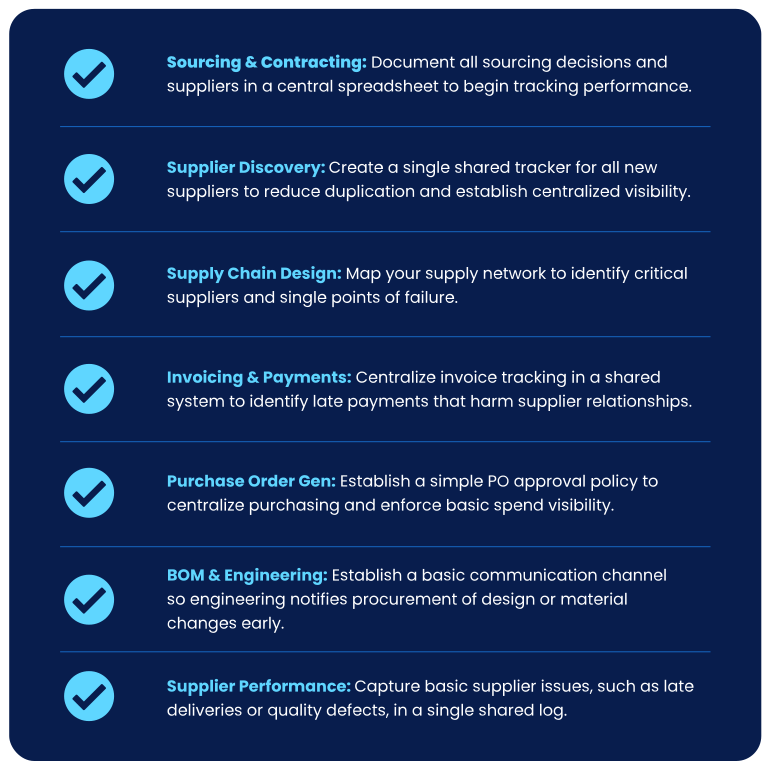
Transitioning from a strategic vision of a roadmap to the practical reality of daily operations requires a disciplined focus on immediate, high-impact changes.
Quick wins checklist
The Direct Spend Maturity Series
This article is part of a series designed to guide you through the Direct Spend Procurement Maturity Model, a roadmap for organizations to evolve from uncoordinated, manual operations to an autonomous, AI-powered competitive advantage. Throughout the series, we will dive into specific Process Dimensions, from Supply Chain Design to Supplier Collaboration, providing concrete action items to help organizations reach the next level of performance.
Our next post explores Stage 2, structured procurement, and how to jump start your processes and technology. We will discuss standardizing the way you connect with suppliers to ensure every transaction is compliant, auditable, and verified. Learn how moving from fragmented point solutions to a unified platform can help your organization transition from one-off bids to a planned sourcing lifecycle.