Volatile news. Stable spend.
Read the latest in the Coupa Business Spend Index™ Quarterly Update.
Get the Report





The market winced. Business spend held firm.
The Coupa Business Spend Index™ Quarterly Update

Direct procurement sits at the center of how manufacturers, distributors, and product companies actually build things. Get it right, and your supply chain hums. Get it wrong, or lose a key supplier without a backup, and production can stop entirely. For companies that make physical goods, direct procurement is a core operational competency.
According to The Hackett Group, organizations that build an AI-powered direct procurement function generate 2.6x greater ROI than their peers, require 31% fewer FTEs to achieve the same results, and operate at 19% lower cost-to-spend. Those numbers reflect a fundamentally different operating model.
Every physical product you’ve ever bought started as a purchase order. Before a car rolls off a line, before a phone ships, before a bottle of medicine reaches a shelf, someone had to source the raw materials and components that made it possible. That’s direct procurement.
Direct procurement is the purchasing of goods and materials that go directly into a company’s finished products. These purchases are tightly coupled to production. Every unit you buy has a downstream effect on what you can manufacture and sell. This is why direct spend is often managed with an intensity that indirect spend management simply doesn’t get.
You’ll often hear direct procurement referred to as “direct spend.” The two terms are used interchangeably throughout this guide and across industries. In industries like automotive, aerospace, electronics, and consumer packaged goods, it can represent the majority of total company expenditure.
Direct procurement is critical in many different industries, especially manufacturing.
Automotive OEM:
Consumer electronics:
Pharmaceutical firm:
Food manufacturer:
Indirect procurement covers everything an organization buys that doesn’t go into its products. Office supplies, IT infrastructure, facilities maintenance, marketing services, consulting, and travel are indirect. They’re necessary to run the company, but they don’t sit on the bill of materials. Indirect-focused tools are distinctly different, built around purchase requisitions, approval workflows, and tail spend management.
| Dimension | Direct procurement | Indirect procurement |
| What’s being bought | Raw materials, components, production inputs | Office supplies, IT, services, facilities |
| Relationship to product | Goes into or enables the production of the product | Supports business operations, not the product |
| Spend volume | Typically, the majority of total company spend | Smaller share, highly fragmented |
| Supplier relationships | Fewer suppliers, strategic and long-term | Many suppliers, often transactional |
| Procurement management approach | Integrated with supply chain operations | Often decentralized across business units |
| Risk profile | High: Disruptions can halt production | Lower: Disruptions are inconvenient, rarely critical |
| Contract structure | Long-term agreements, volume commitments | Spot buys, catalogs, frameworks |
| Key metric focus | Supply continuity, product quality, cost per unit | Compliance, cost reduction, tail spend control |
What counts as direct spend for one company might be squarely indirect for another. Packaging is the classic example. For a consumer goods company, packaging is clearly a direct input. It’s part of the product a customer receives, subject to brand standards, engineering specs, and supplier qualification. But the line blurs when you look at secondary or tertiary packing. For example, a CPG company shipping products to retailers relies on pallet wrap and bulk shipping materials to move goods through the distribution network. Those materials are essential to getting the product to market, but they don’t change the product itself — so some teams classify them as indirect.
Similarly, logistics and transportation sit in a gray zone. For a company with a just-in-time manufacturing model, transportation is inextricably tied to production continuity. A missed delivery window shuts down the line. For a retailer, securing logistics is certainly important for getting the finished product to the store, but it isn't directly tied to the product's production.
The categorization question also gets complicated with contract manufacturers and outsourced production. When you outsource production, the manufacturing labor is indirect to you, but the components and raw materials your contract manufacturer buys on your behalf are direct inputs to your product.
Direct procurement gets treated as something close to a strategic capability — because that’s what it is. For most companies that produce or sell physical goods, direct spend is the largest single expenditure category. When a company talks about procurement cost savings, it’s often direct spend where the real dollars are.
The supply chain risk argument is more urgent. A disruption in direct procurement — a key supplier going out of business, a geopolitical event cutting off a raw materials source, a quality problem forcing a recall — can halt production entirely. That’s lost revenue, broken customer commitments, and in some cases, permanent damage to market position. Indirect disruptions are painful. Direct disruptions can be existential. It’s why supply chain visibility — knowing what’s happening across your supplier network before problems surface — is treated as a strategic priority, not a reporting exercise.
Good direct procurement management means making consequential decisions, often under uncertainty and time pressure.
Strategic sourcing in direct procurement isn’t just about finding the lowest unit price. It’s about understanding total cost of ownership, including logistics, quality risk, lead times, currency exposure, and the cost of a supplier failure. A component that costs less per unit but comes from a single factory in a high-risk geography might carry a much higher total cost than the unit price suggests.
Single-source relationships offer deeper collaboration, better pricing leverage, and cleaner supply chain design. They also concentrate risk. Multi-sourcing spreads that risk but adds complexity — more supplier relationships to manage, more potential for quality variation, more overhead. The decision depends on the criticality of the component, market dynamics, and the company’s risk tolerance.
Should you manufacture this component yourself, or source it externally? Deciding to make it offers tighter quality control and protection of proprietary processes, but requires capital investment and distracts from core competencies. Deciding to buy gives you flexibility and access to specialized suppliers, but creates dependencies.
Procurement cost savings look different depending on what you’re measuring. A unit-price lens can drive decisions that look good on paper but increase total cost through quality failures, expediting fees, and supplier instability. TCO discipline requires collaboration with engineering, finance, and operations, not just the procurement team.
Direct procurement teams live and die by forecast accuracy. Over-forecast and you’re sitting on excess inventory, tying up capital and warehouse space. Under-forecast and you’re scrambling for supply at spot prices, or worse, you can’t get the materials at all. Inventory management is a constant balancing act between service levels and working capital efficiency.
The direct procurement process starts well before a purchase order is issued.
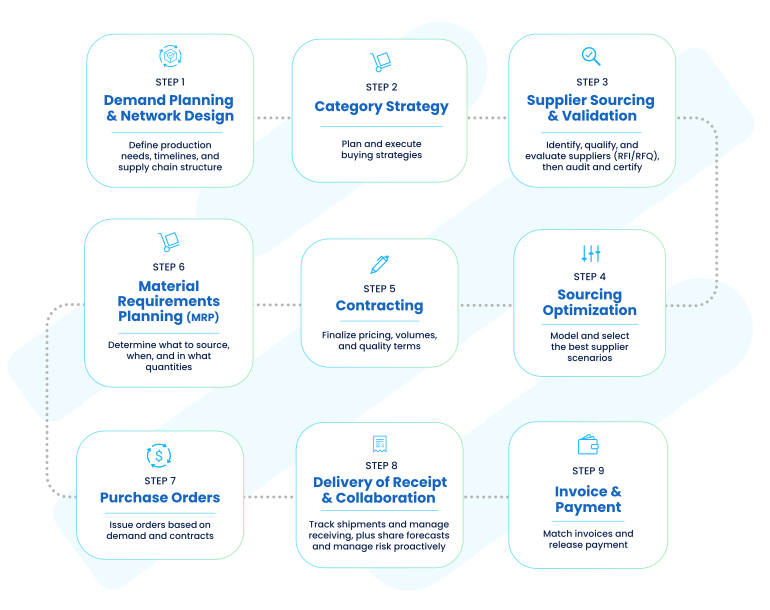
It begins with demand planning and supply chain design, understanding what needs to be produced, in what quantities, and on what timeline, then mapping the network of suppliers, logistics routes, and inventory positions needed to meet that demand. That signal flows into materials requirements planning, which determines what needs to be sourced, when, and in what volumes.
From there, sourcing begins. Teams identify and qualify suppliers, issue requests for information (RFIs) and requests for quote (RFQs), and evaluate bids. For new components or new supplier relationships, this takes longer — site audits, quality certifications, and sometimes prototype evaluations before anyone gets awarded business. High-volume or complex categories often undergo formal sourcing optimization events, where the goal is to stress-test award scenarios against real-world variables such as cost, lead time, and supplier capacity.
Winning suppliers get contracts. Direct procurement contracts run longer and cut deeper than what you’d see on the indirect side. They spell out volume commitments, quality expectations, and pricing terms that can shift with commodity markets.
From there, purchase orders flow. The team tracks deliveries against committed dates and coordinates receipt and inspection with warehouses and production. Supply chain collaboration runs alongside all of it: sharing demand forecasts, acknowledging orders, catching capacity constraints before they become problems.
Invoices are matched to purchase orders and receipts before payment is released.
Direct procurement doesn’t sit in one universal place on the org chart, but it’s almost always close to operations and supply chain rather than finance or administration.
Direct procurement sits close to operations and supply chain, typically reporting to the Chief Supply Chain Officer or the COO. The core roles involved:
Supplier quality engineers are often embedded within or closely aligned to direct procurement teams, ensuring that what’s being bought meets specification and working with suppliers when it doesn’t. As organizations mature, roles specialize, and procurement professionals increasingly function as strategic orchestrators rather than reactive buyers.
Where you start depends on where you are. Best practices for managing direct procurement look different depending on how mature your company’s processes already are. The Direct Spend Procurement Maturity Model is a useful baseline for determining that.
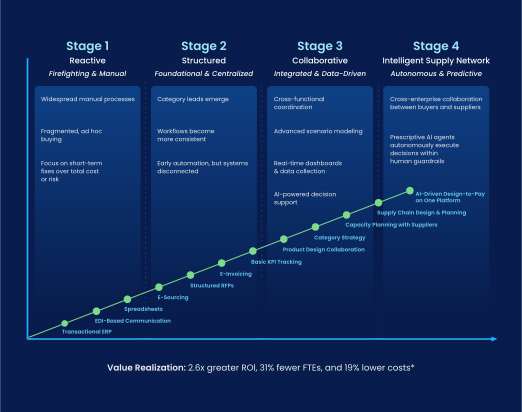
The model describes four stages: Reactive, Structured, Collaborative, and Intelligent Supply Network. At Stage 1, teams are firefighting manual processes and siloed data with no formal category structure. By Stage 4, AI agents are autonomously executing decisions across the full design-to-pay cycle. Most organizations sit somewhere in the middle, with pockets of maturity in some areas and gaps in others.
Direct procurement looks different depending on where you sit in the organization. A category manager’s Stage 1 priority is conducting a basic spend analysis to create visibility into what’s being spent, with whom, and on what. Sourcing teams should focus on documenting decisions and suppliers in a central tracker to build the data foundation that everything else depends on. Buyers managing POs and supplier relationships should start by extracting basic order details from spreadsheets and consolidating them into a single source of truth. For role-specific guidance across all nine process dimensions, explore the full Direct Spend Procurement Maturity Model.
What gets measured gets managed. In direct procurement, the right KPIs connect operational execution to business outcomes like production continuity, product quality, cost performance, and working capital efficiency. The metrics that matter also evolve as an organization matures.
Direct Procurement KPIs
| KPI | What it tracks | Why it matters |
| On-Time-In-Full (OTIF) Delivery | Supplier deliveries received on time and in full | Low OTIF is a leading indicator of production disruption |
| Supplier Quality Yield | Materials meeting spec on first inspection | Poor rates drive scrap, rework, and production delays |
| Average Sourcing Cycle Time | Time from sourcing event initiation to award | Longer cycles slow production planning and limit responsiveness |
| % Suppliers with Scorecards | Active suppliers tracked against defined metrics | Indicates progress toward consistent performance management |
| Inventory Turns | How frequently inventory is consumed and replenished | Too-low turns signal overstocking and working capital drag |
| % Direct Spend Through Single Platform | Spend flowing through a unified procurement system | Demonstrates system consolidation and end-to-end visibility |
| Invoice Match Rate | Invoices auto-matched to POs without manual intervention | Low rates create payment delays and supplier friction |
| Total Landed Cost | Full cost, including sourcing, logistics, quality, and operations | Prevents unit-price optimization that creates hidden costs |
| % Spend Analyzed by AI Models | Direct spend is subject to AI-driven decision support | Measures AI embedment in procurement; a Stage 4 indicator |
No single KPI tells the full story. OTIF looks great until a supplier starts shipping on time but with degrading quality. Cost savings look impressive until you realize they came from concentrating spend with a single high-risk source.
In indirect procurement, the typical relationship with a supplier is transactional. You need office furniture, you find a vendor, you buy it. Spend analysis in indirect procurement is often about finding consolidation opportunities and negotiating better catalog pricing. The stakes are low.
Direct procurement supplier relationships are a different animal entirely.
Direct suppliers tend to be fewer in number, far more strategic, and managed through long-term contracts or collaborative partnerships. A Tier 1 direct supplier might have access to your production schedules, demand forecasts, and engineering drawings. You might be codeveloping products with them. In the most mature companies, key suppliers are part of the design team providing input on cost, manufacturability, and alternative materials during new product development — not after the design is locked.
That depth creates leverage and exposure. Supplier risk management in direct procurement isn’t a periodic audit exercise. It’s a continuous operational discipline. A supplier’s financial instability, a quality problem in their own supply chain, or a capacity constraint at their plant, these can become your production problem in weeks or days. Proactively monitoring supplier performance and supplier health before problems escalate is one of the most valuable things a direct procurement team can do.
Dürr AG, the global automotive engineering leader, learned this the hard way. Three independent business units had been operating with duplicate contracts and inconsistent supplier terms, a classic silo problem. After centralizing contracts and standardizing processes on a single platform, the company unlocked multimillion-euro savings and unified three divisions under one procurement organization. As Chief Procurement Officer René Schwalm put it: “We’ve not only saved millions — we’ve broken down silos, connected teams globally, and built a more transparent, efficient procurement organization.”
At Stage 2 maturity, this looks like basic scorecards and semiannual performance discussions. At Stage 3, it means quarterly business reviews, formal improvement plans, and supplier segmentation that distinguishes strategic partners from tactical vendors. At Stage 4, advanced risk monitoring systems automate alerts when a supplier’s deliveries begin to lag, quality incidents occur, or external indicators such as financial ratings worsen. Supplier risk scores get factored directly into sourcing decisions.
Planet Labs, the satellite imaging company, was managing its buying across Jira tickets, emails, screenshots, and Slack threads. There was no single source of truth, audits were painful, and the team had no consistent way to track the status of parts or approvals. After moving direct spend onto Coupa, that changed.
“As we expand into manufacturing more satellites, having intuitive, standardized purchasing in Coupa is a major advantage,” said Christina Ta, Director of G&A Systems. “We need far more predictability in lead times, tighter control over component-level spend, and clearer visibility into where parts are in the process. Coupa gives us that foundation.”
As Plant Labs scales into manufacturing more satellites, the foundation is in place for predictable lead times, component-level spend control, and full process visibility.
Lowes, the Fortune 50 home improvement retailer, had a sourcing platform problem. Their previous solution was so complex that most sourcing defaulted back to email. Teams weren’t adopting it, and executives couldn’t get visibility into outcomes. After switching to Coupa, adoption was immediate. In just three months, Lowe’s ran as much sourcing volume as it had in four years on the prior solution. More than $3 billion was sourced through Coupa’s sourcing optimization tool in a single year, with tens of millions in savings captured, including over $2 million on a single event.
“The real benefit has been speed,” said James Mergel, Former Shared Services Manager. “Speed for associates, speed to market, and speed in reporting results up to our executives.”
Leadec, a global industrial services company that maintains and optimizes factories and supply chains, had limited visibility into its direct spend and was reacting to market disruptions rather than anticipating them. After implementing Coupa, the team secured multiple sourcing options for critical materials, cut regulatory reporting time from days to hours, and strengthened supplier relationships enough to unlock cost concessions.
“With Coupa, we have options,” said Beth Bracey, Buyer at Leadec. “We can shift suppliers, negotiate better costs, and respond quickly to volatility — turning supply chain challenges into opportunities.”
Most procurement software on the market was built to address indirect procurement issues around purchase requisitions, approval workflows, catalog management, and tail spend management. Those do those things reasonably well.
Direct spend is a different set of problems entirely. Supply chain visibility across a multitier supplier network. Supplier collaboration tight enough to exchange demand signals and capacity updates in near-real time. Production alignment that connects procurement decisions to manufacturing schedules. Scenario planning for supply chain distributions. Bill of materials management that links engineering changes to sourcing implications automatically.
When companies try to force direct spend through spend management software designed for indirect, the gaps show up quickly. The system doesn’t understand bills of materials. It can’t model supply chain alternatives. Supplier collaboration is limited to transactional document exchange. Visibility stops at Tier 1.
Any serious direct procurement platform needs to cover the basics: supplier risk management, purchase order generation, invoice matching, contract management, and spend visibility. If a solution can’t do those things reliably, the conversation ends there.
But the real differentiator — and where most platforms fall short — is whether sourcing optimization, category strategy, and supplier discovery live on the same platform as everything else. When these capabilities are fragmented across point solutions, you lose the data continuity that makes good decisions possible. A sourcing event that doesn’t connect to your category strategy, or a supplier discovery process that doesn’t feed into your risk management, creates the same silo problem you were trying to solve in the first place.
Sourcing-only tools can speed up individual events, but they operate at the execution layer, optimizing bids without visibility into the category strategy, sourcing optimization, contract management, and procurement execution in a closed loop, so that every sourcing decision is informed by upstream strategy and flows directly into downstream purchasing. That’s a fundamentally different capability than running faster RFQs. For a deeper comparison of integrated versus point-solution sourcing tools, see Coupa vs. Keelvar: Enterprise-Wide Spend Strategy vs. Sourcing-Only Tools.
Beyond the feature checklist, there are five questions worth pressing on during any software evaluation.
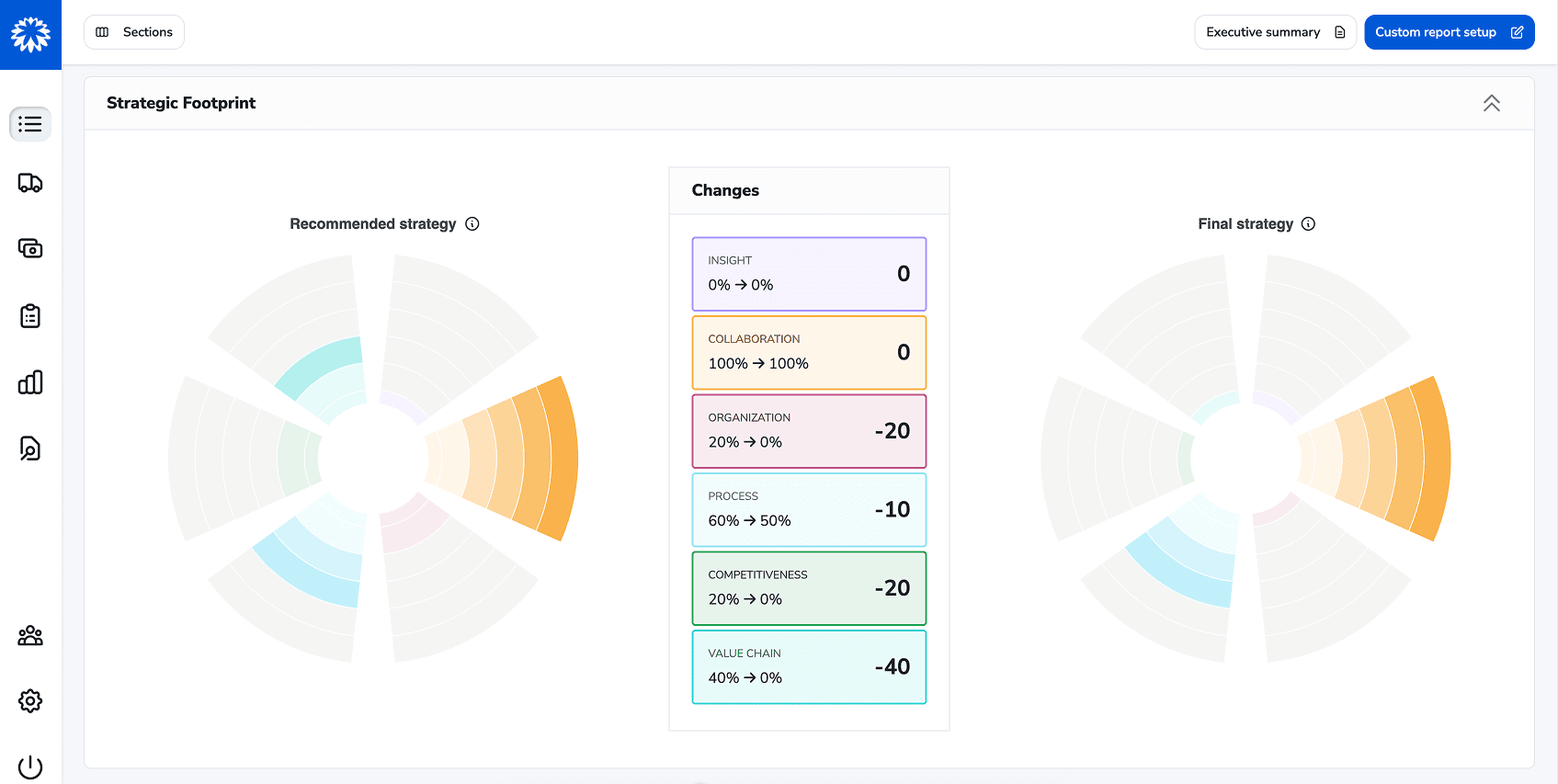
Building category strategies from scratch is slow and inconsistent. Look for a platform that uses AI-assisted guidance and community intelligence to accelerate the process with built-in frameworks like the Kraljic Matrix and SWOT. These tools help teams align supplier decisions with category goals and segment suppliers based on performance data and market intelligence.
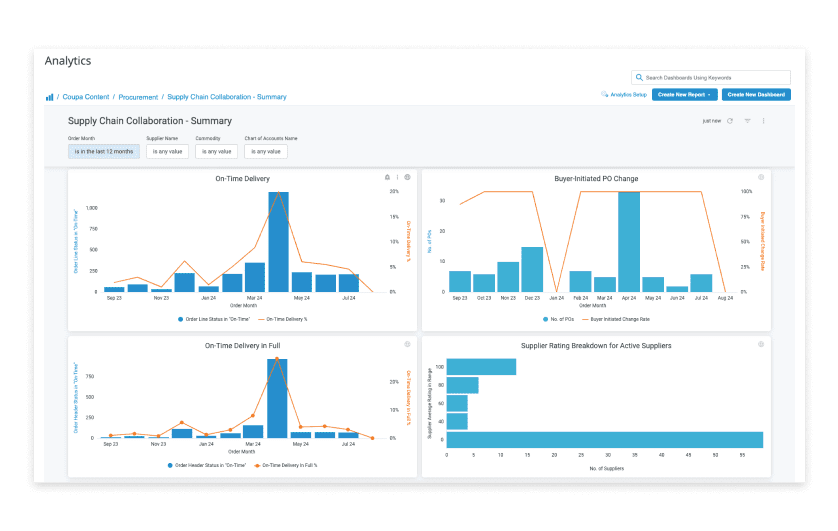
Direct procurement teams can’t afford to find out about supply bottlenecks after the fact. The platform should give you live visibility into where materials are in the order cycle, alert you to disruptions before they hit the factory floor, and support the kind of end-to-end collaboration with suppliers that keeps supply consistent and factory shutdowns off the table.
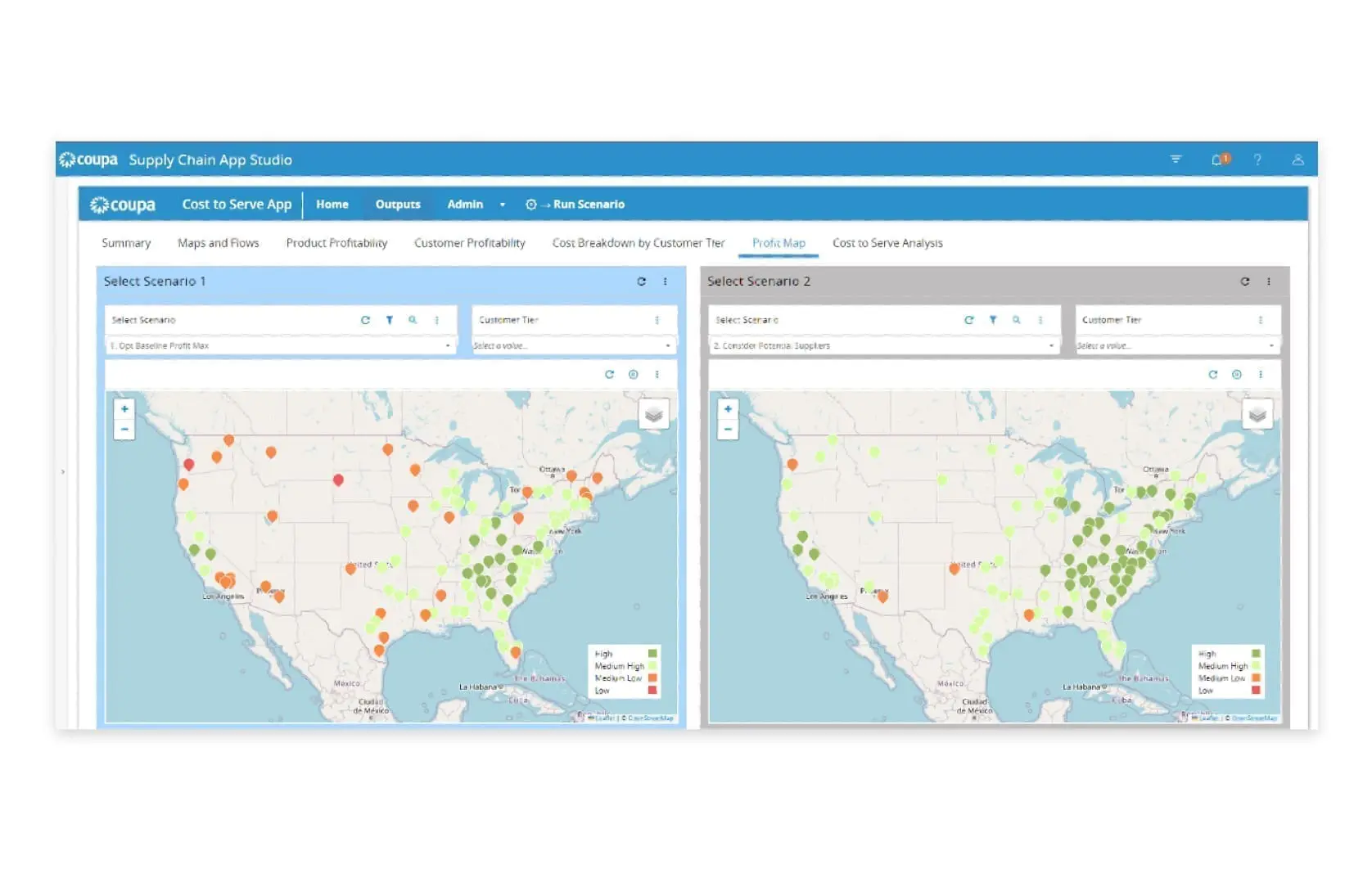
Direct procurement isn’t a set-it-and-forget-it function. Supply chain design has to evolve as markets shift, suppliers change, and demand fluctuates. A platform that only supports periodic, manual network reviews will leave you perpetually behind.
Unlike indirect spend, where you’re largely negotiating catalog prices, direct spend requires breaking down costs at a much finer level, from labor to materials to overhead. You need that granularity to negotiate effectively, especially with raw materials suppliers, where landed cost, cost of goods sold (COGS) impact, and bill-of-materials-level pricing all matter.
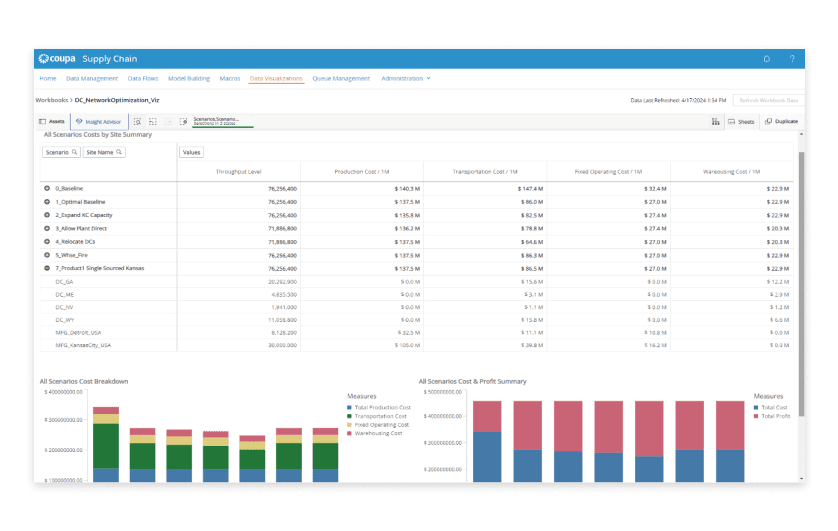
A fire at a Tier 3 facility can stop your production line just as surely as a Tier 1 failure — you just won’t see it coming unless your platform can map beyond your immediate supplier relationships. Ask specifically how the tool surfaces risk across multiple tiers of the supply chain, not just the suppliers you buy from directly.
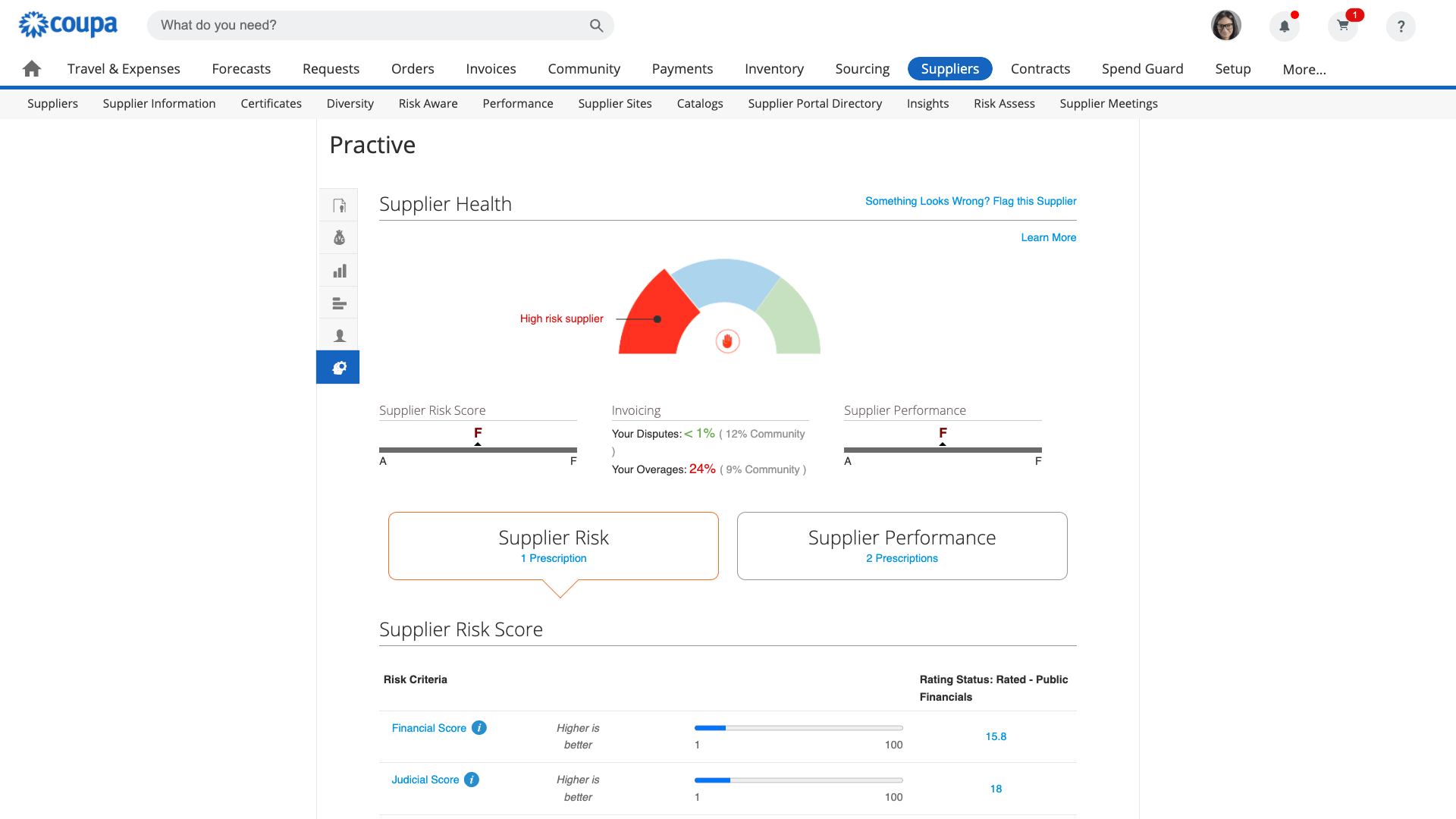
The right platform won’t eliminate the complexity of direct procurement, but it changes what your team spends its time on. Time for less firefighting and more strategy ultimately separates companies that manage direct spend well from those that are perpetually reacting to it.
Oh! It looks like you opted out from using the needed cookies. If you are interested in using the AI Agent, then please opt-in to the cookies in the preference center.
Update preferences