







Key Takeaways
- Procure-to-pay automation digitizes the entire purchase-to-payment lifecycle — from purchase requests and approvals to invoicing, two-/three-way matching, and a natively-built and embedded payments process.
- Automation enhances efficiency, compliance, and fraud prevention while strengthening supplier relationships and providing real-time visibility into spending and cash flow.
- Investing in automation to reduce manual processes and costs is the No. 1 strategic priority for CFOs.
- The best way to start automating P2P is by addressing the biggest friction points — such as users buying off-contract goods and services, invoice matching, and investigating and understanding the history of a payment — before scaling automation, enabling supplier adoption through a portal, and preparing for AI-driven growth.
What’s it like without procure-to-pay (P2P) automation?
In a mid-sized organization processing thousands of purchases and invoices each month, procurement teams are buried in manual requests, compliance checks, and supplier emails. Meanwhile, accounts payable (AP) spends hours matching purchase orders to invoices and chasing approvals. It’s not uncommon for one team to use one system for invoicing and another for batching in the ERP, which takes up even more time. One missing field can delay payments for weeks, damaging supplier relationships. Errors like duplicate payments or approving non-compliant spend often slip through unnoticed until month-end reconciliation.
For finance and procurement leaders, these inefficiencies aren’t just operational headaches. They’re costly. That’s why leading organizations turn to P2P automation. Digitizing everything from requisitions to payments reduces risk, accelerates cycle times, and improves control over spend. No surprise, then, that investing in automation to cut manual work and costs is the No. 1 strategic priority for CFOs, according to Coupa’s Strategic CFO report of 500 CFOs worldwide.
What is procure-to-pay (P2P) automation?
P2P automation is the digitization of workflows in the purchase-to-payment lifecycle — from employee purchase requests and approvals to purchase order creation, supplier invoicing, two-/three-way matching, and final payment. Automating each step in the procure-to-pay process helps improve efficiency, reduce errors, and ensure seamless collaboration between a company’s procurement and finance departments and suppliers.
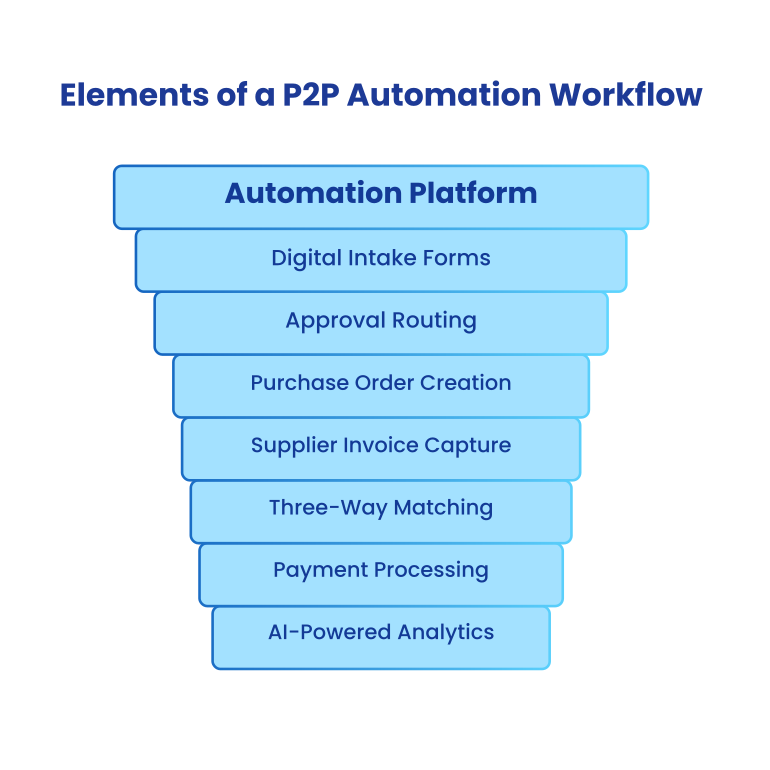
Modern P2P automation uses technologies such as optical character recognition (OCR) to capture data from invoices, machine learning (ML) to flag duplicates or anomalies, and artificial intelligence to route approvals instantly to the right stakeholders. Certain platforms offer a supplier portal and ERP-compatible integrations, ensuring every purchase order, invoice, and payment flows seamlessly without manual re-entry. For employees, that means requests and approvals move faster. For suppliers, it means payments are accurate and on time.
As companies scale, the stakes only grow higher — not just in terms of efficiency, but also exposure. Manual processes may seem manageable with a few hundred purchase requests or invoices each month. But a few thousand, and things quickly start to break down. Growing transaction volumes and complex supplier networks make organizations more vulnerable to fraud risks.
Automation not only cuts processing time and errors, but it also transforms visibility and control. According to Coupa’s latest Benchmark Report, best-in-class companies achieve an invoice approval cycle time of only 10.5 business hours and a 97.1% first-time match rate, providing finance leaders with real-time insights into spend and cash flow, eliminating the need for manual reconciliation. On the procurement side, best-in-class companies see structured spend on 55.3% of orders. Accurate data and connected processes give finance and procurement leaders the clarity and control they need to make faster, more strategic decisions.
Challenges with manual P2P workflows
Manual P2P processes create friction across procurement management, accounts payable, and supplier relationships. Common pain points include:
- Limited spend visibility: Without centralized tracking, procurement teams struggle to track where money is spent across categories, leading to maverick spend and unmanaged long-tail purchases. For finance, it’s more difficult to track cash flow and working capital constraints, and spot savings opportunities.
- Cross-functional friction: Manual purchase requisitions, invoice approvals, and handoffs between departments slow cycle times and make collaboration more difficult. And if it takes forever for a purchase request to get approved, employees will often go through unauthorized channels (like expensing items after the fact) to get what they need.
- Contract and policy compliance gaps: Inconsistent sourcing practices and missed checks against procurement policies allow non-compliant spend to slip through the cracks.
- Inaccurate budgeting and reporting: Disconnected, manual processes and an increase in non-compliant spend create data gaps that lead to inaccurate budgeting and financial reporting.
- Weak process control: Disconnected approval chains and a lack of integrated payment controls make it difficult to enforce compliance across the P2P workflow. It also increases the risk of errors and fraud.
- Missed savings opportunities: Late or inaccurate payments damage supplier relationships, while a lack of real-time cash flow visibility makes it harder to optimize working capital. It’s also more difficult for the procurement team to create a category strategy and consolidate or bundle spending to qualify for volume discounts with suppliers.
Benefits of procure-to-pay automation
P2P automation transforms procurement management and finance functions. Workflows that took days can now be completed in hours, thanks to digital intake, automated routing, and integrated supplier communication, ensuring that nothing gets stuck in the process. Teams can process higher volumes of transactions in less time, freeing them to focus on strategic initiatives like sourcing, category planning, or supplier relationship management.
Reduced errors
Accuracy is built into automated workflows. Technologies like OCR and three-way matching minimize errors by automating data entry, invoice reconciliation, and payment execution. This ensures that every PO and purchase is correct the first time, reducing rework and financial leakage. Over time, that accuracy compounds — creating cleaner data that leads to more precise forecasting and budgeting. Suppliers are also paid the right amount at the right time, strengthening trust and reliability.
Greater compliance
Automation creates consistency across the entire P2P process. AI-driven intake guides employees to help them enter the correct information or select from a group of preapproved suppliers. Then, automated workflows enforce the right approvals at every step, ensuring requisitions are routed through policy checks and providing clear audit trails for all transactions.
This level of compliance makes it easier for finance leaders to demonstrate adherence during audits or supplier reviews.
Stronger fraud prevention
Advanced P2P platforms offer built-in, AI-powered safeguards for invoices and payments, including digital approvals, audit trails, and anomaly detection. Fraud detection software continuously analyzes transaction patterns, vendor behavior, and internal data to flag irregularities — such as duplicate invoices, price changes after a PO is issued, or non-compliant purchases — that humans might miss.
Each handoff between teams is made visible in the system, a feature that doesn’t always occur with manual or paper-based procurement. Every step is visible, traceable, and accountable. This transparency creates confidence for finance leaders while also building trust with suppliers. Fraud prevention isn’t just about protection — it also helps distinguish between an honest mistake and an actual fraud attempt, helping reinforce integrity across the organization.
Cost savings
Automation lowers the cost per transaction by reducing manual work, eliminating overpayments, and enabling teams to process higher volumes without additional headcount. Beyond efficiency, it also unlocks the opportunities for AP to capture early payment discounts and for procurement to negotiate better supplier terms.
When teams aren’t bogged down in tedious tasks, such as manual intake approvals or PO-to-invoice matching, they can focus on more strategic initiatives that bring greater value to the organization. Category management, contract analysis and negotiation, or cash flow forecasting for smarter budgeting can all bring significant savings. At scale, P2P automation becomes a powerful lever for driving margins and smarter working capital management.
Adaptability and scalability for growth
As companies grow, so does the complexity of procurement and supplier management. P2P automation helps teams scale processes seamlessly, handling higher transaction volumes, multiple categories, and global supplier networks without added strain.
Since P2P automation provides a digital trail for every transaction and compiles it into a single system, it also offers real-time visibility into spending and cash flow. This enables leaders to make informed decisions quickly in fast-changing markets, making organizations more agile and proactive.
Automating each step of the P2P process
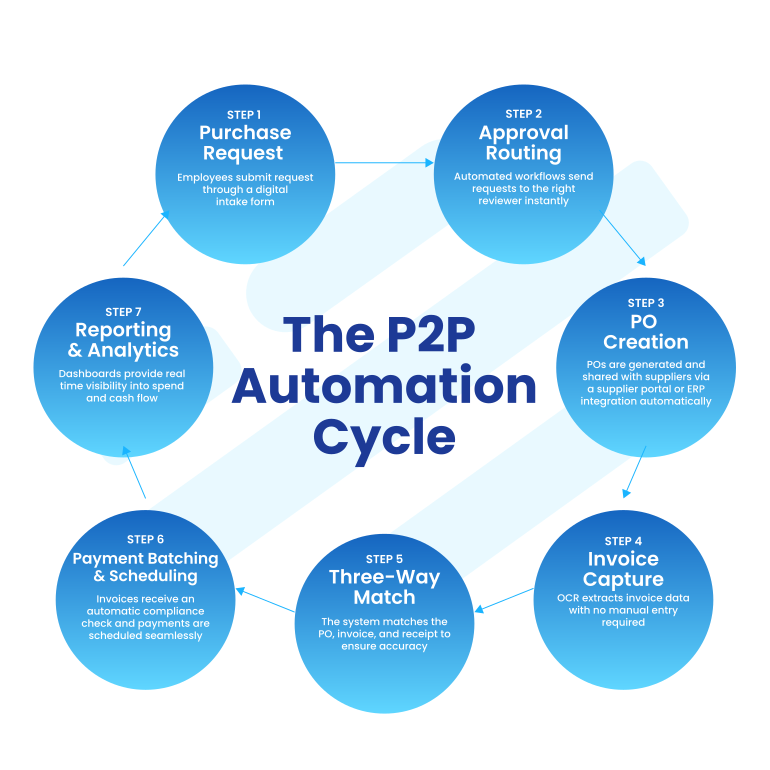
A fully automated procure-to-pay process requires digitizing every step of the purchase-to-payment lifecycle. Organizations gain efficiency and visibility across the entire procurement orchestration workflow when all components work together on a single platform. Here’s what that looks like:
1. Purchase requests
Employees submit purchase requisitions through a digital intake form, with some platforms using AI to surface preferred items or preapproved vendors set by the procurement team. Automation validates the request against budgets, categories, and policies before routing it to the appropriate approver — eliminating the need for manual checks or emails.
2. Approval routing
Automated workflows send requisitions to the appropriate managers or budget owners instantly, based on preset parameters. Instead of bottlenecks caused by email or paper-based approvals, requests move quickly while adhering to company policies. End-users can also view the status of their request, reducing the need for back-and-forth communication.
3. Purchase order (PO) creation
Once approved, POs are generated automatically and shared directly with suppliers through integrated portals or ERP systems. This step ensures accuracy and keeps procurement and suppliers aligned without manual intervention.
4. Invoice capture
Supplier invoices are received digitally or automatically converted from various formats into digital invoices using technologies like optical character recognition (OCR), which extracts the data. Manual data entry isn’t required — automation ensures clean, standardized data feeds directly into the platform.
5. Three-way match
Purchase orders, supplier invoices, and receipts of goods or services are automatically matched and built into workflows through touchless invoicing. This safeguard prevents errors such as overpayments, duplicate invoices, or mismatched records.
6. Payment batching and scheduling
Once an invoice is approved, payments are batched and scheduled in accordance with the agreed-upon terms outlined in the contracts. Automation ensures that suppliers are paid on time, and with a single view, thanks to embedded payments capabilities, AP can easily track all outgoing payments and cash flow.
7. Reporting and analytics
Data flows into dashboards at every stage to provide real-time insights into spend, supplier performance, and process efficiency (like first-time invoice match rates). Finance and procurement leaders can monitor compliance, optimize working capital, identify cost-saving opportunities, and see areas for process improvement that weren’t visible before.
Key features to look for in procure-to-pay software
Not all P2P automation solutions are created equal. It’s essential to look for software that goes beyond basic invoice processing and provides comprehensive end-to-end procurement orchestration.
Just as important, companies should seek platforms with AI integrated into their core — not fragmented systems that rely on third-party add-ons or tools. When AI is embedded across the stages of the P2P process, insights flow seamlessly between procurement and finance, creating a unified foundation that scales as AI capabilities evolve. Here are the essential features to prioritize and questions to ask when evaluating a P2P solution:
- Guided, AI-powered intake: Employees should be able to easily submit a purchase request, with AI guidance ensuring compliance throughout. Surfacing preferred vendors or items helps speed up the approval process. Procurement teams also need to be able to customize pre-made intake form templates to embed and update policies as they shift or business needs change.
Key question: Does the solution give procurement the flexibility to update intake workflows without extensive IT involvement?
- Intelligent services and inventory management: Beyond one-off purchases, companies often need to manage ongoing services or recurring inventory. P2P software should track these categories, making it easy to monitor consumption, receipts, and contract terms in one place.
Key question: Does the solution provide analytics on inventory and service management, such as actionable insights on stock levels and usage or on-time quality and on-quality performance metrics for suppliers?
- Real-time PO collaboration with suppliers: Effective P2P automation solutions allow POs to be shared and managed directly with suppliers in a portal. Built-in collaboration tools reduce back-and-forth emails and ensure that changes, receipts, and confirmations are visible to both sides in real time.
Key question: Does the solution enable confirmation of orders at the line-item level and provide real-time alerts when a supplier identifies possible disruptions?
- Easy-to-use, fee-free supplier portal: Supplier adoption is critical to success. A portal that’s simple to navigate and doesn’t charge supplier fees encourages participation.
Key question: Does the portal allow suppliers to update POs and invoices easily? Does the portal automatically alert suppliers if they’re missing information?
- Built-in Compliance as a Service: The platform should include tax compliance, regulatory requirements, and approval workflows. Automated compliance reduces risk and frees teams from constant manual oversight. Equally important are robust reporting capabilities, which give teams the ability to generate detailed, audit-ready reports quickly for real-time visibility into compliance status and potential risk areas.
Key question: Does the solution automatically update compliance across regions and regulations?
- Ready-to-use spend analysis and dashboards: Pre-built dashboards and drag-and-drop analytics make it easier for finance and procurement leaders to analyze spend patterns, spot saving opportunities, and identify workflow inefficiencies. Advanced P2P platforms take it a step further with comprehensive data analysis and AI-driven predictive insights, surfacing proactive recommendations before issues arise or highlighting areas for improvement. This helps teams work faster and smarter.
Key question: How easy is it to turn raw data into actionable insights for leaders?
- Integrated payments engine: A complete P2P automation solution should include secure, integrated payment capabilities. This means automated reconciliation, multi-payment scheduling, the ability to manage several different payment types (virtual cards for bank rebates), and one view of the company’s entire cash position.
Key question: Is the payments engine embedded in the platform, enabling seamless automation without third-party tools or add-ons?
Implementation best practices for P2P automation
Every company is at a different point in its procurement maturity. Most organizations begin at Stage 1: Foundation & Enablement, a phase focused on laying the groundwork for efficiency and AI readiness. If a company is looking to implement P2P automation, it’s likely they’re at this stage. The priority here is not to automate everything all at once, but to establish the core processes that will support scalable, intelligent AI procurement management in later stages.
With that in mind, here are four best practices for successfully rolling out P2P automation.
1. Start small, then scale
Don’t attempt to automate the entire procure-to-pay lifecycle at once. Instead, first target the biggest manual pain points — like purchase requests or invoice matching — and choose a P2P solution with full ERP integration to deploy these quick wins easily. Companies reduce processing time and demonstrate ROI by implementing AI in low-risk, high-impact areas such as smart intake or expense receipt extraction, building a strong foundation to scale automation across the full P2P workflow.
2. Prioritize supplier adoption
Automation can’t happen in a vacuum. Suppliers need to be part of the process. Make onboarding easy with a fee-free portal and clear communication about the benefits, like faster payments and fewer errors. Early supplier enablement is critical to building the strong, collaborative relationships that underpin later procurement maturity stages.
3. Invest in change management and training
Technology alone doesn’t drive transformation. People do. To reinforce adoption, provide tailored training, highlight wins, and empower champions within the business. This builds trust in the system and helps teams transition smoothly from manual workflows to automated, AI-supported processes.
Coupa’s approach to procure-to-pay automation
There's never been a better time to establish a foundation of P2P excellence and use it to build a competitive edge. The future of global trade is quickly moving toward Autonomous Spend Management — a connected network that eliminates traditional procurement roadblocks and frees teams to focus on higher-order, strategic work that drives revenue, not just cost savings. Companies that embrace automation and AI will widen the gap between themselves and their competitors. The ones who hesitate will struggle to play to win.
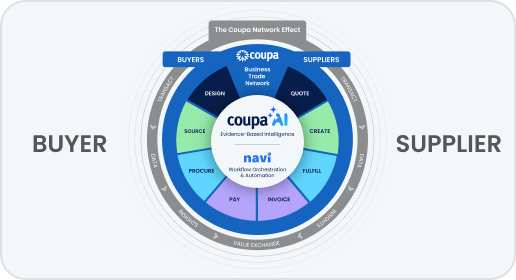
Coupa’s Procure-to-Pay software isn’t just another automation tool — it’s built as an AI-native platform that embeds intelligence and orchestration across the full P2P lifecycle. With Coupa, companies build a scalable foundation to unlock greater value from AI and stay competitive. Data shows that best-in-class companies that use Coupa increase visibility by 24.4% in managed spend, save 8.1% on their overall spend, and achieve a requisition-to-order cycle time of just four business hours. That’s real time and savings your teams can reinvest into strategic work that drives the business forward.
Here’s what makes Coupa different:
- End-to-end procurement orchestration: Coupa connects the entire P2P cycle — requisitions, invoicing, payments, and analytics — on a single platform. And when companies are ready to grow, Source-to-Contract can be added without reconfiguration or costly implementations.
- AI-powered intelligence and community data: Coupa combines your internal operational data with insights from more than $8 trillion in real-world transactions across the Coupa community. This vast dataset powers AI that delivers highly tailored, context-specific recommendations — not generic benchmarks. Teams receive smarter, data-backed insights that uncover new savings opportunities, improve process efficiency, and strengthen supplier relationships.
- Adoption and supplier enablement: Guided buying workflows, an intuitive interface, and a fee-free supplier portal drive rapid adoption across employees and suppliers. High adoption translates to faster ROI, stronger supplier relationships, and fewer workarounds.
“Coupa was the product that would allow us to build the right foundation and get us to where we needed to be in the future.”
— Amanda Conlen, Global Director, Transformation, at Schneider Electric