Volatile news. Stable spend.
Read the latest in the Coupa Business Spend Index™ Quarterly Update.
Get the Report




State of Agentic Procurement 2026
Agents expected to handle 3x the work within 12 months

Picture this: A sourcing team spends months on an RFP and wins a 15% volume discount. Six months later, finance pulls the numbers and finds that buyers have been paying list price the whole time. The signed agreement sits in a PDF on a shared drive, and the purchasing system never saw it. And then the CFO gets involved, asking, “Why did the savings that were reported last quarter never reach the bottom line?”
This scenario plays out at organizations every day, and it’s expensive. World Commerce & Contracting research finds that poor contract management costs organizations an average of 8.6% of annual revenue in value leakage.
Basic tools stored contracts. Today, the contract is the control point for spend, and AI agents can read, score, and track agreements on your behalf. That raises the bar for what managing contracts means. These five signs show whether your process has fallen below it. For the full path an agreement takes from request to renewal, see our guide.
On-contract spend is the percentage of spend a company runs through pre-negotiated contracts to get better prices and terms. Its opposite goes by several names: off-contract spend, rogue spend, and maverick spend. All describe employees buying at non-negotiated prices, from suppliers with no formal agreement, or both.
Higher on-contract spend:
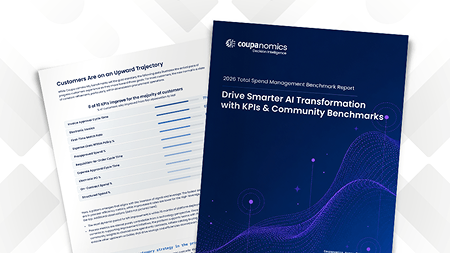
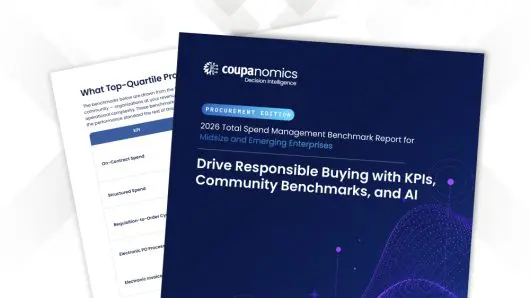
Coupa’s 2026 benchmark data shows top-performing large enterprises putting 82.7% of spend on contract, and top-performing midsize and emerging enterprises putting 84.8%.* Both of these figures are the median of the top-performing quartile of customers. Even at that level, roughly 15 to 17 cents of every dollar is spent outside negotiated terms.
Indirect procurement: Off-contract buying concentrates here. Many buyers purchase from many suppliers across categories like software and professional services, and employees often don’t know a contract exists or can’t find it at the moment they buy.
Direct procurement: Contracts usually exist, because suppliers of raw materials and production components are contracted to protect production. The risk shifts to enforcement. Pricing formulas, index adjustments, and bill of materials (BOM) revisions have to reach purchasing, or buyers keep paying yesterday’s terms.
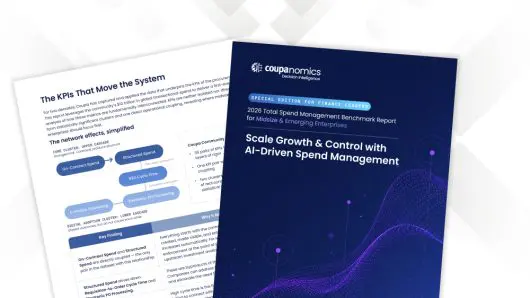
Coupa Spend Lab, Coupa’s embedded research function, analyzed pairs of KPIs across a 2025 dataset of $9.5 trillion in transactions (now $10.5 trillion at the time of this publication). One pair stood out: On-Contract Spend and Structured Spend move together within individual customers, month over month. No other pair in the analysis does this. The contract is the domino. When contracts are created, made visible, and enforced, structured spend rises with them.
A low on-contract number usually indicates one of three contract failures:
Downstream fixes can’t repair any of these indicators. Invest only upstream, and you can’t enforce or measure the value you planned. Invest only downstream, and you create little leverage, because the leverage was set when the contract was negotiated. The best outcomes come from moving high-impact categories through the whole cycle, from sourcing to contract to purchase. (For more about the connection between value and leverage across the source-to-pay process, head to our 2026 Agentic Spend Management Benchmark Report and 2026 Agentic Spend Management Benchmark Report for Midsize & Emerging Enterprises).
Percentages hide the stakes. Convert yours into dollars:
| On-contract spend | Spend outside negotiated terms |
| 83% | About 1 in 6 dollars |
| 80% | About 1 in 5 dollars |
| 75% | About 1 in 4 dollars |
| 67% | About 1 in 3 dollars |
(Each row subtracts the on-contract percentage from 100% to find the share of spend outside negotiated terms, then restates that share.)
If one in four dollars you spend carried no negotiated price, payment terms, or risk protections, would you feel comfortable reporting that to your board? Your answer is your threshold.
Fixed-price contracts feel safe, and buyers choose them for budget certainty. Suppliers respond by pricing in every unknown, then protecting their margin with change orders. You pay more, reopen the contract, and strain the relationship. The better approach matches the contract to the work, and your system has to run each structure:
| When the work: | Use this contract: | Your system must: |
| Is clearly scoped | Fixed-price | Hold a firm budget and track change orders |
| Is fuzzy in scope or moving | Time and materials | Enforce a not-to-exceed cap |
| Has effort that can’t be estimated (such as R&D and pilots) | Cost-plus | Show every cost so someone can verify it |
| Focuses on a strategic supplier and has many projects | Master Service Agreement (MSA) | Let each short statement of work (SOW) inherit the master terms |
| Covers recurring goods | Supply agreement | Lock the price and tie it to purchasing |
| Will have in demand and involve several suppliers | Framework agreement | Vet suppliers once, then compete and track each call-off |
You’ll know your system is falling short when:
When the platform can’t model your contract types, buyers work around it. Your off-contract spend numbers start to rise accordingly.
Top-performing large enterprises in the Coupa community move contracts through approval in 11 business days. Top-performing midsize and emerging enterprises take 14.8.* Weeks beyond that signal friction: manual intake forms, agreements rebuilt from scratch, approval chains without rules, and third-party paper reviewed line by line.
Modern software removes those delays with standardized intake, preapproved clause libraries, rule-based approval routing, and AI-assisted review of third-party paper. AI speeds the analysis, and your legal, procurement, and risk teams still make the final calls.
Slow contracting also causes off-contract spend to increase. A business partner who can’t wait three weeks for an agreement will buy from whoever can invoice today.
Negotiators often can’t see what the company paid last time, or which terms it prefers. The Coupa Contract Negotiation Guidance agent benchmarks live contract attributes against historical performance and preferred standards, right inside the workflow. It flags high-risk commercial deviations and missing required data fields, and it answers questions across current and historical contract data.
Policies change, and contracts signed under old policies drift out of line. The Coupa Contract Deviation Evaluation Agent scores a single contract, or a bulk-submitted portfolio, against your playbook. Run it mid-negotiation to guide the deal, or after publication to catch drift. Every contract gets a compliance and deviation score, and outdated evaluations get flagged so risk doesn’t sit hidden.
Can you state, as a number, how closely your contracts follow your playbook? If not, it’s time to take action.
Large enterprises can score portfolios across business units.
Midsize and emerging enterprises without a formal playbook can start with the Coupa Contract Negotiation Guidance agent, which measures deals against their own past agreements.
The SLAs, rebates, and delivery milestones you negotiated sit inside signed PDFs. If this information isn’t extracted and tracked, value leakage sets in and accumulates through seemingly small instances, such as a missed rebate, an auto-renewal, and a renegotiation window that closed without anyone noticing.
The Coupa Contract Obligation Management agent extracts obligations from signed contracts for verification. It shows them in a dashboard across your contract network, so you can see commitments in one place. Teams assign owners and track updates through notifications, including supplier-facing ones through the Coupa Supplier Portal (CSP) and email.
Large enterprises need a network-wide view across thousands of agreements.
Midsize and emerging enterprises often keep obligations in a spreadsheet or in one person’s memory, which puts value at risk when that person moves on.
If you answered “no” to two or more, your contracts aren’t controlling your spend the way they should. Here’s where top performers stand:
| KPI | Community benchmark* for large enterprises | Community benchmark* for midsize and emerging enterprises |
| On-Contract Spend | 82.7% | 84.8% |
| Contract Management Cycle Time | 11 business days | 14.8 business days |
Whether or not a negotiated discount turns into genuine value depends on what happens after both sides sign the contract. Our comprehensive guide to contract lifecycle management shows you how each stage connects.
* Coupa community benchmarks use a full year of 2025 data from customers who were live in production before 2025. For each KPI, customers are grouped by relevant product usage and the top-performing quartile within each group is identified. The benchmark value is that quartile’s median.
Oh! It looks like you opted out from using the needed cookies. If you are interested in using the AI Agent, then please opt-in to the cookies in the preference center.
Update preferences