Volatile news. Stable spend.
Read the latest in the Coupa Business Spend Index™ Quarterly Update.
Get the Report





The market winced. Business spend held firm.
The Coupa Business Spend Index™ Quarterly Update
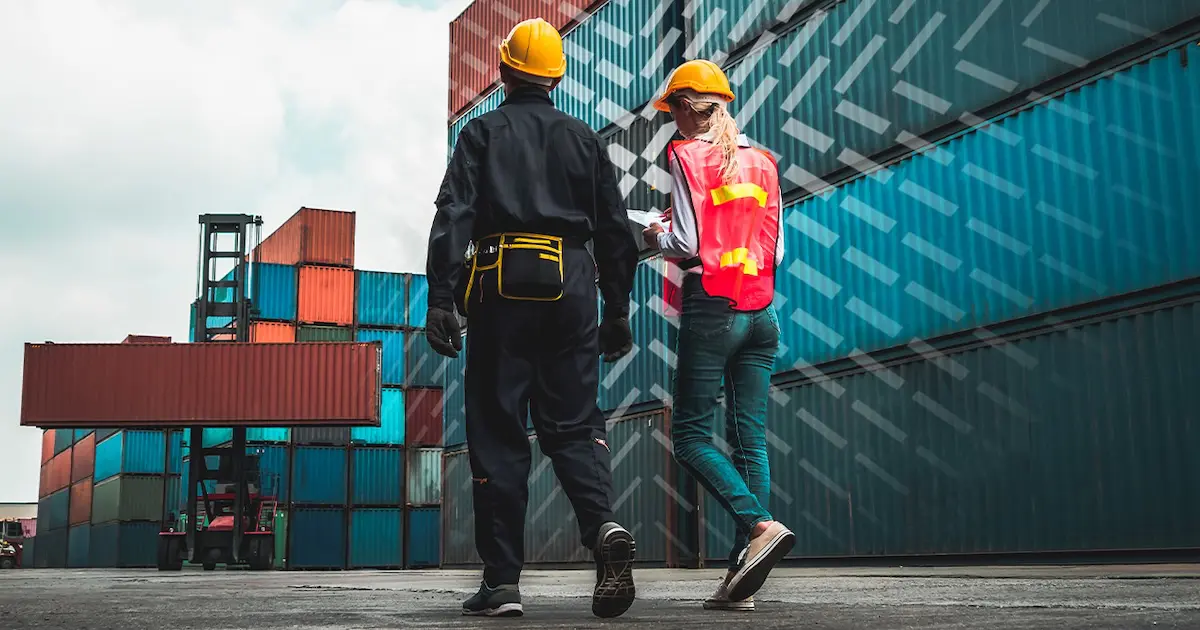
For global businesses, disruption has become the default operating condition. From the sweeping 2025-2026 tariff updates to ongoing Red Sea shipping reroutes, modern networks face constant pressure. True supply chain resilience means building an adaptive, proactive system that can handle constant change without missing a beat.
Why does this matter? Our global economy relies on these networks to turn raw materials into finished products and deliver them to customers. Even the raw computing power behind modern AI depends on the steady manufacturing and shipping of specialized microchips.
Our lives depend on these systems running smoothly. Because of this, supply chain leaders face intense pressure to design networks that grow stronger under stress.
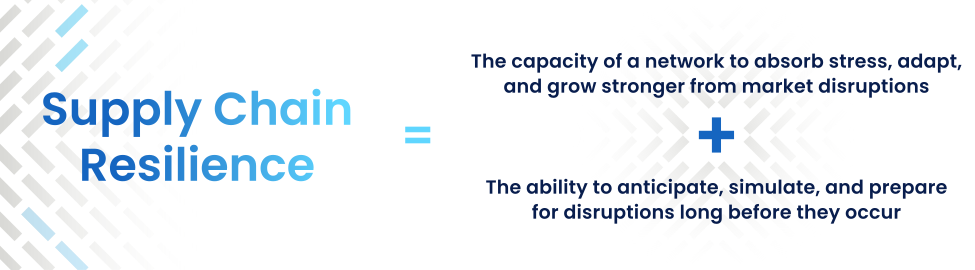
Modern resilience refers to two equally important capabilities:
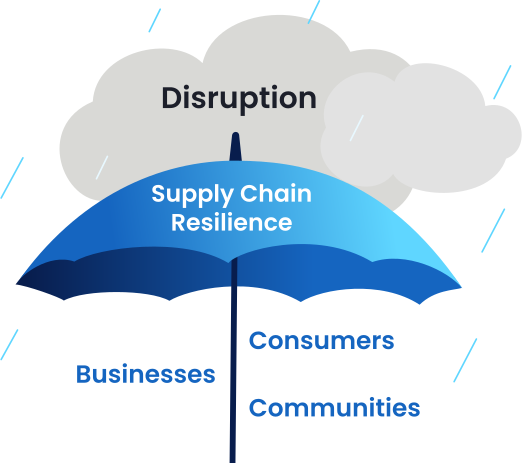
A resilient supply chain builds an adaptive network that handles external shocks with minimal loss of revenue and profit. When these systems are strong, they protect businesses, consumers, and entire communities.
Businesses rely on resilient supply chains to protect their bottom lines by keeping operations running and revenue flowing even when a disruption occurs. Resilient supply chains mean more resilient businesses — helping to reduce risk, navigate challenges, and protect trusted relationships with vendors and customers alike.
For consumers, supply chains keep the shelves stocked and stores full. By keeping goods reliably available, strong and resilient supply chains also help keep prices stable.
Through a macro lens, resilient supply chains keep our communities strong and stable by ensuring an uninterrupted supply of goods and services. For essential goods like food, medical supplies, and energy, supply chains are critical to public health and safety.
Ultimately, supply chain resilience ensures that businesses, homes, and entire economies can run reliably, even in the face of sudden market changes.
The true measure of supply chain relies on two critical operational metrics:
In the best-case scenario, your time-to-survive is longer than your time-to-recovery. This means you can pivot to an alternative source and recover without your production lines ever turning off.
Risks vary by industry. For example, a manufacturer relying on specialized direct materials from a single global supplier faces high risk. If that supplier shuts down, the manufacturer's TTS might only be a few days. If their TTR is three weeks, they face a costly gap in production.
Identifying these gaps across your network is key to designing a resilient system. With foresight, you can map alternative suppliers and shipping routes in advance. This prevents you from having to rely on expensive emergency measures, such as costly expedited shipping, when a crisis hits.
To know if your supply chain is resilient, you must track the right metrics. Measuring resilience requires looking at how your network handles stress, recovers, and finds new advantages. Leading companies measure their resilience using primary metrics and key performance indicators (KPIs):
| Metric/KPI | What it measures |
| Time-to-survive (TTS) | As mentioned above, this measures exactly how long your operations can continue using available inventory and backup plans after a primary supplier or route goes down. |
| Time-to-recover (TTR) | This tracks how quickly your network returns to full, normal capacity following a disruption. |
| Time-to-thrive (TTT) | This measures how fast your organization capitalizes on opportunities after a shock. A highly resilient, antifragile company uses disruptions to capture market share while competitors are still struggling to recover. |
| On-time-in-full (OTIF) and fill rate during disruptions | This tracks how reliably you fulfill customer orders when parts of your network are stressed. |
| Forecast accuracy | This measures how closely your demand predictions match reality. High accuracy helps prevent costly inventory mismatches. |
| Dual-sourced or regionalized spend | This is the percentage of your budget spent on backup or local suppliers. Tracking this helps ensure you are balancing cost with continuity, treating regional sourcing as an insurance premium that protects revenue. |
| Scenario coverage | This counts how many different disruption scenarios you have actively stress-tested using continuous integrated scenario planning. |
Supply chain disruptions can come from many sources, and each brings its own set of variables to consider and challenges to overcome. They can range from large-scale global events to local occurrences. Here are a few of the most common.
Political instability, trade wars, tariffs, and sanctions can all impact global supply chains, often in complex and unpredictable ways. For example, historical shifts like the U.K.’s departure from the European Union (Brexit) demonstrated how sudden regulatory and legal changes can instantly disrupt a company's ability to buy and sell goods across borders.
Today, volatility is the default. One look at global events shows a landscape shaped by ongoing, systemic risks. These include persistent threats to major maritime supply lines around Yemen and the Red Sea, as well as complex, shifting trade policies.
Companies must navigate the broader tariff environment. This includes managing layered universal, country-specific, and sector tariffs — such as heavy duties on imported steel and aluminum. Because these rates can change frequently, proactive supply chain leaders rely on resources like the Tax Foundation’s tariff tracker to monitor policy shifts and adjust their regional sourcing strategies before margins are impacted.
Climate change presents a persistent threat to global supply chains. Extreme weather has become a major operational risk that demands continuous planning. In 2025, natural disasters caused roughly $224 billion in global economic damage, with weather-related events accounting for 92% of those losses. Extreme weather can devastate entire regions, causing immediate downstream impacts like flooding, power grid failures, and destroyed infrastructure.
Even historically localized risks are scaling up. For instance, the January 2025 wildfires in Los Angeles alone drove an estimated $40 billion in insured losses — setting a record for wildfire-related damage. Beyond sudden disasters, sustained climate shifts like prolonged droughts create long-term strains on water supplies, agricultural output, and major shipping canals.
To build resilience against these escalating threats, businesses use real-time risk mapping and continuous scenario planning to identify which suppliers, warehouses, and transport routes are highly exposed to climate events.
Labor disruptions encompass a wide range of challenges that can significantly impact supply chain resilience. Strikes and worker shortages are notable examples of how labor instability can disrupt operations downstream.
For instance, the October 2024 International Longshoremen’s Association (ILA) strike shut down 36 East and Gulf Coast ports. This shutdown cost the economy an estimated $3.8 to $4.5 billion per day before a long-term contract was ratified in February 2025. This single event disrupted shipping schedules and caused inventory backlogs that took weeks to clear.
Beyond high-profile strikes, organizations face persistent skilled-labor gaps. As supply chains become more digitized, companies often struggle to find and retain workers who can manage advanced logistics systems and automated warehouses.
Skills gaps within your existing team can also hurt efficiency. To address these gaps, leading organizations invest in training their teams to use modern tools. They also design their operations so they do not rely entirely on a few highly specialized roles.
In today’s global economy, financial volatility forces companies to constantly reevaluate their cost structures. While general inflation remains a background factor, trade policy and tariff-driven cost increases have become the dominant economic pressures.
According to a 2025 McKinsey risk survey, 82% of supply chain leaders report that recent tariffs actively affect their operations, with 20% to 40% of their total supply chain activity directly impacted. These duties raise the cost of raw materials and imported components, squeezing profit margins and forcing companies to rethink their sourcing strategies.
Additionally, rapid shifts in consumer demand can quickly strain production lines. When social media trends or sudden spikes in popularity cause demand for a specific product to skyrocket, unprepared supply chains face stockouts, purchase limits, and lost revenue opportunities.
To navigate these economic pressures, businesses build flexible sourcing networks and use real-time cost visibility to protect their margins when tariffs or demand patterns shift.
Changes to laws and regulations can mandate sudden shifts in supply chain design. For example, evolving environmental mandates often require companies to update machinery or source from local suppliers to hit new carbon emission targets.
Other times, regulations ban or strictly limit certain chemicals or byproducts. A classic example is the 1972 ban on the pesticide DDT in the U.S. Once broadly used to control agricultural pests, the ban forced the entire agricultural industry to overhaul its operations and find alternative solutions.
Today, navigating compliance is highly complex, as seen with the increasing regulation of PFAS (per- and polyfluoroalkyl substances), commonly known as "forever chemicals." In the EU, a sweeping universal PFAS restriction reached its final evaluation phase in mid-2026, setting the stage for broad market restrictions by 2029.
Meanwhile, in the U.S., individual states are driving the regulatory agenda. Following a wave of roughly 350 related bills introduced in 2025, new PFAS product bans took effect on January 1, 2026, across Colorado, Connecticut, Maine, Minnesota, Vermont, and Washington.
To stay compliant and avoid costly fines or market lockouts in this fragmented landscape, organizations maintain deep, multitier visibility into exactly what materials are embedded within their supply chains.
For companies operating global networks, transportation bottlenecks are a constant threat to inventory stability. A shipping delay at a single major port on one continent can stall downstream manufacturing and delay customer deliveries worldwide.
Modern supply chains must manage systemic logistics constraints, like volatile container rates, capacity crunches across major ocean and air freight lanes, and unpredictable customs delays.
If a company relies on a single transport mode or route, its time-to-survive is extremely low. When a primary shipping lane becomes congested, businesses without alternative transport plans face costly production halts and empty retail shelves.
To mitigate these risks, resilient organizations design flexibility into their logistics networks. By establishing relationships with multiple carriers and securing alternative transport modes (such as sea-air hybrid routing or regional trucking backups), businesses can quickly bypass shipping bottlenecks and keep their goods moving.
Traditional approaches to supply chain management include strategies such as maintaining a surplus of “buffer” inventory, diversifying suppliers or geographic locations, and building in redundancies to cover transportation or IT disruptions.
Some of these approaches may still be considered best practices and make sense for some businesses. For others, though, they may be too costly or inefficient to be sustainable — such as paying to store extra inventory “just in case.”
Modern strategies build true, antifragile supply chain resilience through smarter, more agile approaches. Core components of this modern playbook include:
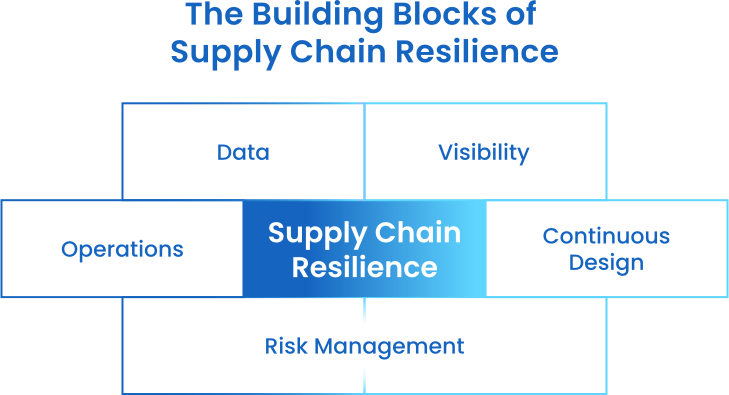
Having access to reliable, accurate data is the baseline. In a modern network, data must be unified and actionable. Integrating clean data into agentic AI systems gives businesses powerful tools to manage inventory. AI agents autonomously identify anomalies, suggest optimal routing alternatives during a crisis, and optimize inventory so you are never dangerously understocked or expensively overstocked.
The more complex supply chains become, the more susceptible they are to upstream disruptions. Achieving end-to-end visibility means illuminating your Tier 1, Tier 2, and Tier 3 suppliers. This holistic, multitier picture allows you to spot risks, like a material shortage three levels down your supply chain, before they ever impact your final product.
To stay ahead, leaders use continuous network design. This means using a digital twin to simulate real-world scenarios. It uses smart modeling to find the best path based on your goals for cost, carbon, and risk.
Supply chain resilience is fundamentally about relationships. Resilient companies deepen supplier collaboration to build stronger networks. By evaluating the total value a supplier brings — including their reliability, sustainability practices, and geographic risk — organizations build mutually beneficial partnerships that act as a safety net during market shocks.
Supply chains are complex ecosystems. To ensure they run smoothly, your supply chain, procurement, and finance teams must operate from a single source of truth. Breaking down these organizational silos requires continuously sharing data, aligning on profitability goals, and adopting unified technologies to manage sourcing, ordering, invoicing, and fulfillment.
Intelligent networks are the foundation of building a modern, resilient supply chain.
To build an adaptive, antifragile operation, organizations must align design, sourcing, and collaboration onto a single platform. This proactive approach enables companies to simulate disruptions, optimize resource allocation, and protect profit margins even in the face of sudden market shocks.
The first step in recovering from disruptions is understanding risks before they occur. Modern supply chains are deeply interconnected, and working with any third-party entity introduces potential compliance, ecological, and financial risks across your Tier 1, 2, and 3 networks.
Actively monitoring and analyzing your supply chain for third-party risks is essential and part of any continuous design approach. This involves evaluating the financial stability, compliance, and operational reliability of suppliers and partners to identify potential threats early and respond swiftly.
When major disruptions, such as a sudden tariff update or a port strike, requires finding alternative supply sources, speed and precision are critical. Sourcing optimization plays a vital role in supply chain resilience evaluating the total value of a sourcing decision.
To build true network resilience, companies adopt a strategize-then-optimize framework. Category constraints are derived directly from data-driven category strategies. This approach ensures that day-to-day sourcing decisions directly support long-term business goals around risk mitigation, regionalization, and supplier diversity.
Through multi-constraint optimization, a unified platform can evaluate millions of permutations across competing business constraints simultaneously — including cost, supplier capacity, lead times, risk scores, and sustainability (ESG) metrics. This mathematical modeling allows organizations to identify the absolute best allocation of spend, ensuring that direct material awards are structurally optimal, compliant with corporate policy, and mathematically backed to prevent production downtime.
Effective supply chain collaboration is the cornerstone of an agile, responsive network. When disruptions hit, businesses cannot afford communication gaps with their suppliers. True collaboration requires integrating suppliers directly into your operational workflow to build a shared defense against volatility.
By sharing real-time inventory visibility and demand forecasts across the supply network, organizations prevent costly chain reactions, where minor changes in customer demand lead to massive over-ordering and chaotic production swings upstream.
This level of transparent partnership directly translates to concrete financial and operational outcomes:
According to McKinsey in 2025, 97% of supply chain leaders have invested in tactics like dual sourcing or regionalization, yet still lack visibility beyond their Tier 1 suppliers. To bridge this gap and build an adaptive supply chain, companies need holistic strategies. The goal is to create an intelligent, antifragile network where continuous design natively informs sourcing execution in an ongoing loop.
Supply chain optimization enables this by creating a digital twin of your physical supply network. Using AI-driven modeling, businesses can run extensive what-if scenarios to stress-test their operations against new tariffs, geopolitical shifts, and transport capacity constraints long before they cause physical bottlenecks.
Leading global organizations use this continuous design capability to drive measurable results:
With this holistic, end-to-end view, businesses can spot vulnerabilities early, optimize for total value, and execute their strategy with confidence.
Artificial Intelligence (AI) has become an active engine for execution through agentic AI. These tools autonomously rebalance supply chains around disruptions to keep operations flowing smoothly.
The foundation of any powerful AI is its data. Coupa AI is fueled by $10 trillion in community-generated spend data across a network of more than 11 million buyers and suppliers. This data trains our AI to understand scenarios and find the right responses.
Recently, Coupa launched Coupa Compose. This is an AI bundle with over 20 specialized Coupa Navi™ agents built into the platform. These tools help build active supply chain resilience:
Through intuitive interfaces and flexible modeling, Coupa democratizes access to these advanced tools. The AI dynamically updates the digital twin and suggests optimizations. By leveraging agentic AI, businesses operate supply chains that actively thrive in a volatile world.
By implementing modern strategies like continuous design, agentic AI, and the use of a digital twin to model real-world scenarios, companies proactively manage their networks. They build resilient, antifragile supply chains capable of withstanding the pressures of complex global markets and grow stronger from them. Investing in the right intelligent platform makes executing these advanced strategies possible — even in an always-changing world.
Oh! It looks like you opted out from using the needed cookies. If you are interested in using the AI Agent, then please opt-in to the cookies in the preference center.
Update preferences