Drive smarter spend strategies with AI
See what exceptional performance looks like and learn how to close the gaps.
Get the Benchmark Report




Coupa Named a Leader in the 2026 IDC MarketScape Worldwide AI-Enabled AP Automation Software for Large Enterprise

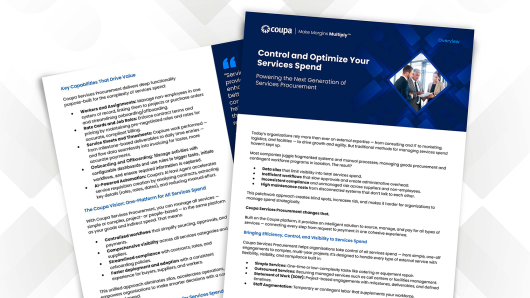
This post is the first in a five-part series exploring how organizations can master services procurement, a critical category that represents more than half of enterprise spend and continues to rise.
Every year, organizations aggressively negotiate on the goods they buy. They run competitive tenders, enforce preferred supplier lists, and track savings to the penny. Yet when it comes to services, which often account for more than half of an organization’s indirect spend, the same level of scrutiny rarely applies.
This is the services procurement paradox: The category that represents the most spend, the most risk, and the most opportunity is often the least controlled.
Services procurement covers the sourcing, management, and payment of external services across several broad categories including simple services engagements such as catering, printing, and translation; outsourced services such as call centers, facilities management, and security; and project-based statement-of-work (SOW) engagements such as construction, software development, and consulting.
Unlike tangible goods, services leave no physical footprint. There is no delivery receipt, no inventory count, and no easy way to verify that what was originally agreed upon was ultimately delivered. That invisibility is precisely what makes services procurement both challenging and substantial.
| Goods Procurement | Services Procurement |
| Clear physical footprint and delivery receipts | Invisible footprint with no delivery receipts |
| Consistent pricing and catalog control | Fragmented rates, SOWs, and scope creep |
| Automated three-way matching | Complex milestone billing and timesheets |
The scale of services spend is significant and one of the fastest growing spend categories in the enterprise. When you look at your budget, you probably find that more than half of your indirect spend is going toward services and contingent labor.
According to Ardent Partners:
| More than 50% of average total spend is services and contingent labor |
Fewer than 1 in 3 procurement teams have formal processes to manage it effectively |
Gartner Research highlights that procurement leaders are under increasing pressure to extend control beyond traditional goods categories, with services procurement cited as one of the top areas for investment and improvement over the next two years. Meanwhile, regulatory complexity is rising. Legislation such as IR35 in the U.K., worker classification rules in Europe, and expanding ESG reporting obligations impact how organizations engage and manage service providers, and is attracting board-level attention.
At the same time, the nature of services spend is shifting. Organizations are relying more heavily on external providers for functions that were previously in-house, driven by cost pressure, skills gaps, and a desire for operational flexibility. Forrester notes that the use of both outcome-based and project-based service engagements has grown significantly in the post-pandemic era, increasing both the volume and complexity of services procurement activity.
The challenges of services procurement are well understood by anyone who has tried to bring this category under control.
Organizations that have brought services procurement under control share several common characteristics. They have full visibility into what they are spending, with whom, and the agreed upon scope. They use standardized SOW templates and approval workflows that make compliance the path of least resistance — not a process to be circumvented. They connect sourcing, contracting, and payment in a single process, eliminating the manual handoff gaps where value leaks. And they track supplier performance systematically, so decisions about renewals and re-sourcing are based on data rather than instinct.
When you get this right, the results speak for themselves. According to the Hackett Group, organizations with mature services procurement capabilities achieve savings rates two to three times higher than their peers, while also reducing compliance risk and improving supplier relationships.
The risk of inaction is not theoretical. Unmanaged services spend leaks value through maverick purchasing, duplicate suppliers, scope creep, and overbilling. Compliance failures carry financial penalties and reputational consequences. And the opportunity cost to not leveraging the organization’s full buying power across its service provider base can be substantial.
In the blogs that follow, we'll explore three distinct services procurement use cases: simple services, outsourced services, and project-based engagements. Each presents its own challenges and opportunities, and each rewards a structured, technology-based approach.
Want a head start? Check out our Services Procurement page to see how we help organizations manage simple services, complex SOWs, and contingent labor in one place.
Ready to dive deeper? Our next post, "Getting the Basics Right — Managing Simple Services with Confidence," explores how to bring clarity and control to your simple services engagements.
Oh! It looks like you opted out from using the needed cookies. If you are interested in using the AI Agent, then please opt-in to the cookies in the preference center.
Update preferences