- Source-to-contract
-
Category Strategy
Scale planning across teams -
Sourcing
Get confident decisions faster -
Sourcing Optimization
Unlock maximum efficiency -
Contract Lifecycle Management
Take control end-to-end -
Supplier Information & Risk Management
Manage risk across suppliers
- Procure-to-Order
-
Intake & Orchestration
Turn requests into action -
Procurement
Buy smarter, spend better -
Services Procurement
Gain visibility and control -
Inventory Management
Manage stock with precision -
Spend Analysis
Get insights you can act on
-
Coupa AI Overview
Real AI for real business outcomes -
AI Use Case Library
See how AI drives results -
Coupa Compose
Intelligence on one platform
-
Where Do I Start with AI?
A step-by-step guide -
AI Report
Real Impact: Before & After Coupa AI -
Academy
Practical AI. Real Impact.
-
AI in Finance
Drive ROI: AI for Finance & AP Demos -
AI in Procurement & Sourcing
AI Procurement SME Roundtable -
AI in Supply Chain
Master Supply Chain Design & Planning with agentic AI
- By Team
- Supply Chain
- Finance
- Procurement
- IT
- By Size
- Enterprise
- Mid-Market
- By Industry
- Automotive
- Banking & Investment
- Business Services
- Consumer Products
- Education
- Federal Agencies & Government Contractors
- Food & Beverage
- Healthcare
- Industrial Manufacturing
- Insurance
- Life Sciences
- Non-Profit
- Oil & Gas
- Process Manufacturing
- Public Sector
- Retail
- Technology
- Telecommunications
- Utilities
- Resources
- Product Demos
- On-Demand Webinars
- Blog
- Analyst Reports
- E-Books & White Papers
- Datasheets
- Video Library
- View All Resources
- Events
- Inspire
- DevCon
- Inspire World Tour
- AI Academy
- Executive Summit
- Upcoming Webinars
- View All Events


- About Coupa
- Leadership
- Newsroom
- Our Offices
- Compliance & Security
- Value Services
- ESG & Corporate Responsibility
- Brand Sponsorships

Predicting the future of business spend, faster
Coupa + MIT Data Science Lab move beyond sentiment
- Source-to-contract
-
Category Strategy
Scale planning across teams -
Sourcing
Get confident decisions faster -
Sourcing Optimization
Unlock maximum efficiency -
Contract Lifecycle Management
Take control end-to-end -
Supplier Information &
Risk Management
Manage risk across suppliers
- Procure-to-Order
-
Intake & Orchestration
Turn requests into action -
Procurement
Buy smarter, spend better -
Services Procurement
Gain visibility and control -
Inventory Management
Manage stock with precision -
Spend Analysis
Get insights you can act on
-
Coupa AI Overview
Real AI for real business outcomes -
AI Use Case Library
See how AI drives results -
Coupa Compose
Intelligence on one platform
- Resources
- Product Demos
- On-Demand Webinars
- Blog
- Analyst Reports
- E-Books & White Papers
- Datasheets
- Video Library
- View All Resources


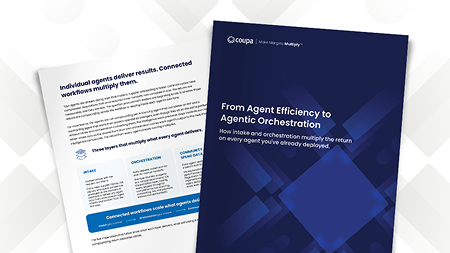
Procurement leaders are racing to adopt AI and the initial returns are real, but they are hitting a ceiling. This e-book shows you how to break the architectural ceiling by unifying intake and orchestration into a single, compounding system.
- Compound AI ROI: A unified intake and orchestration system is the only way to ensure your AI investments scale.
- Autonomous execution: Transition to agentic workflows where AI handles the heavy lifting while your team maintains strategic control.
- Real, deep data: Trillions in global spend data provides needed context to trust, verify, and scale.
You’ve started the AI journey. Now learn how unified architecture ensures your investment continues to compound.
FAQs
What is Coupa Compose?
Coupa Compose is a connected architecture of AI agents and workflows designed to manage intake and orchestration as a single, unified system.
Does autonomous mean humans are removed from the process?
Not at all. In Coupa Compose, autonomy refers to the system’s ability to handle repetitive orchestration and data gathering. Humans remain strategic orchestrators, using human-in-the-loop touchpoints to review, override, and approve complex decisions, ensuring AI stays aligned with corporate policy.
Why is architecture more important than individual AI tools?
Fragmented tools create integration debt while a unified architecture enables context and policy intelligence to flow seamlessly, enabling AI to execute complex, end-to-end outcomes.