- Source-to-contract
-
Category Strategy
Scale planning across teams -
Sourcing
Get confident decisions faster -
Sourcing Optimization
Unlock maximum efficiency -
Contract Lifecycle Management
Take control end-to-end -
Supplier Information & Risk Management
Manage risk across suppliers
- Procure-to-Order
-
Intake & Orchestration
Turn requests into action -
Procurement
Buy smarter, spend better -
Services Procurement
Gain visibility and control -
Inventory Management
Manage stock with precision -
Spend Analysis
Get insights you can act on
-
Coupa AI Overview
Real AI for real business outcomes -
AI Use Case Library
See how AI drives results -
Coupa Compose
Intelligence on one platform
-
Where Do I Start with AI?
A step-by-step guide -
AI Report
Real Impact: Before & After Coupa AI -
Academy
Practical AI. Real Impact.
-
AI in Finance
Drive ROI: AI for Finance & AP Demos -
AI in Procurement & Sourcing
AI Procurement SME Roundtable -
AI in Supply Chain
Master Supply Chain Design & Planning with agentic AI
- By Team
- Supply Chain
- Finance
- Procurement
- IT
- By Size
- Enterprise
- Mid-Market
- By Industry
- Automotive
- Banking & Investment
- Business Services
- Consumer Products
- Education
- Federal Agencies & Government Contractors
- Food & Beverage
- Healthcare
- Industrial Manufacturing
- Insurance
- Life Sciences
- Non-Profit
- Oil & Gas
- Process Manufacturing
- Public Sector
- Retail
- Technology
- Telecommunications
- Utilities
- Resources
- Product Demos
- On-Demand Webinars
- Blog
- Analyst Reports
- E-Books & White Papers
- Datasheets
- Video Library
- View All Resources
- Events
- Inspire
- DevCon
- Inspire World Tour
- AI Academy
- Executive Summit
- Upcoming Webinars
- View All Events


- About Coupa
- Leadership
- Newsroom
- Our Offices
- Compliance & Security
- Value Services
- ESG & Corporate Responsibility
- Brand Sponsorships

Predicting the future of business spend, faster
Coupa + MIT Data Science Lab move beyond sentiment
- Source-to-contract
-
Category Strategy
Scale planning across teams -
Sourcing
Get confident decisions faster -
Sourcing Optimization
Unlock maximum efficiency -
Contract Lifecycle Management
Take control end-to-end -
Supplier Information &
Risk Management
Manage risk across suppliers
- Procure-to-Order
-
Intake & Orchestration
Turn requests into action -
Procurement
Buy smarter, spend better -
Services Procurement
Gain visibility and control -
Inventory Management
Manage stock with precision -
Spend Analysis
Get insights you can act on
-
Coupa AI Overview
Real AI for real business outcomes -
AI Use Case Library
See how AI drives results -
Coupa Compose
Intelligence on one platform
- Resources
- Product Demos
- On-Demand Webinars
- Blog
- Analyst Reports
- E-Books & White Papers
- Datasheets
- Video Library
- View All Resources


Risk, Resiliency, and Supply Chain Modeling
In the face of increasing constraints and complexities, it is more important than ever to reassess the risks your organization faces and to prepare for any circumstance. Download this white paper to learn how design and analytics can better equip your organization to understand and prepare for any risk scenario and to give it the flexibility and readiness it needs to weather unforeseen disruptions ahead.
Existing supply chain management practices are insufficient to create supply chain resilience
Download this white paper to learn:
- Why most supply chains are susceptible to high-impact-low-probability (HILP) incidents
- How to evaluate, rank, and prioritize risks and how to determine the implications of risks in the supply chain
- What type of response your organization should take to mitigate this risk
As companies face an increasingly complex world, supply chain leaders must face the reality that traditional supply chain risk management practices will need to evolve.
But with a clear understanding of supply chain risks, what resilience means in today's world, companies can quickly understand supply chain risk, choose optimal responses, and recover faster when disruption does occur. Understanding and planning for risk, is an essential step in building an adaptive supply chain.
"Modern supply chain networks are complex, and their components are highly interdependent. Resiliency and risk analyses – and the selection of effective responses to identified risk scenarios – must be supported with advanced analytics."-- Risk, Resiliency, and Supply Chain Modeling White Paper
FAQ
How is supply chain risk identified?
The general approach to distinguishing risks is to cluster them by impact and probability. Supply chain risk factors include: probability, impact, source, and predictability. After the risks are identified they are then ranked using the SMAUG model and appropriate responses are formulated to terminate, transfer, treat or tolerate the risk.
How can a supply chain model help with risk analysis?
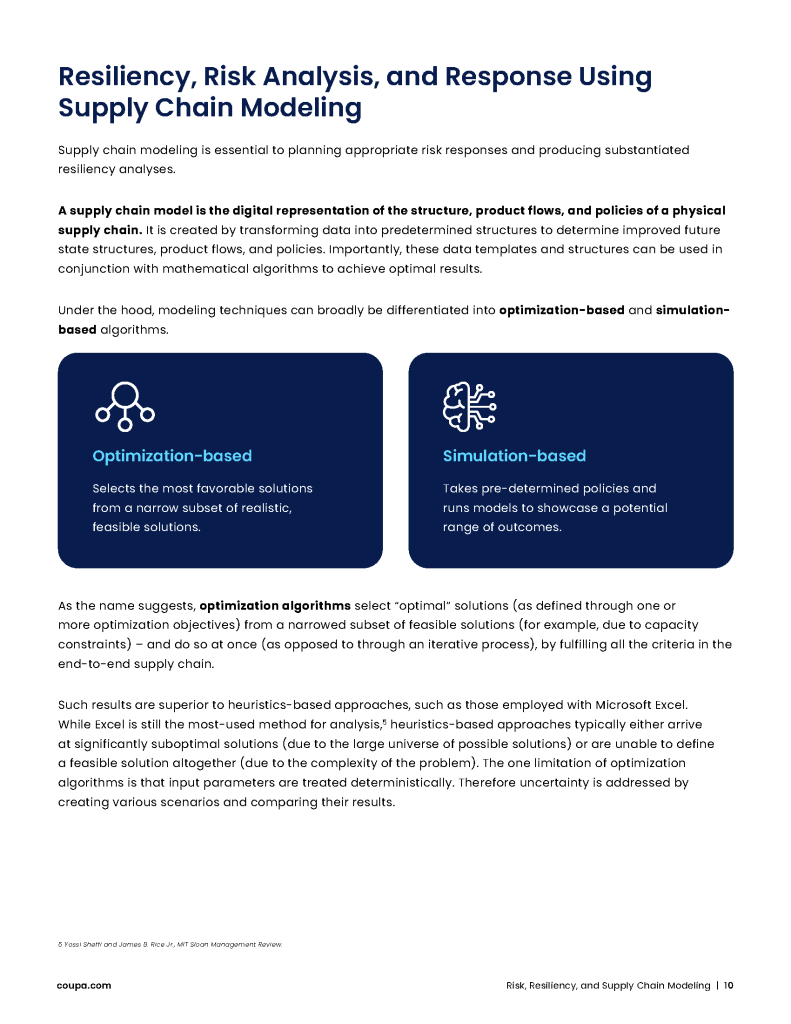
A supply chain model can uncover hidden breaking points in unexpected places – in commodity suppliers, for example, at small nodes, in the network or in ostensibly minor components. Among other insights, such a model can point at assets and processes that are being utilized at capacity, spot single-sourced materials inbound and products outbound, show volume or value concentration at particular nodes, identify bottlenecks in lead times, or quantify the impact of foreign exchange fluctuations on revenue and cost. Such analyses may lead to the discovery of measures to increase the resiliency of the supply chain that are independent of risks and their identified implications. Hence, these may be implemented even if no disruptions to the supply chain are assumed.
What does it mean to have a resilient supply chain?
Supply chain resiliency defines to what extent a supply chain can withstand disruptions. The most common definition of a resilient supply chain is its ability to quickly recover from disruptive events, ideally emerging stronger than before. With disruptions piling up and impacting supply chains more frequently, however, the definition of the resilient supply chain will have to change – it likely will be impossible to recover to an ante-disruption state. Rather, resilient supply chains of the future should have the capacity to continuously morph into new states that enable them to operate under the new (but also temporary) conditions prevailing post-disruption – and do so repeatedly.