Drive smarter spend strategies with AI
See what exceptional performance looks like and learn how to close the gaps.
Get the Benchmark Report




Coupa Named a Leader in the 2026 IDC MarketScape Worldwide AI-Enabled AP Automation Software for Large Enterprise

A shipment is running late. Nobody on your team knows yet, because the only place that shows right now is the dock, on the day it didn’t arrive.
A supplier’s price has drifted above what you negotiated. No one catches it because the invoice that would flag it is sitting in a queue three departments away.
A supplier’s risk score has been sliding for weeks. But you aren’t alerted because the system that tracks risk and the system that tracks spend cannot communicate with each other.
None of this is anyone’s fault. It’s how most procurement, supply chain, and finance teams are set up to work: reacting to problems after they surface instead of seeing them coming.
The first problem is visibility. Most teams are working out of systems that don’t talk to each other, across business units that each keep their own version of the truth. So when a simple question is posed, like, what are we actually spending with this supplier across the whole company, there isn’t a clear answer. A single view of spend shouldn’t be hard to get. However, for most teams, it’s nearly impossible.
The second problem shows up even after you have good data. Classification is still mostly manual. By the time spend is sorted and ready to view, the moment to act has often passed. This is how opportunities are missed, because the process was too slow to see them in time. And when an insight is surfaced, there’s another gap: the ability to take quick, informed action. This is the worst scenario, when you watch a problem unfold and are fully aware of it but you have no clear way to respond while it is happening.
The third problem is the quiet one. It doesn’t show up until much later, if at all. Cost leakage often goes undetected. The supplier risk escalates without notice until it becomes a disruption. Contract terms quietly stop being followed, deal after deal, and nobody catches it until the margin is already gone.
These common scenarios are reactive and have a measurable and avoidable cost.
This is why the answer isn’t another dashboard that shows you the same three problems but a little faster. What is needed is something that helps close the distance between spotting a problem and fixing it, one that doesn’t just display data, but acts on it.
This is the core idea behind Coupa Spend Pulse: unifying market and spend data into signals for predictive insights and autonomous action.
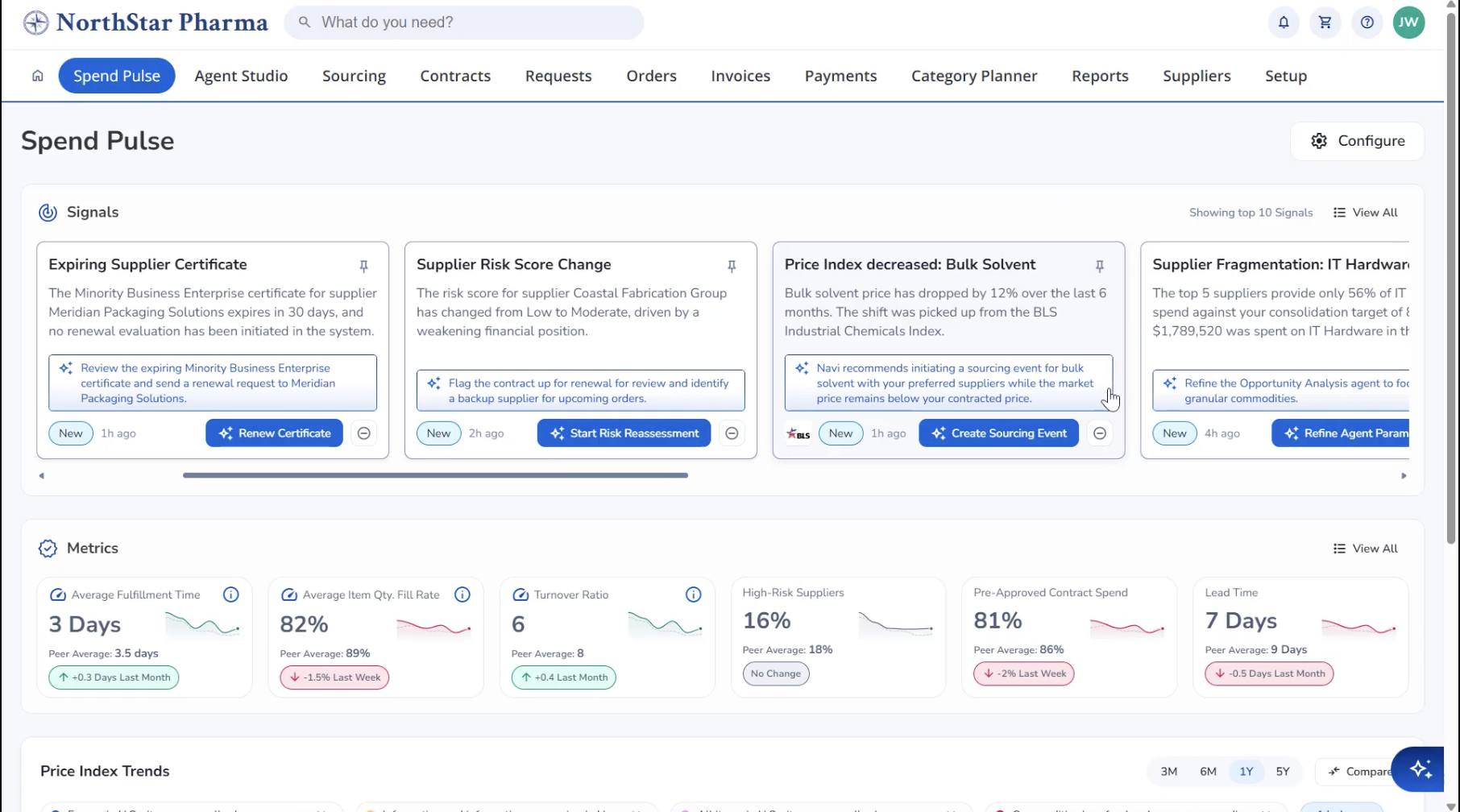
Spend Pulse brings issues to you, with a clear explanation and the context to help you understand why it’s happening, and often with the right action already lined up. You won’t be searching for problems, they’ll be presented to you early enough to still matter.
Spend Pulse works in three connected parts. Each one solves a different piece of the reactive cycle we’ve outlined.
Imagine knowing a critical shipment was going to be late before it disrupts your production line — not when the dock reports it missing, but days earlier when there is still time to act. Imagine seeing a supplier’s risk score sliding before it becomes a supply disruption, instead of finding out when the order doesn’t show up.
This is Autonomous Intelligence, continuously monitoring for disruption and opportunity by blending three things: your own spend data, benchmarks drawn from Coupa’s community of customers, and outside market data, including U.S. Bureau of Labor Statistics inflation indices. Put these together, and you get an objective read on whether a price is fair, a supplier is stable, or a shipment is at risk. Not guesses, but signal and data backed real numbers. When something is worth knowing, Spend Pulse brings it to you with a recommendation for the next step.
Next, imagine you are in the middle of your day reviewing a sourcing event or looking at a supplier record and the exact insight you need is right there. Not a new tab, no separate tool to open but in your current screen.
This is Embedded Analytics with context directly inside your normal workflow. If you have a follow up question, you do not need to file a ticket with a reporting team. Just ask in plain language and the Navi Analytics Agent delivers a chart or drill-down instantly, right where the question surfaced. Navi pairs advanced reasoning with explainable, data-grounded analysis — so every chart and drill-down is backed by a source your team can check, not a black box.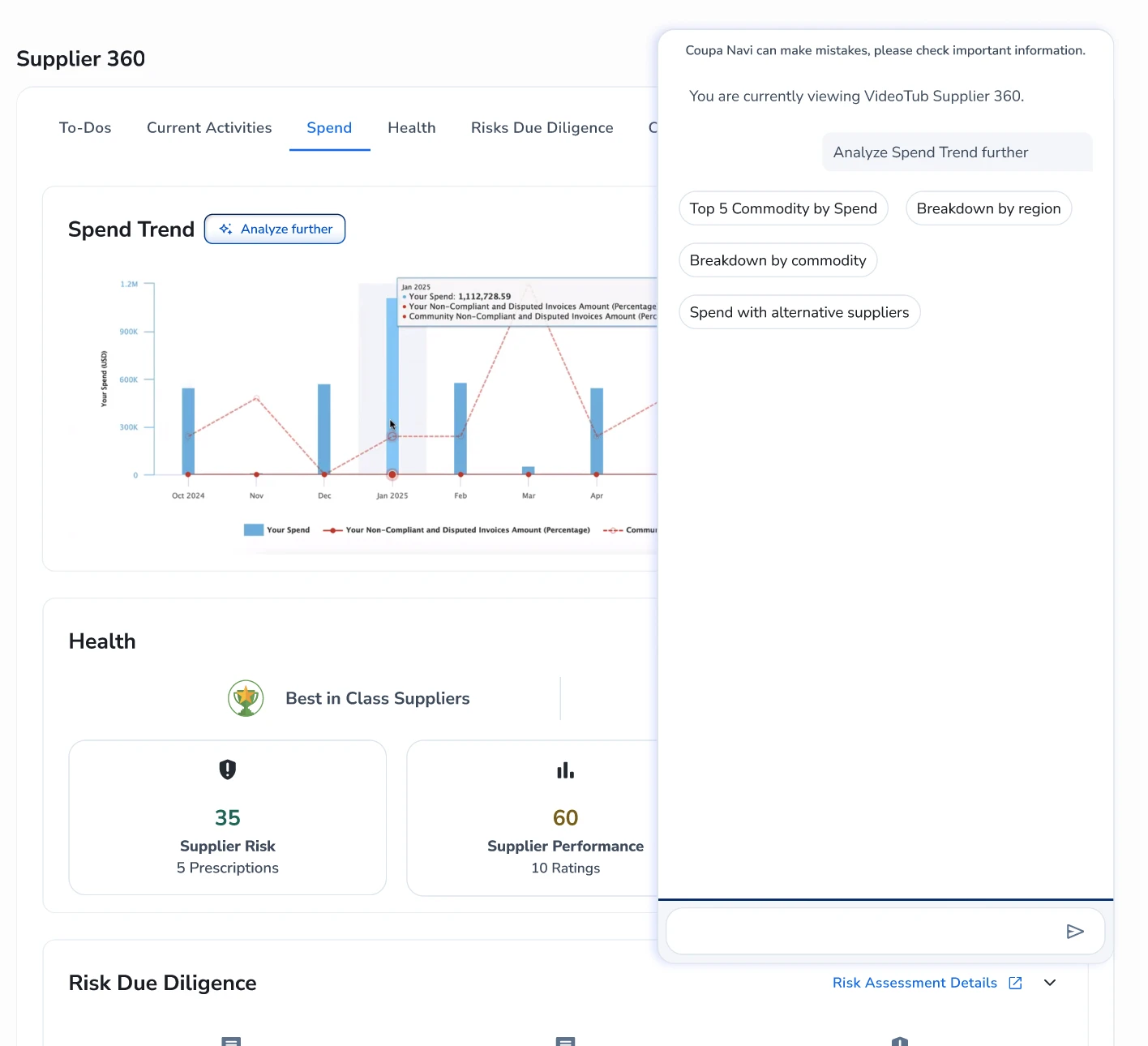
And imagine that instead of an analyst spending a week digging through spend data to find savings, the work is already done when you sit down to work.
An agent hands you the list:
This is what the Opportunity Analytics Agent can do. It will scan for spend patterns and turn them into savings you can act on today — and, as we expand its coverage, connect a finding directly to next steps like a sourcing event. AI recommendations only earn trust when the reasoning behind them is visible. Because of this, every one of the recommendations comes with its data source, a confidence level, and an explanation your team can check for themselves. Your team can make quick, informed decisions.
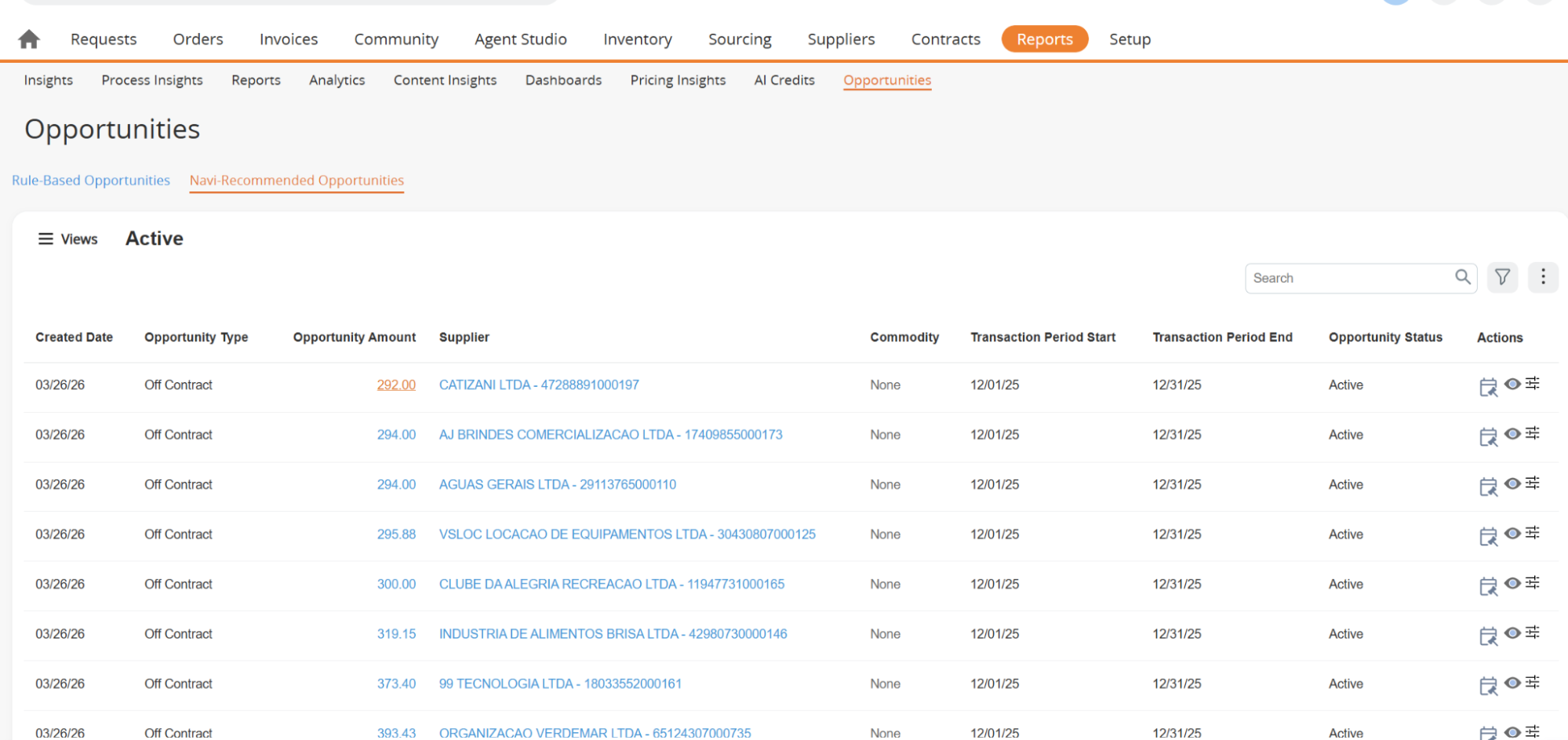
Spend Pulse is in limited release now, and the early feedback is telling us we’re solving the right problem.
A global enterprise in the travel sector, one of our early adopters, is already excited about the return on investment they expect to see from Spend Pulse. Two cases stood out to them first: Supplier Risk signals, which surface financial and performance risk before it disrupts supply, and Inventory ASN signals, which flag shipment delays early enough to plan around them. For a business built on tight timelines and physical inventory, catching those issues a few days earlier is the difference between a minor adjustment and a real disruption.
Strip away the mechanics, and this is what changes for procurement day to day:
These are small, continuous actions that compound into real, protected margin over time. Not one big fix. Just a lot of small ones, caught early, again and again.
Spend Pulse is available now in limited release, with general availability coming in January 2027.
Oh! It looks like you opted out from using the needed cookies. If you are interested in using the AI Agent, then please opt-in to the cookies in the preference center.
Update preferences