Drive smarter spend strategies with AI
See what exceptional performance looks like and learn how to close the gaps.
Get the Benchmark Report




Coupa Named a Leader in the 2026 IDC MarketScape Worldwide AI-Enabled AP Automation Software for Large Enterprise

How direct materials teams are bypassing ERP complexity to secure line-level visibility, streamline warehouse docks, and protect production schedules.
For global manufacturers and product-centric companies, direct materials are the absolute backbone of the P&L, typically determining 60% to 80% of total product costs. Yet, despite these massive stakes, many procurement and operations teams remain constrained by highly manual, fragmented back-office processes.
Traditional ERP systems excel as internally optimized Systems of Record. They track what happened inside your company's four walls. However, they are notoriously poor at orchestrating external, real-time collaboration across complex, multitier supplier networks.
When critical direct procurement updates are left to unscalable emails, texts, faxes, and phone calls, the supply chain becomes fragile and reactive. Planners spend 30% to 50% of their time manually chasing suppliers for order confirmations rather than focusing on strategic exceptions.
This collaboration gap is incredibly costly. Research shows that 89% of companies have experienced a supplier risk event in the past five years, and supply disruptions cause companies to lose up to 11% in revenue growth opportunities. When communication breaks down, companies face a cascade of operational headaches: late or partial shipments, unexpected production halts, bloated safety stocks, and frequent invoice disputes.
To protect margins and ensure supply continuity, organizations must transition from basic transactional systems to a dedicated, AI-enabled System of Collaboration. Crucially, this does not require a risky, multiyear IT overhaul; organizations can deploy standalone supply chain collaboration as an agile orchestration layer directly on top of their existing ERP landscapes.
Coupa Supply Chain Collaboration (SCC) bridges the handoff points that traditionally break direct spend management. It unifies planners and suppliers on a single network across four strategic execution pillars:
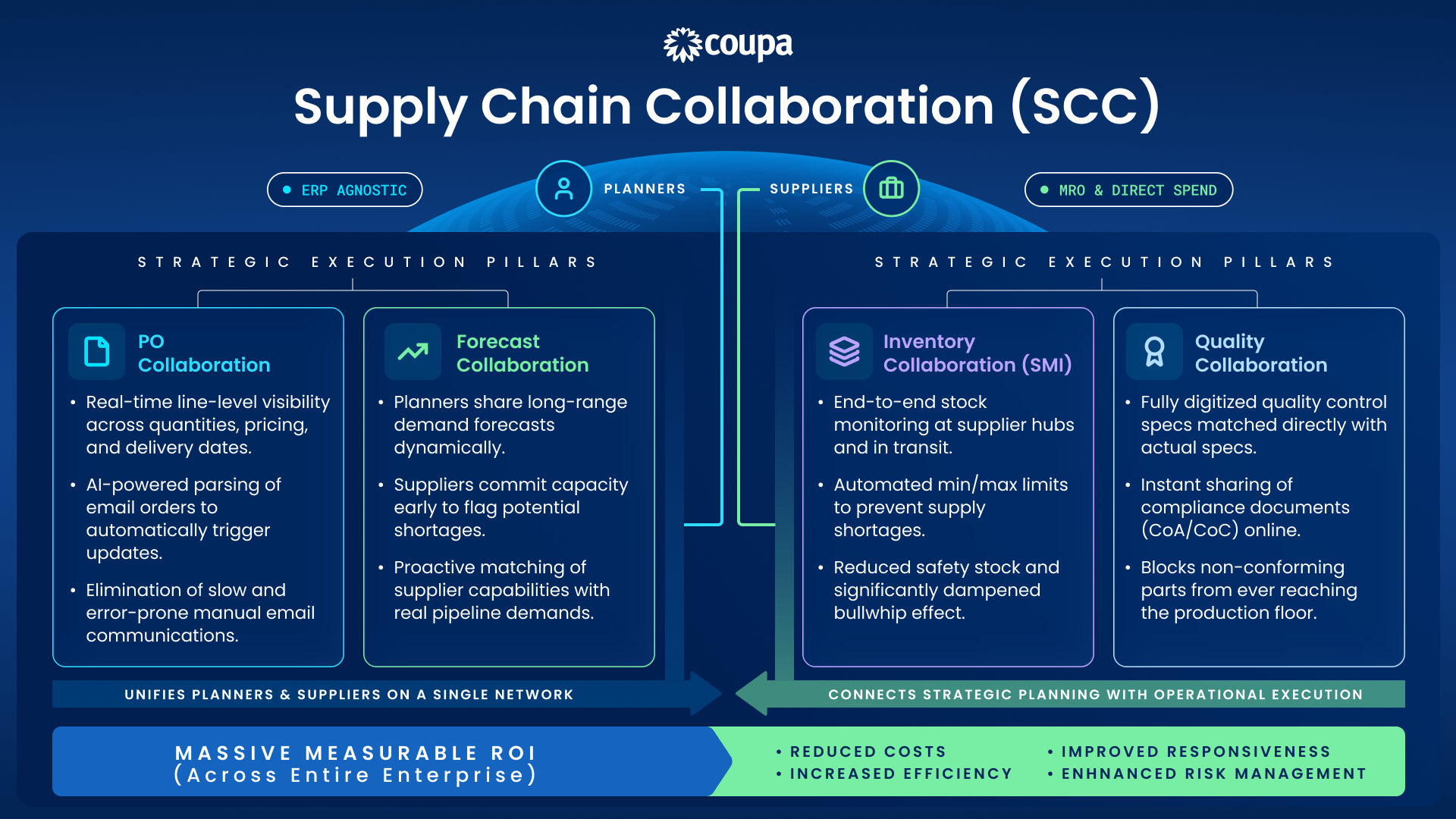
Starting with a standalone SCC footprint secures the clean, validated order and receipt data required to automate downstream finance. When your organization is ready to scale into a full P2P model, this clean transactional data drives up to a 75% first-time PO-to-invoice match rate and an 80% touchless invoice processing rate.
Real-time supply chain collaboration drives massive, measurable ROI across the entire enterprise:
Ultimately, supply chain excellence is no longer about simply buying parts; it is about orchestrating an ecosystem of value. By uniting procurement, supply chain design, and supplier collaboration on a single platform, leaders ensure that the resilient network they design is the exact network they build.
Oh! It looks like you opted out from using the needed cookies. If you are interested in using the AI Agent, then please opt-in to the cookies in the preference center.
Update preferences