- Source-to-contract
-
Category Strategy
Scale planning across teams -
Sourcing
Get confident decisions faster -
Sourcing Optimization
Unlock maximum efficiency -
Contract Lifecycle Management
Take control end-to-end -
Supplier Information & Risk Management
Manage risk across suppliers
- Procure-to-Order
-
Intake & Orchestration
Turn requests into action -
Procurement
Buy smarter, spend better -
Services Procurement
Gain visibility and control -
Inventory Management
Manage stock with precision -
Spend Analysis
Get insights you can act on
-
Coupa AI Overview
Real AI for real business outcomes -
AI Use Case Library
See how AI drives results -
Coupa Compose
Intelligence on one platform
-
Where Do I Start with AI?
A step-by-step guide -
AI Report
Real Impact: Before & After Coupa AI -
Academy
Practical AI. Real Impact.
-
AI in Finance
Drive ROI: AI for Finance & AP Demos -
AI in Procurement & Sourcing
AI Procurement SME Roundtable -
AI in Supply Chain
Master Supply Chain Design & Planning with agentic AI
- By Team
- Supply Chain
- Finance
- Procurement
- IT
- By Size
- Enterprise
- Mid-Market
- By Industry
- Automotive
- Banking & Investment
- Business Services
- Consumer Products
- Education
- Federal Agencies & Government Contractors
- Food & Beverage
- Healthcare
- Industrial Manufacturing
- Insurance
- Life Sciences
- Non-Profit
- Oil & Gas
- Process Manufacturing
- Public Sector
- Retail
- Technology
- Telecommunications
- Utilities
- Resources
- Product Demos
- On-Demand Webinars
- Blog
- Analyst Reports
- E-Books & White Papers
- Datasheets
- Video Library
- View All Resources
- Events
- Inspire
- DevCon
- Inspire World Tour
- AI Academy
- Executive Summit
- Upcoming Webinars
- View All Events


- About Coupa
- Leadership
- Newsroom
- Our Offices
- Compliance & Security
- Value Services
- ESG & Corporate Responsibility
- Brand Sponsorships

Predicting the future of business spend, faster
Coupa + MIT Data Science Lab move beyond sentiment
- Source-to-contract
-
Category Strategy
Scale planning across teams -
Sourcing
Get confident decisions faster -
Sourcing Optimization
Unlock maximum efficiency -
Contract Lifecycle Management
Take control end-to-end -
Supplier Information &
Risk Management
Manage risk across suppliers
- Procure-to-Order
-
Intake & Orchestration
Turn requests into action -
Procurement
Buy smarter, spend better -
Services Procurement
Gain visibility and control -
Inventory Management
Manage stock with precision -
Spend Analysis
Get insights you can act on
-
Coupa AI Overview
Real AI for real business outcomes -
AI Use Case Library
See how AI drives results -
Coupa Compose
Intelligence on one platform
- Resources
- Product Demos
- On-Demand Webinars
- Blog
- Analyst Reports
- E-Books & White Papers
- Datasheets
- Video Library
- View All Resources


Adapting Payments and Inventory to Protect Cash
It’s no secret that we are living in unprecedented times. In today’s landscape, a robust supply chain is essential when overcoming widespread disruption. And one of the biggest casualties affecting you and your suppliers is cash flow. Learn key steps that leading organizations are taking to protect cash and stabilize supply chains.
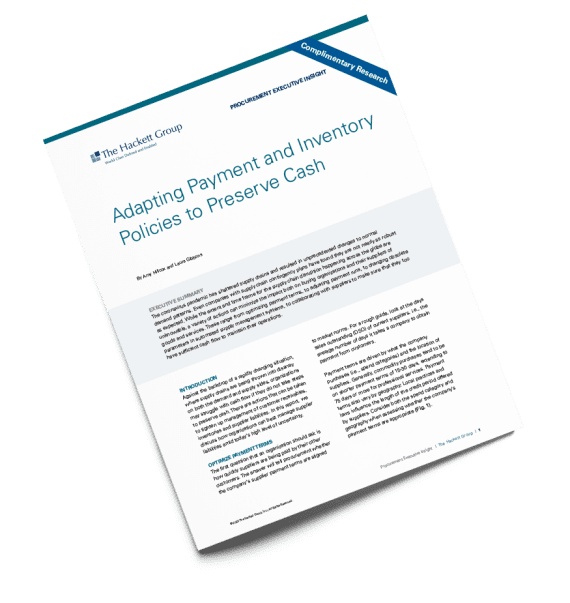
Uncover an agile approach to payments and protecting cash
Download this Hackett Group report to explore three ways you can safeguard cash:
- Extend payment terms. By how much? What should you look for before you extend?
- Change payment runs. Instead of daily or weekly, consider less frequent runs to ease the pressure on your organization’s cash flow.
- Anticipate demand. If spikes or slumps are impacting inventory, how can you ensure that you have a robust supply chain contingency plan to minimize the impact of inventory holding?
In a world of uncertainty and unpredictable demand spikes, organizations must become more agile. One key way to improve agility is to protect and optimize cash.
The Hackett Group surveyed nearly 100,000 companies to uncover how successful organizations are safeguarding cash by optimizing payment terms, managing payment runs, and anticipating stock management demand.

Featured Speakers
Amy Hillcox
Director, Procurement and Purchase-to-Pay Advisory
The Hackett Group

Laura Gibbons
Senior Director of Research, Procurement Executive Advisory Program
The Hackett Group
FAQ
What are some benefits of adjusting the way that payment runs are managed?
By altering the management of payment runs, a company can ease pressure on the timing of cash flow. Organizations that run payments daily or weekly should move to a weekly or bi-weekly schedule. This is an effective way to quickly slow down the outflow of cash in a measured and controlled manner. To ease pressure on cash flow, you should also consider which invoices are paid when payment runs are created. A common practice is to include everything due plus invoices due by the next payment run (i.e., pull-forward payments). Instead, pay only what is already due, being transparent with suppliers about the change. Another change that can be made is in how an organization manages cash constraints. Organizations that are highly cash-constrained may be unable to pay all suppliers. In this case, conscious decisions need to be made about which suppliers to pay. Both finance and procurement should be involved in this assessment. For more information, be sure to download the complete whitepaper from The Hackett Group.
Why is it important to identify how quickly an organization’s suppliers are being paid by other customers?
The answer to this question will tell procurement whether the company's supplier payment terms are aligned to market norms. For a rough guide, look at the days sales outstanding (DSO) of current suppliers, i.e., the average number of days it takes a company to obtain payment from customers. Payment terms are driven by what the company purchases (i.e., spend categories) and the location of suppliers. Generally, commodity purchases tend to be on shorter payment terms of 15-30 days, extending to 75 days or more for professional services. Payment terms also vary by geography: Local practices and laws influence the length of the credit period offered by suppliers. Consider both the spend category and geography when assessing whether the company's payment terms are appropriate.
Before making sweeping changes in an effort to tighten up management of customer receivables, inventories and supplier liabilities, why is it important to consider the cash needs of specific suppliers?
One example of a situation when it’s important to consider the cash needs of specific suppliers before making sweeping changes is the following: specialist temporary labor suppliers often have tight margins and can run into difficulties paying their employees if there are sudden changes in payments from key customers. It is also important to understand how specific suppliers are being impacted by the rapidly changing business environment. It is advisable to work collaboratively with suppliers to make sure they too have the cash flow required to maintain their operations. If not already in use, consider introducing supply chain finance offerings, including payment-term discounting, to inject liquidity into the supply chain.