Volatile news. Stable spend.
Read the latest in the Coupa Business Spend Index™ Quarterly Update.
Get the Report




Coupa named a Leader
in the Forrester Wave™: Supplier Value Management (SVM), Q4 2026

Contract lifecycle management (CLM) is the end-to-end process of managing a contract from initial request through drafting, negotiation, approval, execution, and ongoing post-signature compliance, renewal, or termination. According to research by World Commerce & Contracting, poor contract management practices cost organizations an average of 8.6% of their annual revenue in value leakage. While corporate leadership and legal teams traditionally view CLM primarily as a risk and compliance tool, it actually serves as the critical bridge where strategic sourcing decisions transform into real savings. For modern procurement and spend management leaders, mastering the contract lifecycle is essential to driving bottom-line results.
When organizations rely on fragmented or manual contract management, business velocity stalls and financial value erodes. In many enterprises, active agreements are scattered across email threads, shared drives, local desktops, and physical filing cabinets, leaving teams without a single source of truth.
This lack of central visibility creates systemic operational challenges:
Basic contract management shows where a file is saved, but full CLM reveals what’s in it, what’s owed, what’s coming due, and the overall health and speed of contract operations. Without that level of proactive visibility, administrative friction quickly drags down the bottom line.
From a procurement perspective, these administrative hurdles represent a fundamental contract management risk. When contracts aren't actively governed throughout their post-signature life, the hard-won discounts and favorable terms secured during sourcing go unrealized. This makes contract mismanagement a direct spend management problem rather than just a legal inconvenience.
When an organization regularly struggles to track obligations or locate agreements only when disputes arise, leaders should review these signs a company has outgrown manual contract management. Addressing these root contract lifecycle management challenges is critical to maintaining total contract compliance and protecting company margins.
The contract lifecycle management process spans every phase of an agreement’s existence. To build a resilient CLM process, organizations divide these operational steps into two distinct operational phases: pre-signature (authoring and finalizing the agreement) and post-signature (governing performance and managing long-term value).
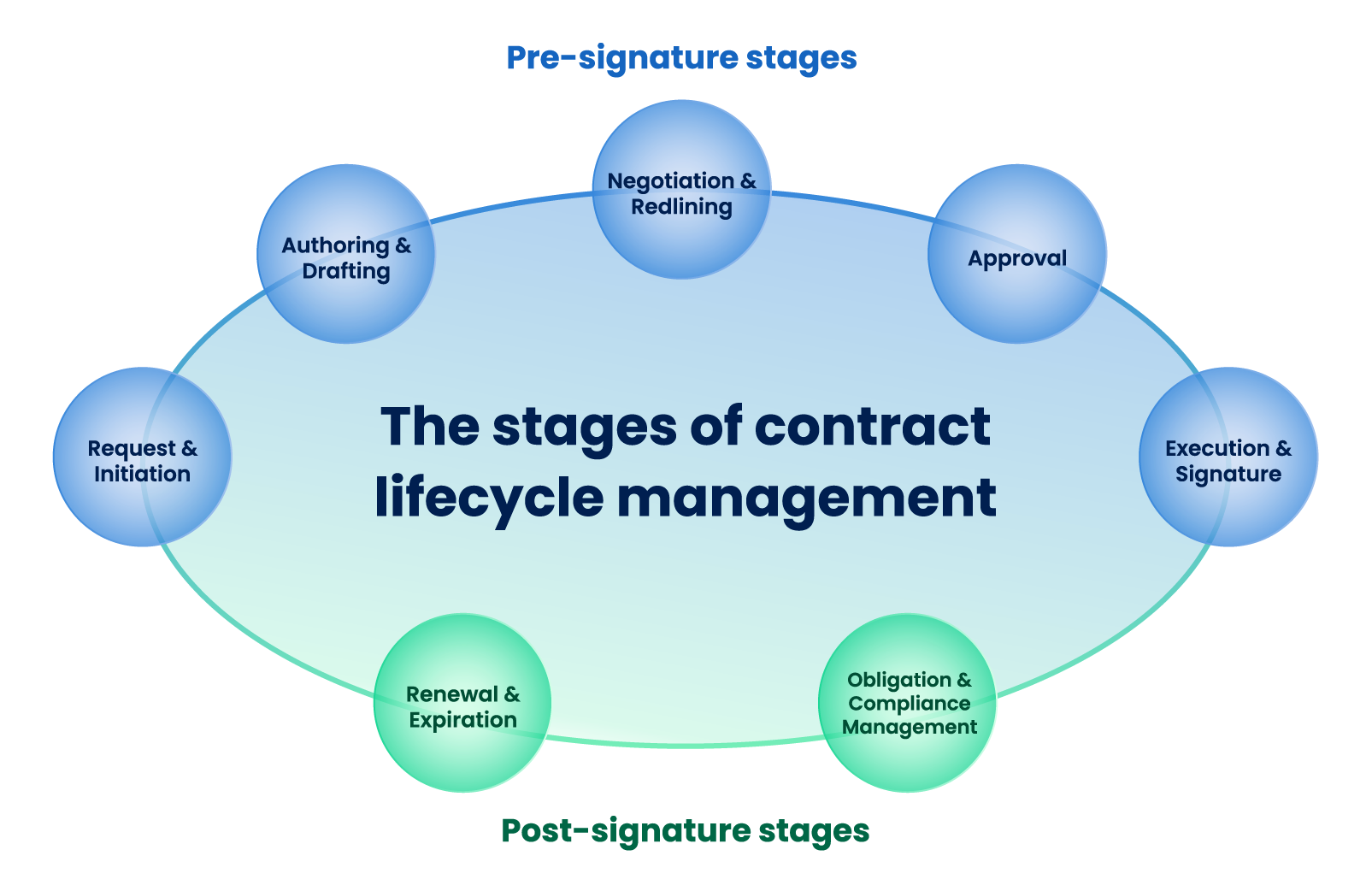
The intake phase where a formal request for a new contract or amendment is submitted.
A business owner identifies the need for a supplier agreement or service modification. Standardized intake forms capture essential metadata upfront, such as spend amount, supplier details, and scope of work, ensuring legal and procurement have complete context before work begins.
The creation of the initial contract document using approved legal terms.
Drafting relies on preapproved clause libraries and standardized templates tailored to specific deal parameters. This minimizes legal risk and eliminates the friction of building every agreement from scratch.
The interactive review phase where internal and external parties refine contract terms.
Both parties exchange revisions, propose adjustments to risk allocations, and finalize commercial terms. Advanced version control ensures total transparency across all iterations, preventing conflicting edits.
The formal sign-off sequence by designated organizational stakeholders.
Automated workflows route the redlined agreement to legal, procurement, finance, or executive leaders based on predefined business rules like spend thresholds or non-standard clause triggers.
The formal commitment phase where authorized representatives sign the agreement.
Using integrated e-signature technology, both parties legally execute the document. The contract becomes active, triggering subsequent financial and operational commitments.
The continuous tracking of supplier performance, deliverables, and contractual terms.
After execution, teams actively monitor key performance indicators (KPIs), tier discounts, and delivery milestones. Proactive obligation management ensures suppliers fulfill their commitments while protecting the organization from noncompliance.
The strategic evaluation phase that determines whether to extend, renegotiate, or terminate the contract.
Prior to expiration dates, the system triggers alerts for stakeholders to evaluate supplier performance and market rates. Proactive contract renewal management prevents costly auto-renewals and gives procurement teams leverage during renegotiations.
Implementing structured contract lifecycle management solutions delivers immediate operational gains while establishing long-term financial discipline.
Coupa's Contract Lifecycle Management Software helps teams move faster across every stage. From request and approval to renewal, so negotiated savings actually stick.
Most conventional perspectives frame contract management purely as a risk-mitigation function owned by corporate counsel. However, within an enterprise source-to-contract framework, CLM acts as the vital hub connecting strategic sourcing decisions directly to bottom-line financial results.
Consider the typical end-to-end procurement journey:
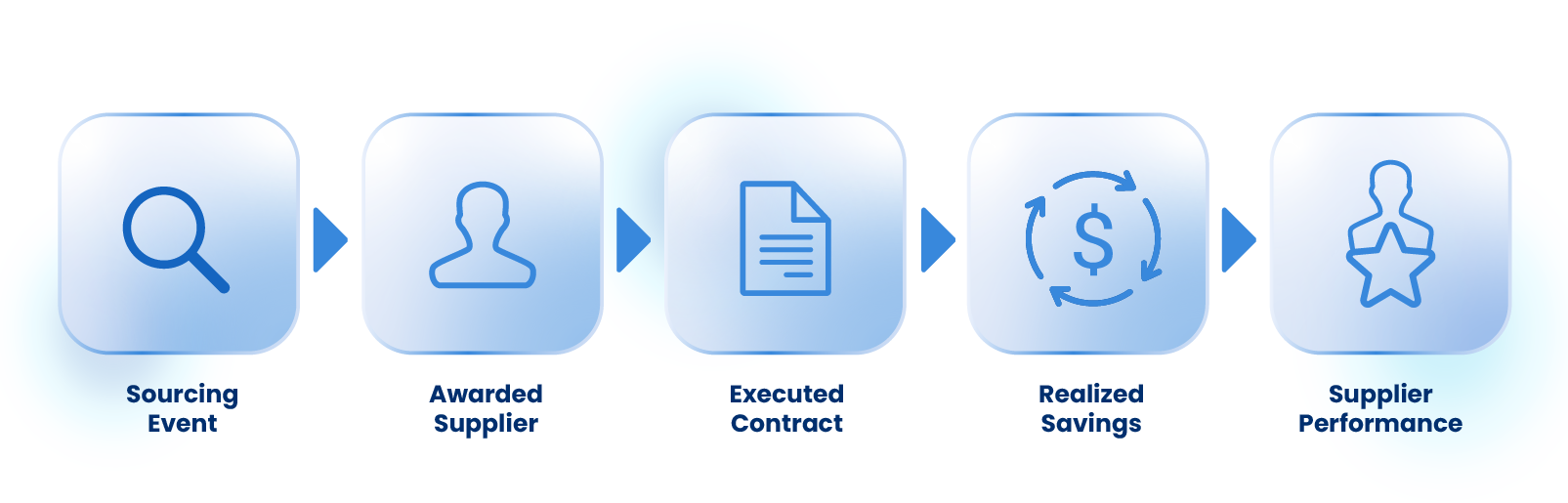
Without robust CLM integration, a critical gap opens between negotiation and execution. A sourcing team might secure a favorable 15% volume discount during an RFP, but if those terms are locked in a PDF on a local drive rather than integrated into daily purchasing workflows, buyers will continue buying at list price.
While traditional CLM discussions focus heavily on indirect procurement, such as software licenses or professional services, direct procurement demands an even higher level of operational precision. Direct supplier agreements govern raw materials and production components, embedding complex pricing structures, Bill of Materials (BOM) revisions, and strict engineering specifications. Enforcing these technical and cost terms through proactive CLM is just as critical as protecting indirect savings, directly safeguarding product margins and supply chain resilience.
Contracts are the exact point where hard-won procurement savings are either fully captured or lost. By embedding CLM within a unified spend management ecosystem, procurement and finance leaders gain full cost savings realization. Contracts transform from static legal paperwork into active, enforceable rules that govern daily spend across the entire organization.
Groundbreaking data from Coupa’s 2026 Total Spend Management Benchmark Report reinforces why this integration matters. A first-ever statistical analysis across a $9.5 trillion global transactional dataset in 2025 (now $10.5 trillion at time of writing) — analyzing 36 pairs of KPIs under rigorous controls — revealed that the On-Contract Spend KPI and the Structured Spend KPI share the strongest direct statistical coupling in the entire source-to-pay landscape. In other words, the executed contract is a true operational “domino” in procurement. Every strategic choice made upstream in sourcing and contracting multiplies hundreds or thousands of times through downstream transactions. Organizations that invest solely in downstream invoice or requisition process fixes without securing their contract foundation create almost no structural leverage, leaving their most substantial financial value behind.
To drive operational excellence and maximize ROI from your software investment, adopt these core contract lifecycle management best practices:
| Best practice | Description |
| Standardize contract templates and clause libraries | Maintain preapproved legal language for common agreement types to accelerate drafting and minimize custom legal reviews. |
| Centralize all contracts in one repository | Establish a single source of truth across all business units to eliminate hidden contract silos and ensure complete portfolio auditability. |
| Automate approval workflows and alerts | Configure automated routing based on contract value, risk levels, and milestones to prevent approval bottlenecks and missed renewal windows. |
| Define clear cross-functional ownership | Establish explicit responsibilities between legal, procurement, and finance for every phase of the contract lifecycle. |
| Integrate CLM with core enterprise systems | Connect contract software directly to the CRM, ERP, and procurement platforms to enforce negotiated terms. |
| Track key lifecycle metrics regularly | Continuously evaluate process performance, supplier compliance, and post-signature contract obligations to eliminate operational bottlenecks, prevent value leakage, and drive ongoing contract lifecycle improvements. |
Measuring performance across key CLM metrics provides clear visibility into operational efficiency and exposure levels:
| Metric | What it measures |
| Contract Cycle Time | The average time elapsed from initial contract request to final execution. This serves as the primary benchmark for process speed and organizational agility.
Top-performing companies in the Coupa community need just 11 business days to manage contracts. |
| On-Time Contract Renewal Rate | The percentage of expiring contracts evaluated and actioned prior to deadline.
This metric reflects how effectively post-signature obligations are governed. |
| Contract Compliance Rate | The percentage of active contracts that adhere strictly to standardized corporate terms, preapproved clauses, and regulatory guidelines. |
| Contract Value at Risk | The cumulative financial value tied to contracts that are approaching expiration without a strategy, undergoing active disputes, or out of operational compliance. |
| Standard Template Utilization Rate | The share of executed agreements authored using preapproved company templates rather than third-party paper (a primary indicator of legal process maturity). |
The best CLM platforms balance strict legal control with effortless usability for procurement and finance teams. Evaluate potential contract management platform capabilities against these essential features:
Unlike standalone CLM tools that operate as isolated contract repositories, embedded solutions connect executed agreements directly to daily buying channels. This ensures negotiated pricing and terms are automatically enforced at the point of purchase.
Ask the vendor: How does your platform enforce executed contract pricing directly within daily requisitions and purchase orders?
Intelligent drafting engines that auto-populate rules based on deal size, region, counterparty type, and specific business parameters.
Ask the vendor: How does the platform populate rules and approved clause variants based on specific deal parameters like spend amount or risk tier?
Advanced platforms must natively handle dynamic index-linked pricing formulas, commodity benchmark adjustments, and version-controlled Bill of Materials (BOM) specifications. This capability keeps manufacturing and direct supply agreements accurate across volatile market cycles.
Ask the vendor: Can your system track formulaic, index-based pricing changes and link terms directly to specific Bill of Materials (BOM) revisions?
Flexible routing engines that automatically direct agreements to appropriate stakeholders based on customized risk matrices and financial thresholds.
Ask the vendor: Can nontechnical users configure and adjust approval routing rules when spend thresholds or risk policies change?
Built-in, legally binding electronic signature capabilities that streamline final execution without requiring third-party tools.
Ask the vendor: Is e-signature built directly into the contract workflow, or does it rely on a separate third-party integration that adds cost and complexity?
Advanced indexing that allows users to query contracts by supplier, termination date, payment terms, or custom clause variables.
Ask the vendor: Can we search and filter our entire contract portfolio by specific clause language, custom metadata, and line-item terms?
Proactive alert systems that notify contract owners well in advance of upcoming deadlines, deliverables, and renewal dates.
Ask the vendor: How are milestone alerts and renewal notifications configured to ensure the right business owners take timely action?
Automated tools that analyze third-party paper, flag high-risk terms, and suggest preapproved replacement language.
Ask the vendor: How does your AI model analyze third-party paper against our company playbook, and how are risk exceptions flagged for legal review?
Systems should continuously stream supplier risk scores, financial health indicators, and supplier performance metrics directly into contract workflows. This gives teams full contextual visibility when drafting terms, evaluating renewals, or awarding new commitments.
Ask the vendor: Does the platform feed real-time financial health, risk, and supplier performance data directly into contract drafting and renewal workflows?
Enterprise connectivity that syncs contract data directly with CRM, ERP, and contract lifecycle management software systems to enforce spend controls.
Ask the vendor: Does contract data sync bidirectionally with our ERP, CRM, and procurement platforms to eliminate manual data entry?
Consider the organization's maturity when evaluating capabilities. While small and midsize businesses need out-of-the-box standardization, fast time-to-value, and room to scale without adding headcount, large enterprises require deep multi-ERP integration, multi-jurisdiction compliance, and advanced risk governance. The evaluation process should balance the need for immediate operational scale and a clear path for growth.
Ask the vendor: What is your typical implementation timeline for an organization of our size, and how does your platform architecture support our scaling requirements?
Artificial intelligence is rapidly transforming contract lifecycle management from a passive administrative repository into an active strategic engine. Modern AI contract lifecycle management goes beyond basic digitizations, fundamentally changing how contracts are created, evaluated, and governed across their operational lifespan.
The primary focus of AI in contract management today centers on eliminating administrative friction and accelerating intake across pre-signature workflows. Powered by specialized contract AI models, teams can automate high-volume tasks that previously required extensive manual legal and procurement effort.
Key current automation capabilities include:
The next evolution of CLM moves beyond basic automation toward agentic workflows — intelligent, multistep systems capable of planning, taking goal-oriented actions, and continuously monitoring commitments across spend systems. Rather than waiting for manual inputs, agentic systems actively observe operational signals and execute policy-governed steps.
Key emerging capabilities in agentic CLM include:
Even as agentic workflows handle complex task execution, clear human oversight remains vital. Autonomous agents manage routine compliance checks, data reconciliation, and preliminary workflows, while delegating strategic negotiation, relationship management, and final approval authority to procurement leadership.
Contract management often refers to basic administrative tasks like storing signed documents or tracking deadlines manually. CLM is a comprehensive, end-to-end business strategy supported by software that governs every phase of an agreement, from initial request and drafting through negotiation, execution, obligation tracking, and renewal.
CLM is used across multiple enterprise functions. Legal teams use it to standardize risk and streamline reviews. Procurement professionals rely on it to track supplier performance and enforce pricing. Finance teams use it to control spend. Sales operations use it to accelerate deal cycles.
When CLM and TPRM operate in silos, companies face blind spots, from auto-renewing high-risk suppliers to drafting terms without visibility into supplier vulnerabilities. Unifying CLM and TPRM directly within a source-to-contract workflow ensures real-time risk scores, financial health indicators, and performance metrics continuously stream into every contract decision. Instead of viewing contracts purely as static legal documents, an integrated procurement platform embeds proactive risk mitigation directly into sourcing, drafting, and spend management. This protects the bottom line while keeping commitments secure.
CLM ensures that the cost savings negotiated during sourcing are actually realized during daily operations. By linking contract terms directly to procurement and invoicing workflows, CLM prevents off-contract spend, enforces contracted pricing tiers, and alerts teams to renegotiate before automatic renewals occur.
Virtually every industry benefits from CLM, especially highly regulated sectors like healthcare, financial services, life sciences, manufacturing, and technology. Any organization managing high contract volumes, complex supplier ecosystems, or strict compliance standards can achieve higher efficiency and risk reduction through automated CLM.
Effective contract lifecycle management relies on connecting negotiated terms directly to enterprise spend action. Part of its AI-native platform, CLM from Coupa unifies contract workflows seamlessly across sourcing, purchasing, and invoicing to transform static agreements into active operational controls. Recognized as a Leader in the IDC MarketScape: Worldwide AI-Enabled CLM Within S2P 2025 Vendor Assessment, Coupa eliminates operational silos across both pre- and post-signature lifecycle stages.
What sets Coupa apart is community intelligence combined with embedded agentic guidance. By bringing negotiation, compliance, and obligation intelligence directly into daily workflows — benchmarking deals, scoring contract risk, and tracking commitments in real time — Coupa helps teams close deals faster, catch risks earlier, and ensure the organization captures the full financial value of what was negotiated. Grounded in an ethically sourced dataset of $10.5 trillion in global spend, Coupa delivers risk-informed clause suggestions and predictive guidance that mitigate contract risk and maximize cost savings. Transform your contract lifecycle from an administrative requirement into a powerful driver of corporate margin efficiency.
Don't let valuable terms get lost in a folder. Use Coupa's AI-native contract lifecycle management to bridge the gap between negotiation and execution, ensuring hard-won savings are realized across every stage of the agreement.
Oh! It looks like you opted out from using the needed cookies. If you are interested in using the AI Agent, then please opt-in to the cookies in the preference center.
Update preferences