Volatile news. Stable spend.
Read the latest in the Coupa Business Spend Index™ Quarterly Update.
Get the Report





The market winced. Business spend held firm.
The Coupa Business Spend Index™ Quarterly Update

Every dollar your organization spends is either working for you or against you.
Political instability, shifting tariffs, supply chain volatility, and rapid AI adoption have raised the stakes on every dollar your organization commits. Spend management is no longer operational — it’s a strategic signal. It shows whether you’re in control of the business or just reacting to it.
Yet most organizations struggle to manage spend because they can’t see it all. Nearly 50% of business leaders lack full visibility into their company’s spending data, according to new research. Meanwhile, organizations that manage spend deliberately are pulling ahead, and the gap is measurable. According to Coupa’s Agentic Spend Management Benchmark Report, top organizations are saving 8.1% of their overall spend and achieving first-time invoice match rates of 97.1%.
The window to catch up is narrowing as technology and market shifts accelerate. This guide breaks down what spend management is, why it matters more than ever, and what it takes to get it right.
Spend management covers the full lifecycle of organizational spending, from the moment a purchase need is identified (intake) through sourcing, procurement, payment, and post-purchase analysis and reporting.
The goal is straightforward. Make sure every dollar leaving the company is doing so intentionally, efficiently, and strategically. AI is increasingly central to achieving that goal, automating the routing, workflows, and analysis that once required entire teams.
Spend management brings together every type of business spend, including direct and indirect spend, which is often managed in silos:
In many organizations, these types of spend aren’t just separated. They’re managed inconsistently across teams, systems, and workflows. The same category of spend may even follow entirely different processes across departments, leading to fragmented data and reduced visibility.
No matter the mix of spend, managing it effectively requires a unified approach. By bringing all spend into a single system, Agentic Spend Management seamlessly connects these processes. Procurement management, expense management, and tail spend management come together to provide the visibility, speed, and control needed to make better decisions and uncover savings opportunities that traditional approaches miss.
| Component of Spend Management | What It Involves | Example in Practice |
|---|---|---|
| Intake & Orchestration | Capturing spend requests and routing appropriately | A spend request is submitted through a guided form and automatically routed for approval |
| Sourcing & Supplier Strategy | Selecting and managing suppliers across cost, quality, and risk | Running an RFP to consolidate packing suppliers and using AI to flag supplier risk before disruption |
| Contract Management & Procurement | Establishing supplier terms and executing purchases | Creating a contract with negotiated pricing, then issuing a PO for 50 laptops from the preferred vendor |
| Inventory Management | Tracking and optimizing inventory levels to align supply with demand | Automatically reordering raw materials when stock drops below a certain threshold |
| Invoicing & Payments | Validating invoices and executing payments to suppliers | Flagging a duplicate invoice and triggering an early payment on a separate invoice to capture a 2% discount |
| Expense Management | Capturing, reviewing, and reimbursing employee-initiated spend | Capturing a travel expense made by an employee who uploaded receipt photos via a mobile app |
| Treasury & Cash Management | Managing cash flow, liquidity, and financial risk | Adjusting weekly cash flow forecasts based on upcoming supplier payments |
| Spend Analysis | Collecting and managing spending data across the organization to find patterns and savings opportunities | Identifying that multiple teams are purchasing the same item from different suppliers at different prices |
Spend management efforts often start with isolated problems that are symptoms of larger issues, such as invoice delays or increasingly complex purchasing needs, but quickly expand to unify processes and improve efficiency across the organization.
The most direct return on investment in spend management is cost reduction. Visibility into how money is spent reveals where companies are overpaying and where purchasing volume can be consolidated to secure better rates. High-performing organizations that put visibility into action achieve average savings of 8.1% by channeling spend through negotiated agreements and reducing off-contract purchases.
“We scrutinize spend and contacts to see where we are growing and where we need to support customer growth and value delivery to our customers.”
— Kenneth Hauge, CFO, Telenor
Every direct or indirect spend decision shapes supply chain resilience. Full visibility into suppliers, including multitier networks and emission tracking, enables organizations to assess risk, meet ESG requirements, and avoid overreliance on any single source. For example, teams can identify alternative logistics routes or suppliers with lower water consumption, thereby reducing not only costs but also carbon emissions. This level of insight helps organizations make more informed decisions that balance resilience, cost, and sustainability.
Organizations are under increasing pressure to meet complex regulatory requirements like SOX, HIPAA, and GDPR. Many now use Compliance as a Service built into spend management platforms. It embeds enforcement directly into purchasing and payment workflows, reducing the need for manual oversight or team intervention. These platforms further bolster security through AI-powered fraud detection.
By centralizing these processes onto a spend management platform, organizations strengthen financial control with real-time visibility into cash flow, automated policy enforcement, and audit trails. This proactive approach reduces risk at every stage, preventing legal violations and ensuring audit readiness, which is especially important for publicly traded companies.
A single source of truth for all spend operations improves coordination and accuracy across all teams. Finance gets real-time visibility without having to chase down data. Procurement moves fast with approvals embedded in workflows and AI surfacing preapproved vendors. Supply chain teams can act on supplier risk signals before they escalate into disruptions.
When risks emerge, like a supply shortage, teams can pivot quickly. It’s easier to launch a sourcing event, select an alternative supplier, and onboard them without delay when spend management processes are connected. Through the connection between finance, supplier management, and procurement, organizations can anticipate risks and adapt in real time.
Spend risk is rarely obvious until it’s too late. More often, it shows up as a slow accumulation of friction, inefficiency, and financial leakage. Here are the most common signals.
“We have no idea where our money is going.”
Fragmented data across spreadsheets, ERPs, and departmental systems is one of the most common barriers to effective spend management.
“Spending keeps growing, and nobody can explain why.”
Uncontrolled growth usually points to a lack of process governance. Employees purchasing outside approved channels, contracts auto-renewing without review, or tail spend left on autopilot.
“Employees are buying whatever they want from whoever they want.”
Maverick spend is one of the biggest drivers of cost leakage, and in direct material supply chains, it’s particularly hard to detect. Production urgency often pushes teams outside normal channels when components run short.
“We’re paying different prices for the same thing.”
When multiple business units negotiate separately with the same suppliers, or when contracts aren’t enforced at the point of purchase, organizations end up with significant purchase price variance that directly erodes margins.
“Our approval processes are a mess.”
Slow, inconsistently applied, or easily bypassed approvals expose the organization to financial and compliance risk. Streamlining approval workflows is one of the highest-impact improvements a spend management program can make.
“Our reports are always outdated by the time they reach leadership.”
When spend data lives in disconnected systems, numbers don’t align, and reports take days to compile. By the time leadership sees them, they’re already outdated. This lack of real-time data visibility makes it easy for issues to grow unnoticed. This is especially true for global operations, where currencies, entities, and regulations add complexity that manual processes can’t keep up with.
Modern spend management isn’t a single process or handoff between teams. It’s a connected set of components that spans the entire lifecycle of how money moves through the organization. Each stage plays a critical role in controlling and aligning spend with business priorities.
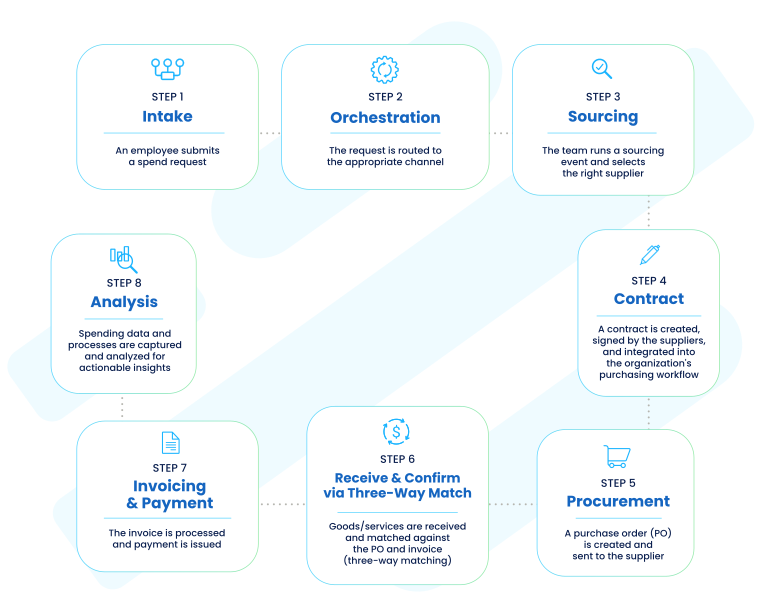
Every spend event starts with a request. A structured intake process that captures the need up front, including what’s being purchased, why, and by whom, ensures the right data is collected before any money is committed.
An intelligent intake process guides users to preferred channels and PunchOut catalogs from the start. This automated guidance ensures every purchase aligns with preapproved suppliers and negotiated contracts, eliminating maverick spend while simplifying the user experience. For existing spend within the system, a user typically skips to Step 5 from here.
Once submitted, requests are automatically routed through the correct workflows, approvals, and systems. AI-powered orchestration connects intake to downstream processes like sourcing, procurement, and finance.
If a supplier isn’t already approved, sourcing identifies the best options based on cost, quality, and risk. Strategic sourcing tools use AI to evaluate multiple scenarios based on business requirements and recommend optimal suppliers.
Selected suppliers are formalized through contracts that define pricing, terms, and obligations. These agreements also establish the foundation for ongoing supplier management, setting the expectations for performance, compliance, and accountability throughout the relationship. Supplier management also includes supplier onboarding and continuous monitoring. Platforms with high adoption often include portals that are free to suppliers and make it easy for vendors to upload and update their information.
Purchases are executed through approved suppliers, contracts, and workflows, typically via purchase orders (POs). This ensures negotiated terms are actually realized in practice. For organizations that get this right, they see 81.1% of on-contract spend through orders.
Goods or services are received and verified against the purchase order and invoice. This three-way matching step ensures that what was delivered matches expectations before payment is approved.
In parallel, employee out-of-pocket expenses are submitted with receipts and categories for review.
Once matching is confirmed and discrepancies, such as incorrect line items or duplicate invoices, are identified and resolved, the finance team releases the payment to the supplier and ensures it arrives on time.
For approved expenses, they are reimbursed through the same controlled payment workflow.
All spending data is aggregated and analyzed to uncover trends, risks, and savings opportunities. Insights from this stage feed back into sourcing, budgeting, and policy decisions.
Spend management looks different depending on the organization’s size and complexity.
For large enterprises, the challenge is control. Spend spans business units, geographies, currencies, and regulatory environments, often across disconnected systems and processes. The goal isn’t just visibility. It’s a consolidation: bringing all spend data onto a single platform so patterns emerge and contracts are enforced consistently to maximize negotiating leverage.
For mid-sized and growth-stage companies, the challenge is getting the foundation right early. Many default to stitching together point solutions — one tool for procurement, another for expense, spreadsheets for everything else. What they end up with is data in silos, manual reconciliation, and process gaps that create inefficiencies and blind spots as they scale. These process gaps and data challenges also prevent AI from working as intended. A unified platform from the start avoids these issues, enabling faster growth with visibility and control already in place.
Spend management touches procurement, finance, supply chain, and individual business units simultaneously. The most effective spend management happens when all of these functions work in close alignment.
| Role/Team | Primary Spend Management Responsibilities |
|---|---|
| Procurement | Intake & orchestration, sourcing, supplier selection and management, contract negotiation and management, purchase order management, and supplier risk governance |
| Finance | Budget management, spend visibility, reporting and compliance, invoice processing, payment terms, cash flow optimization, financial controls, and regulatory compliance oversight |
| Supply chain | Direct spend planning, inventory management, demand forecasting, supplier collaboration, logistics, and distribution |
Authority for spend decisions typically escalates based on value thresholds. Routine, smaller purchases in compliance with spend policies are auto-approved, while spend above certain thresholds requires cross-functional sign-off. Building these guardrails and segregation of duties into system workflows rather than relying on manual oversight is what separates organizations with strong spend discipline from those perpetually fighting maverick spend.
The gap between “we need better spend management” and “we have a functional spend management program” can feel enormous. There’s no need to solve everything at once. Many organizations make progress in phases as they develop a spend management strategy.
Start with one area where pain is already clear, like invoice delays or off-contract spending, and build from there. In practice, this looks like:
The goal isn’t full visibility from day one. It’s all about creating structure. Once spend starts flowing through a consistent process, visibility follows naturally. From there, organizations can expand into broader spend analysis and supplier collaboration.
Once an initial use case is in place, expand into two to three high-impact spend categories rather than trying to govern every dollar at once. Focus on areas where consolidation or standardization will deliver measurable gains, such as high-spend categories, fragmented suppliers, or frequent off-contract purchasing. In practice, this looks like:
Fragmented, manual processes hit a ceiling quickly. AI can only deliver value when it has access to clean, unified, structured data. In fact, a majority of finance leaders (73%) say their biggest barrier to expanding AI into workflows is data quality and readiness. AI cannot work across siloed systems, and it cannot scale on top of manual workflows. Companies that delay building a unified data foundation are limiting their ability to compete as AI-powered capabilities become standard.
A unified spend management platform connects intake, sourcing, procurement, supplier management, invoicing, expense management, payments, and analytics in one place. That foundation makes AI actionable and enables the entire program to scale as the business grows.
There has never been a more critical time to invest in spend management, especially amid price volatility, political instability, supply shortages, and the closure of major global trade routes. Recently, freight costs shot up 130%. All of this has a significant impact on industries of every kind.
Securing buy-in comes down to framing the spend management in terms of what each stakeholder already values. For finance, that means margin protection and control in an increasingly unpredictable environment. For the C-suite, it’s speed and agility, ensuring the organization can move quickly without sacrificing governance. For IT, it’s simplification. A unified platform with an open API framework and pre-built connectors simplifies integration and reduces system complexity. Start with a focused pilot and tie results to familiar metrics like PO cycle time, contract compliance, and supplier risk to build momentum quickly.
The right KPIs depend on the organization’s maturity level and priorities, but a handful of metrics matter across virtually every spend management program. The following are just a few examples.
| KPI | What It Measures | Why It Matters in Practice |
|---|---|---|
| Spend under management | Percentage of total spend flowing through approved procurement channels | The higher this number, the more data you have and the more leverage you have with suppliers |
| Savings rate | Savings achieved through sourcing, negotiation, and process improvements relative to prior spend | Directly demonstrates the ROI of the spend management program to finance and leadership |
| On-contract spend rate | Percentage of purchases made through pre-negotiated contracts and approved suppliers | Ensures that savings negotiated at the sourcing table are actually realized at the point of purchase, not just on paper |
| Spend with primary suppliers | Percentage of total spend flowing through an organization’s core, strategic supplier relationships | A higher concentration with primary suppliers means better pricing leverage and stronger relationships |
| Invoice first-time match rate | Percentage of invoices that match POs and receipts without exception | High match rates reduce processing costs, prevent overpayment, and indicate process discipline |
| Requisition-to-order cycle time | Time from purchase request to approved PO | Measures process efficiency; long cycle times create bottlenecks and drive maverick purchasing |
Tracking these spend analytics is step one. Knowing what good looks like is step two. Internal progress means nothing without external context. The Coupa Agentic Spend Management Benchmark Report provides a useful peer reference point, reflecting average values from the top quartile of Coupa customers, giving finance and procurement teams a concrete target to measure against rather than an abstract aspiration.
Saga, the U.K.-based consumer services company, struggled with manual, disconnected finance and procurement systems. Payments were consistently late, and there was no centralized view across the group’s procurement functions.
After deploying Coupa, 90% of Saga’s overhead and marketing invoices were processed through the AI Agentic Spend Management platform. Invoice cycles dropped by 70%, and payment approvals went from hours each week to just minutes. Finance and procurement now operate from a single source of truth with significantly improved control and efficiency.
When Uber needed to prepare for its IPO, spend management wasn’t a side project; it was a prerequisite. The company had to standardize and scale procurement processes across 13,000 internal users and suppliers worldwide, while maintaining tight controls.
Uber deployed Coupa’s platform across procure-to-pay, virtual cards, invoicing, spend analysis, and sourcing. The spend management platform impact is clear: 40% of purchase requisitions are now hands-free, 100% of spend is preapproved, and order processing time has dropped to just five days or less. Automated AI-driven workflows made compliant purchasing easier for employees, including teams at newly acquired companies who needed to get up to speed quickly.
Talos Energy, a Houston-based oil and gas company, was managing procurement almost entirely on paper. Ad hoc PO numbers, manual processing, and a near-total lack of spend visibility were creating risk across drilling operations and maintenance environments where supply disruptions carry serious operational consequences.
Coupa gave Talos a single system for sourcing, procurement, invoicing, and expense management. Spend under management grew to over $200 million. Visibility increased by 400%. Invoice cycle times dropped by 90%. Preapproved spend and e-invoicing enabled automated three-way matching. This eliminated the manual reconciliation work that had been slowing the team down and meaningfully reduced operational risk.
The right spend management software doesn’t just automate existing processes. It fundamentally changes what’s possible. Here’s what to look for when evaluating platforms.
The most important differentiator in modern spend management software is its data foundation and embedded AI. A unified platform can analyze transactions in real time to surface spending patterns, market price variances, and risks, while delivering actionable recommendations. Platforms that leverage anonymized insights from millions of businesses provide a particularly powerful advantage, surfacing benchmarks and signals that no single organization could generate on its own.
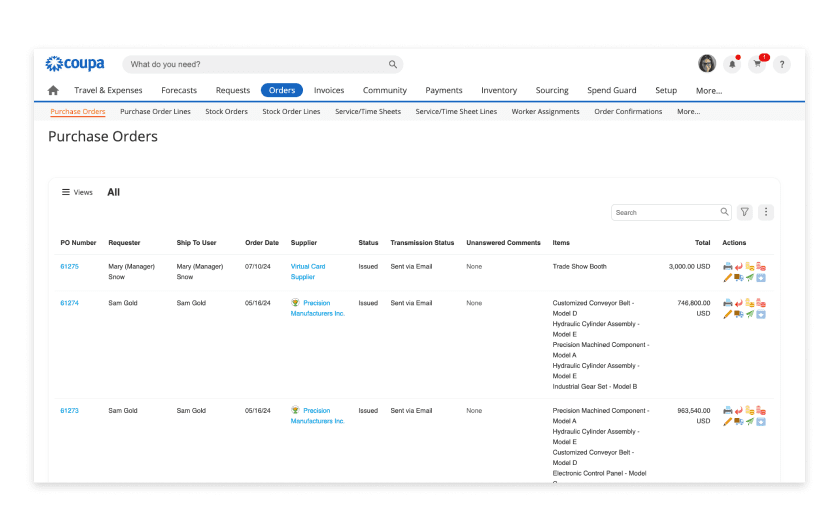
Look for a platform that handles the full source-to-pay lifecycle today and can extend into supply chain and treasury without requiring a platform change tomorrow. Fragmented point solutions create data silos that undermine the visibility needed for spend management to work as your organization grows in size and complexity.
One of the most underappreciated capabilities in spend management software is intake and orchestration, which is the ability to capture every spend request and automatically route it to the appropriate workflows. It's the starting point of the intake-to-pay lifecycle, and when it works well, every dollar is managed, approved, and visible before it’s spent. A platform should have customizable intake templates and offer guided support for non-procurement users.
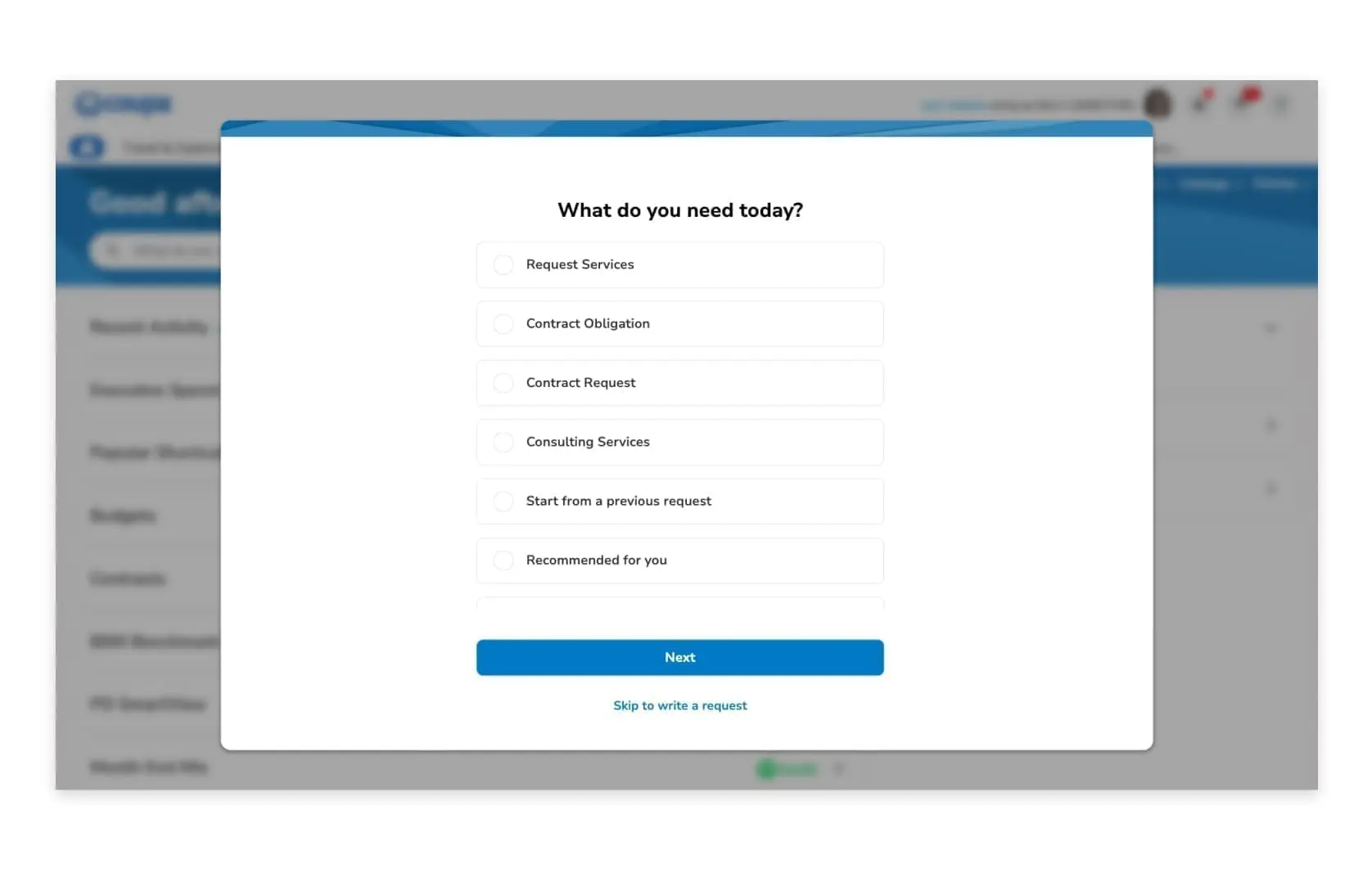
Effective supplier management starts with onboarding. Look for platforms with a fee-free supplier portal that makes it easy for suppliers to submit required information, get onboarded quickly, and receive payments without friction.
From there, management should be continuous rather than periodic. The right platform automates third-party risk monitoring across areas such as financial stability, information security, regulatory compliance (InfoSec, ABAC, and more), and ESG, surfacing risks and recommending actions in real time.
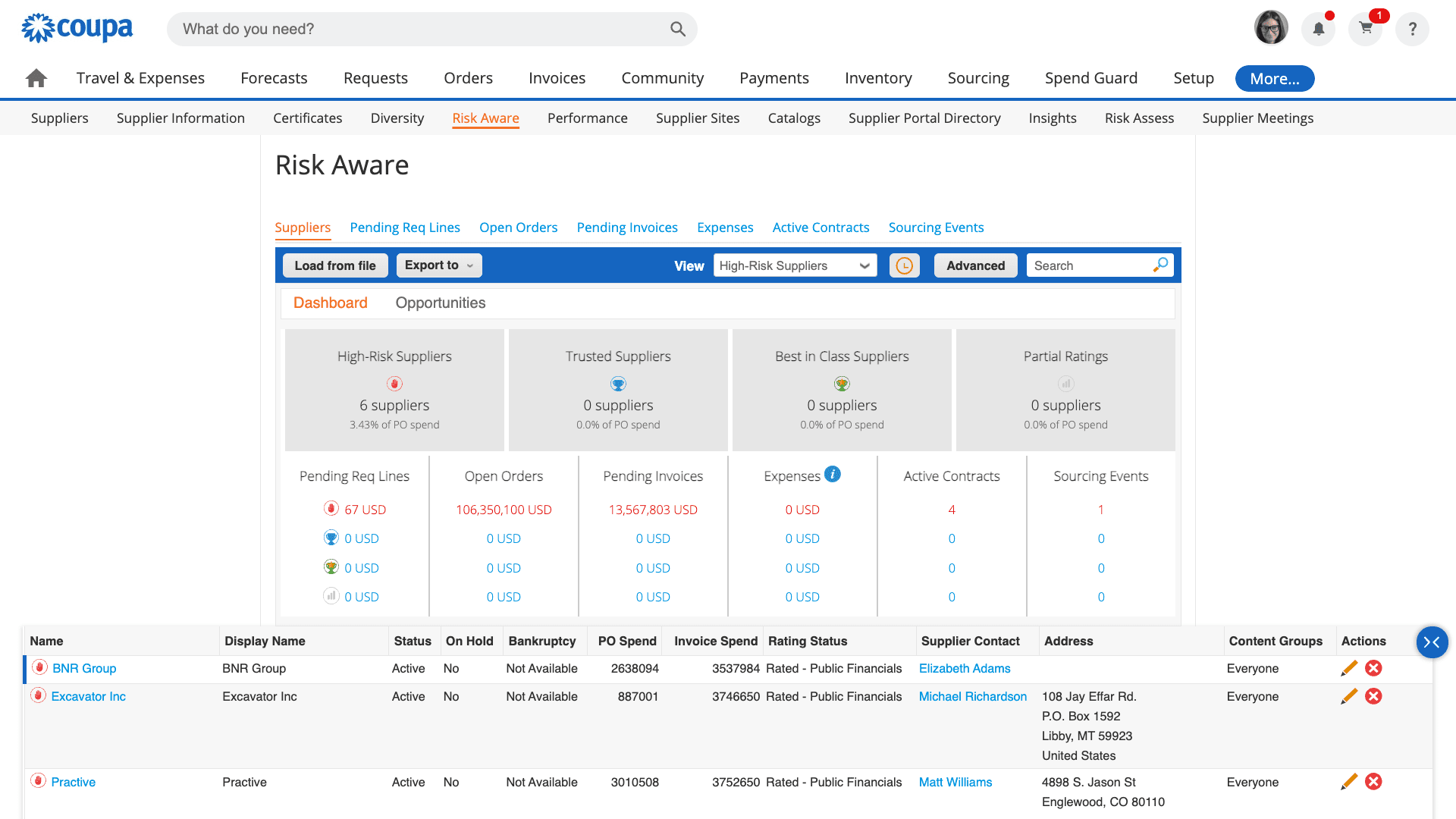
A spend management platform is only as good as its adoption rate. Complex or difficult-to-use systems drive employees back to informal purchasing channels and email-based approvals. Prioritize platforms with intuitive interfaces, mobile access, and self-service capabilities that make compliance the path of least resistance.
Oh! It looks like you opted out from using the needed cookies. If you are interested in using the AI Agent, then please opt-in to the cookies in the preference center.
Update preferences