Volatile news. Stable spend.
Read the latest in the Coupa Business Spend Index™ Quarterly Update.
Get the Report





The market winced. Business spend held firm.
The Coupa Business Spend Index™ Quarterly Update

Chief procurement officers are accelerating investments in digital transformation and AI. Top performers are now allocating up to 24% of their budgets to procurement technology, a clear sign that the pressure to deliver results is real. Yet an MIT study found that 95% of AI pilots fail, often because companies lack access to the right, clean data needed to make AI work effectively.
But cutting procurement costs isn’t just about finding cheaper suppliers anymore. Companies are juggling supply chain disruptions, rising material costs, and pressure to maintain quality while cutting expenses. The companies that get procurement cost savings right are seeing real results, with world-class procurement teams boasting a rate of 96.4% of pre-approved spend and a requisition-to-order cycle time of just four business hours, according to Coupa’s annual Benchmark Report.
The key is knowing where to start, how fast you can move, and ensuring strong change adoption across your organization. Some cost-saving opportunities can deliver results within weeks, while others require months of planning but transform your entire procurement function. The strategies below are organized by implementation complexity, ranging from quick wins you can tackle this quarter to major initiatives that will transform your procurement function over the next year.
These strategies can deliver results within 30 to 90 days and require minimal investment to implement.
Off-contract purchases can quietly drain your budget. The fix starts with visibility. You need to see where money’s going before you can control it. Procurement orchestration platforms that connect intake, approvals, and supplier management can stop off-contract purchases immediately. When employees have an easy path to compliant purchases through guided workflows, they’ll take it.
Don’t just focus on price. Payment terms can be just as valuable for cash flow and maximizing working capital. Extending payment periods from 30 to 45 days might not sound dramatic, but it adds up quickly across your supplier base and the company’s liquidity position. Many suppliers will accept longer payment terms in exchange for maintaining their contract volumes.
Those small, frequent purchases add up faster than you think. Bundle similar items or services together for bulk purchasing power. Instead of ordering office supplies monthly from different vendors, create a single quarterly order with one preferred supplier to unlock volume discounts.
Set aside time quarterly to review your largest contracts for hidden costs, outdated terms, or renegotiation opportunities. Market conditions change, and contracts that made sense two years ago might not reflect today’s pricing landscape. AI in procurement can help flag renewal dates and identify terms that are out of line with current market rates. A systematic contract review process can uncover immediate savings opportunities.
|
Top 6 Contract Levers for Procurement Savings |
|
| Payment Terms
Extend payment periods (e.g., from 30 to 60 days) to free up working capital. |
Pricing Structure
Lock in fixed pricing or tie adjustments to transparent indices to avoid surprise cost increases. |
| Volume Discounts
Consolidate spend and commit to higher volumes to unlock tiered pricing and rebates. |
Service Levels and Penalties
Embed certain KPIs with concessions to reduce waste, delays, and rework costs. |
| Scope of Supply
Bundle products or services to simplify admin and attract more competitive pricing. |
Flexibility Clauses
Enact flexible negotiation and exit clauses, so procurement can renegotiate or pivot to better-priced suppliers if market conditions change. |
You can’t manage what you can’t see. Modern procurement management platforms provide real-time visibility into spending patterns, helping identify cost reduction opportunities. Investing in spend analytics tools pays for itself quickly, particularly as organizations recognize that spreadsheets and manual tracking can’t keep up with modern supply chain complexity. Companies are increasingly turning to digital solutions that provide visibility into where money actually goes and enable decisions based on real data rather than guesswork.
These strategies require more planning and resources but deliver substantial procurement cost savings over six to 12 months.
Strong supplier relationships translate directly to better terms and service levels. But first, you need the infrastructure to actually track performance. Many companies lack centralized supplier portals and performance monitoring systems. Modern platforms provide self-service supplier portals that automatically collect delivery data and quality metrics, while AI continuously monitors risk across financial health, compliance, and operational performance. Use this data during contract renewals to negotiate better terms with top performers while addressing issues with underperformers.
Move beyond simple price comparisons to total cost of ownership analysis. Factor in delivery costs, quality risks, and supplier stability when evaluating bids. E-procurement platforms can streamline this process by standardizing RFP creation and response analysis.
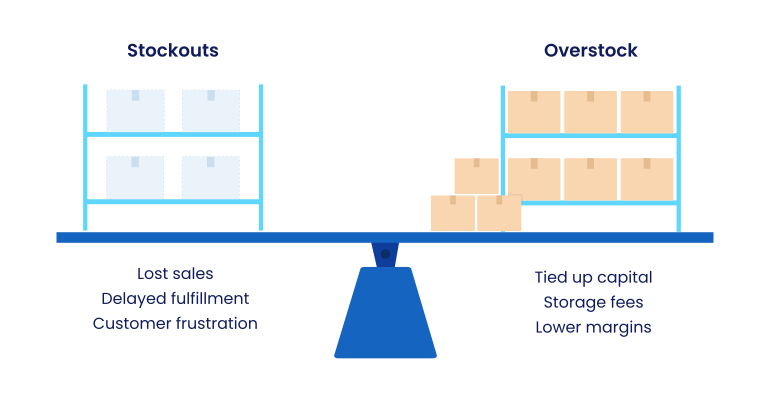
Better demand predictions prevent both stockouts and excess inventory. Use historical purchasing data and market intelligence to forecast needs more accurately. This reduces emergency purchases (which always cost more) and prevents capital from being tied up in unnecessary inventory.
PO collaboration is another tool in your arsenal. It gives procurement teams and suppliers real-time visibility into order status and changes. Suppliers can confirm quantities and timelines within one place (typically a supplier portal), helping companies align inventory planning with actual supply availability. This transparency reduces stockouts and overstocking.
Work with fewer, stronger suppliers instead of spreading purchases across many vendors. Consolidation increases your buying power with remaining suppliers and reduces administrative overhead. The key is maintaining competition while achieving economies of scale.
Treat similar purchases as strategic categories rather than individual transactions. Develop category-specific sourcing strategies that consider market conditions, supplier capabilities, and internal requirements.
AI-powered category management tools can guide strategy creation through structured analysis, helping teams move beyond tactical execution to strategic thinking. These systems analyze spend patterns, market intelligence, and supplier relationships to create actionable strategies that align with business priorities like sustainability and risk mitigation. This systematic approach often reveals savings opportunities that get missed in ad hoc purchasing while ensuring strategies translate into measurable initiatives with clear owners and timelines.
These comprehensive strategies require significant investment and 12 to 18 months to implement, but they accelerate procurement cost savings performance.
Moving from manual, paper-based processes to an integrated digital platform delivers compound benefits. Procurement orchestration connects intake, approvals, supplier management, and payments into unified workflows. Organizations are seeing significant improvements in spend visibility and process automation through modern procurement platforms, with streamlined workflows reducing manual effort and improving compliance.
Artificial intelligence transforms how procurement teams analyze spending patterns and predict future needs. According to McKinsey research, advanced analytics platforms can reduce the time required to evaluate tenders by two-thirds, enabling faster and more data-driven supplier decisions. AI in procurement capabilities include automated spend classification, supplier risk monitoring, and predictive demand forecasting.
Implement comprehensive supplier risk monitoring that goes beyond financial stability. Track geopolitical risks, ESG compliance, and operational disruptions in real-time. The cost of supplier disruptions far exceeds the investment in risk monitoring tools, making this a critical area for long-term savings.
Expand your supplier base geographically to access lower-cost markets while maintaining quality standards. This requires careful planning around logistics, quality control, and cultural differences, but can deliver significant unit cost reductions for the right categories.
Automate contract creation, approval, and monitoring processes to ensure you never miss renewal opportunities or fail to capture negotiated terms. Advanced contract management systems can alert you to upcoming renewals, track compliance with agreed terms, and identify opportunities for consolidation or renegotiation.
Technology isn’t just an enabler; it’s often the difference between procurement teams that hit their savings targets and those that don’t. According to Coupa's annual Strategic CFO Report, 100% of finance leaders say they're currently using AI to cut costs and increase productivity across different business areas.
For procurement software to work effectively, your data needs to be integrated across all processes. Single-platform solutions enable you to see spending in one consolidated view, while AI analyzes patterns and spending trends to surface cost-saving opportunities.
High-performing companies save 8.1% of their overall spend by integrating workflows to make compliance easier. When employees can quickly find approved suppliers and negotiate pricing through guided buying, rogue spending drops naturally.
Modern procurement software facilitates stronger, more strategic supplier relationships through better communication tools. Suppliers can confirm purchase orders, update delivery information, and share forecasting summaries from centralized portals. Top-performing organizations achieve e-invoicing levels of 86.2%, reducing administrative burden while streamlining operations and providing early alerts to potential disruptions before they impact your business.
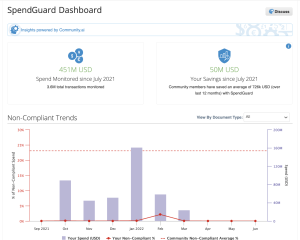
Advanced fraud detection is another critical capability. According to Deloitte's survey of CPOs, 92% are planning and assessing AI capabilities, with organizations seeing promising early returns despite implementation challenges. Coupa’s SpendGuard™ technology reviews each transaction for accuracy and flags potential fraudulent activity across 25 different risk areas. Given that procurement fraud can cost organizations millions annually, automated monitoring pays for itself quickly.
The integration between procurement and financial systems ensures that savings actually hit the bottom line rather than getting lost in budget transfers or scope changes. When procurement, finance, and operations teams work from the same data, there’s nowhere for savings to hide.
Transform your procurement cost savings with comprehensive visibility and control across your entire spend ecosystem. The right combination of strategy, process improvement, and technology turns procurement from a cost center into a profit driver, exactly where it should be when margins matter most.
Oh! It looks like you opted out from using the needed cookies. If you are interested in using the AI Agent, then please opt-in to the cookies in the preference center.
Update preferences