Volatile news. Stable spend.
Read the latest in the Coupa Business Spend Index™ Quarterly Update.
Get the Report





The market winced. Business spend held firm.
The Coupa Business Spend Index™ Quarterly Update

The 2026 Q3 Coupa Business Spend Index™ (BSI) reports that four of the five sectors it tracks held steady or grew through six months of tariff whiplash, an oil shock and a 13.2% Nasdaq correction. Healthcare & Life Sciences committed 2.8% less. GDP grew in both quarters.
Six months of macro shocks gave every finance team a reason to freeze spending. But most didn't and some sectors even grew. But Healthcare & Life Sciences went the other way.
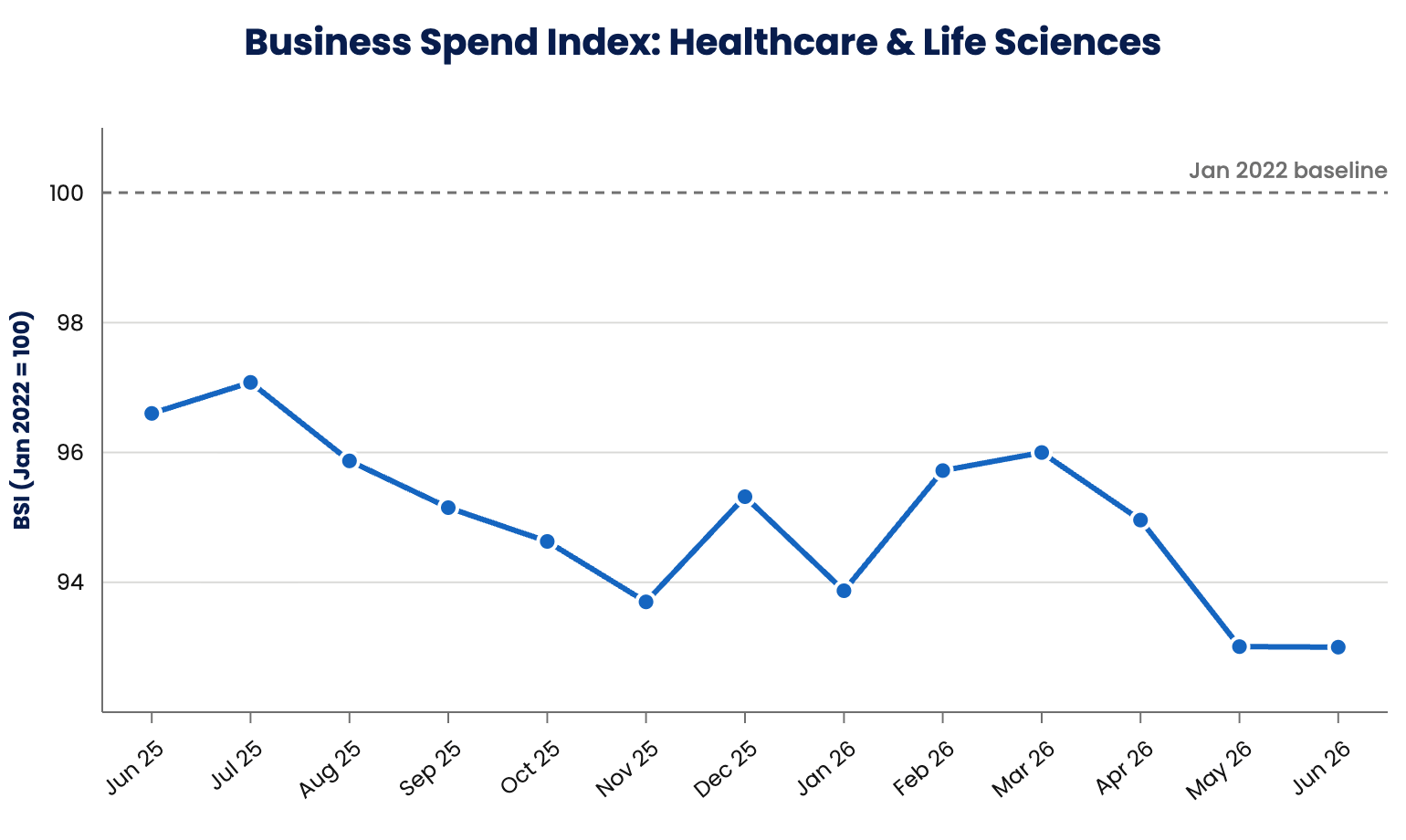
Healthcare & Life Sciences spending commitments fell 2.8% from February to June 2026, with the decline concentrated in April and May and staying flat in June. Over those same months, GDP grew 2.1% in the first quarter and 1.5% in the second, according to the Bureau of Economic Analysis, and the ISM index stayed in expansion every month.
One sector out of five moved against the economy. The divergence came as healthcare organizations faced rising operating costs, changes in coverage and uncertainty over federal research funding.
Healthcare buyers faced a different set of pressures from those affecting the other sectors. Hospitals were contending with thin margins and rising costs. According to the American Hospital Association, hospital supply expenses rose 9.9% in 2025 and drug expenses rose 13.6%. Changes in insurance coverage added uncertainty about future revenue, while research organizations faced questions about the pace of federal grant funding.
Healthcare’s funding pressures also reach purchasing decisions differently from a change in import costs. A hospital may defer an equipment purchase when its revenue outlook tightens. A research organization may wait to commit to a project until funding is secure. Against that backdrop, Healthcare & Life Sciences was the one sector in Coupa’s index where spending commitments declined.
Several decisions affecting healthcare budgets remain open. CMS’s proposed 2027 Medicare Physician Fee Schedule has not been finalized. The Provider Reimbursement Stability Act of 2026, a separate bill concerning physician payments, has cleared a House committee but has not become law. NIH’s fiscal 2026 funding notice confirms funding for the year, but does not establish when individual awards will be made.
What we can watch is the shape of the line. Healthcare & Life Sciences spending commitments fell from February to May 2026 and held at that lower level in June. By May, the sector had reached its lowest reading in the period shown on the chart below — June 2025 to June 2026.
The June stagnation is either a floor or a pause before the next leg down. Insurance renewal season runs through the back half of this year, which is when a large share of contracted commitments actually reprice, so that is where the flat reading gets tested. The Q4 edition of the Business Spend Index will give us the first read on whether it held.
Most economic data is a rearview mirror. GDP is a government estimate, published after the quarter closes and revised for months afterward. The ISM index asks purchasing managers what they expect to do.
The Coupa Spend Lab Business Spend Index works from a different input. It is built from purchase orders approved, contracts signed, and renewals executed by thousands of businesses on Coupa's platform, captured at the moment the commitment is made rather than months later in a filing or a survey response. Every data point is money a company has already decided to spend. That makes the BSI a measure of decisions rather than opinions, and it comes from a dataset only Coupa holds, because no other company sits inside the procurement workflow of this many businesses at once.
It also means the index is hard to move. Companies keep paying on multiyear contracts while their outlook sours, because exiting costs more than continuing. Spend divides into two layers that travel at different speeds. Contracted spend is slow. Discretionary spend, the deferrable purchases and services, is the fast channel where distress shows up first. So if a sector's line falls for six straight months, something concrete broke.
The Coupa Business Spend Index is built from purchase orders, signed contracts, and renewals committed by thousands of businesses using Coupa's platform, captured the moment each commitment is made. It tracks five U.S. sectors: High Technology, Manufacturing, Business Services, Healthcare & Life Sciences, and Financial Services. Findings are aggregated and reported at sector level. No individual company, supplier, or transaction is identified.
Coupa Spend Lab is the research and intelligence arm of Coupa, focused on generating strategic insight from aggregate patterns across one of the world’s largest repositories of business spend
data. The lab applies data science, predictive modeling, and AI to transform anonymized, community-level procurement signals into decision-grade intelligence. The lab produces benchmarks, indices, and analytical frameworks that help organizations understand and optimize how they spend.
Oh! It looks like you opted out from using the needed cookies. If you are interested in using the AI Agent, then please opt-in to the cookies in the preference center.
Update preferences