Volatile news. Stable spend.
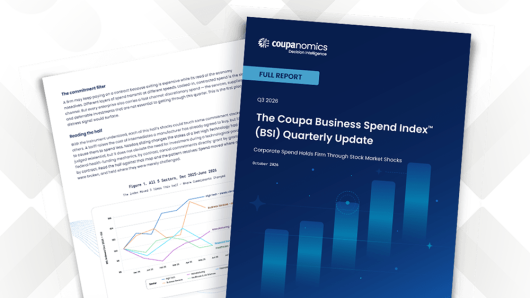
Read the latest in the Coupa Business Spend Index™ Quarterly Update.
Get the Report





The market winced. Business spend held firm.
The Coupa Business Spend Index™ Quarterly Update

Between Oct. 29, 2025, and March 30, 2026, the Nasdaq fell 13.2%. But the stock market dip was not reflected in corporate technology spend. In fact, business spend climbed during the same period and, soon after, the Nasdaq rose again. A new business spend indicator captured the widening gap between changing investor sentiment and the technology commitments companies were actually making.
In early 2026, investors were reassessing AI valuations, questioning the path to returns, and asking whether years of extraordinary investment had pushed the market too far, too fast.
But, inside of businesses, corporate technology spend continued to rise despite that uncertainty.
The Coupa Business Spend Index™ is a new economic indicator built from committed spend data on the Coupa platform. The High Technology component of the BSI (composed of technology companies like Oracle, Nvidia, etc.) reached new spending highs in five of the first six months of 2026. By June, it stood 6.5% above its December level.
The Nasdaq recovered its previous peak on April 15 and continued climbing, reaching another record closing high on June 2.
That creates a live question for investors: Did corporate spending correctly look through a temporary stock market correction and predict further growth, or were business budgets simply locked in and unable to adjust to the market’s concerns?
Markets and corporate budgets respond to change on different timelines.
Stock prices can adjust within seconds to a new forecast, earnings report, or rumor. Business spending is built around purchase orders, contracts, renewals, and implementation programs. These decisions represent commitments that companies have made.
That relative slowness is not necessarily a weakness as an economic signal. It can reveal whether changing sentiment has started to affect behavior inside businesses.
The BSI analyzes committed spend transactions from Coupa customers, offering a complement to government reports and executive surveys. Coupa Spend Lab found that the underlying spend data exhibited leading signals relative to economic indicators, including FRED series, ISM PMI, and real GDP. Specifically, in early 2026, the ISM Manufacturing Purchasing Managers' Index (PMI), suddenly jumped into growth mode after nearly a year of decline. But the BSI had registered that same spike nearly three months earlier.
Through the first half of 2026, doubts about the AI investment cycle were clearly visible in the stock market. They were not yet visible in the overall direction of High Technology spending inside of businesses.
Businesses may have felt they had no choice but to stay committed to AI spending.
Gartner repeatedly raised its 2026 worldwide IT spending forecast, eventually projecting 14.2% growth and $6.37 trillion in spending.
The BSI gives investors a new way to monitor what might happen next.
The absolute level of High Technology spending will matter, but so will its trajectory. Continued growth would suggest that businesses remain committed to the technology investment cycle. Slower growth could signal greater selectivity. A decline around renewal periods could indicate that concerns about AI returns are beginning to change corporate behavior.
Future data may also reveal whether technology investment is spreading more broadly across the economy or remaining concentrated among technology companies and the largest AI infrastructure providers.
The BSI should not replace market data, earnings, or management guidance. But it can add something those signals do not provide: a view of the spending commitments being made inside of businesses.
In 2026, the Nasdaq showed how quickly investors’ expectations could change, but the High Technology BSI showed that business spending did not necessarily change with them, and the Nasdaq eventually recovered and reached new highs.
Not definitive proof of predictive powers, but a sign that the BSI will remain worth watching.
Oh! It looks like you opted out from using the needed cookies. If you are interested in using the AI Agent, then please opt-in to the cookies in the preference center.
Update preferences