Volatile news. Stable spend.
Read the latest in the Coupa Business Spend Index™ Quarterly Update.
Get the Report





The market winced. Business spend held firm.
The Coupa Business Spend Index™ Quarterly Update

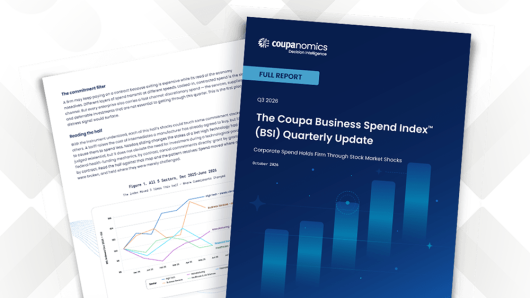
Coupa's Q3 2026 Coupa Business Spend Index™ (BSI) shows Manufacturing spending commitments held above their entire 2024-to-mid-2025 range through the first half of 2026. February was this year's weakest month at an index reading of 156.5, and it still came in above the 152.5 peak of the prior 18 months, even as U.S. tariff rules changed.
Tariff uncertainty gave manufacturers plenty of reasons to reconsider their purchasing plans in the first half of 2026. Yet across Coupa’s network of 3,400 global customers, manufacturing spending commitments remained above the sector’s 2024-to-mid-2025 range in every month from January through June.
The rules kept changing while that happened. A 10% import surcharge under Section 122 took effect Feb. 24 and was still being collected through June, though its legal footing did not hold: On May 7 the Court of International Trade ruled 2-1 that it exceeded the President's statutory authority, and collection continued only because the Federal Circuit issued an administrative stay five days later. After this report's window closed, the surcharge ran out its statutory 150 days, expired July 24, and Section 301 duties of 10% to 12.5% took over.
None of it reached the commitments. Manufacturing's purchasing surge came in late 2025, months before the first of those changes took effect, and our 2026 annual BSI edition read that surge as restructuring: reshoring, dual-sourcing, network redesign, and automation.
The reason it held cuts against intuition. A tariff raises the cost of goods a manufacturer already agreed to buy. It does not make that manufacturer buy less. The commitment was made upstream of the policy, and what changes is the price on the invoice.
Factory construction is rolling off its 2024 peak, with Census Bureau figures putting manufacturing construction down 20% year over year in May, while core capital-goods orders rose 9.3% in the first six months of 2026 compared with the same period in 2025.
Read together, that is a handoff. The buildings are being completed and the equipment is going in. Independent analysis of the same period finds the macro data does not yet support a reshoring boom, with the fastest construction growth going to data centers, so this looks like a build-out that already happened now being equipped.
The full-expensing provisions in the One Big Beautiful Bill Act may have pulled a longer investment pipeline forward into 2025 and 2026 rather than creating new demand, which would explain the timing of the surge better than its durability.
Spending plans in the current pipeline were largely formed under two assumptions. Full expensing made equipment cheaper to buy now than later. And the cost of money was expected to fall: rates held at 3.50% to 3.75% through January, March and June, and the Fed's March projections showed a median of one more cut in 2026.
The second assumption reversed this month. The Federal Reserve raised rates a quarter point on Sept. 16, its first increase since 2023, taking the target range to 3.75-4%. Sixteen of the 19 FOMC members expect at least one more increase this year.
New project starts are thinning as the incentive-era megaprojects complete. If the equipment acceleration now showing up is the tail of those projects, growth could erode through 2027.
Orders already committed are unlikely to be pulled, because exiting costs more than completing. The question is the next round.
Committed spend travels in layers at different speeds. Multiyear contracts are slow. Deferrable purchases are the fast channel, and the first place a change in appetite shows up.
That difference is also what separates this index from the measures alongside it. A purchase order exists the moment a company decides something. A sentiment index exists when someone answers a questionnaire about what they expect to do. An official estimate exists after the quarter closes, and then gets revised for months. In our 2026 annual BSI report, the Manufacturing index registered a major economic turning point three months before the ISM PMI recorded it.
So the Q4 BSI is where we expect to see it. Renewal season runs through the back half of this year, which is when contracted commitments reprice. ISM manufacturing expanded in all six realized months of this window, from 52.6 in January to 53.3 in June, and its next reading lands Oct. 1.
The Coupa Business Spend Index is built from purchase orders, signed contracts, and renewals committed by thousands of businesses using Coupa's platform, captured the moment each commitment is made. It tracks five U.S. sectors: High Technology, Manufacturing, Business Services, Healthcare & Life Sciences, and Financial Services. Findings are aggregated and reported at sector level. No individual company, supplier, or transaction is identified.
Coupa Spend Lab is the research and intelligence arm of Coupa, focused on generating strategic insight from aggregate patterns across one of the world’s largest repositories of business spend
data. The lab applies data science, predictive modeling, and AI to transform anonymized, community-level procurement signals into decision-grade intelligence. The lab produces benchmarks, indices, and analytical frameworks that help organizations understand and optimize how they spend.
Oh! It looks like you opted out from using the needed cookies. If you are interested in using the AI Agent, then please opt-in to the cookies in the preference center.
Update preferences