Volatile news. Stable spend.
Read the latest in the Coupa Business Spend Index™ Quarterly Update.
Get the Report





The market winced. Business spend held firm.
The Coupa Business Spend Index™ Quarterly Update

In many organizations, procurement still struggles to gain credibility with senior leadership and earn a true seat at the table. But the problem may have little to do with execution; instead it comes down to alignment. Too often, conversations about “value” start and end with cost savings targets. As a result, procurement strategies may miss the broader context of what the business actually needs to achieve.
That’s where the RAQSCI framework comes in. In order to create actionable category plans that drive real business outcomes, procurement teams must learn how to capture, prioritize, balance, and validate business requirements across multiple dimensions that go beyond just cost.
Coupa’s guided approach to category strategy follows a structured, four-phase process:
RAQSCI is an integral part of Phase 1: Internal analysis, where procurement teams establish a clear, shared understanding of organizational requirements. In our related blog, we explored how smart category strategies are built on a thorough analysis of the organization’s operating environment, strategic objectives, and stakeholder needs. RAQSCI is core to that foundation, offering a practical way to capture and organize what the business needs from the supply market.
The challenge, of course, is balance. Business priorities don’t always align neatly. The lowest cost, the highest quality, the most sustainable option, and the most reliable supplier don’t always coexist. RAQSCI provides a proven way for category leaders to navigate these tensions and design sourcing approaches that reflect reality — not wishful thinking.
RAQSCI is a structured framework for identifying and organizing a company’s expectations for both its procurement team and its suppliers. Each dimension represents a distinct lens through which stakeholders define “success” for a category:
One of the most important — and often overlooked — aspects of RAQSCI is sequence. The framework is designed to be applied step by step, like climbing a staircase. Each dimension should be explored and understood before moving on to the next. Skipping steps can distort priorities and undermine downstream decisions.
This structured progression helps procurement teams engage stakeholders more consistently and avoid overlooking critical requirements.
As the role of procurement has expanded, so too have the expectations placed on suppliers and category leaders. Regulatory pressure, societal change, and increased focus on ESG (environmental, social, and governance) outcomes all wield significant influence on the definition of “value.”
To reflect this shift, Coupa’s approach to category strategy expands the traditional RAQSCI framework by incorporating three additional dimensions — transforming RAQSCI to GRAQSCIED:
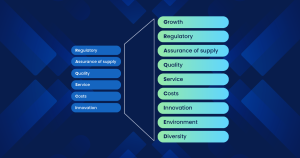
These dimensions are no longer optional or “nice to have.” For many organizations, they directly influence supplier selection, partnership decisions, and long-term category direction. GRAQSCIED reflects the reality that modern category strategies must support both commercial performance and corporate values.
Getting value out of RAQSCI and GRAQSCIED requires more than just collecting information. Effective category leaders go beyond documentation to interpret, challenge, validate, and prioritize those data points.
Not all business requirements carry equal weight. Category managers must work with stakeholders to:
This is where many teams struggle. Cost considerations often dominate the conversation simply because they’re easier to measure. The result is a category plan that looks good on paper but lacks strategic relevance.
When procurement focuses on savings alone, it reinforces the perception that the function is purely tactical. Building a category strategy that reflects the full spectrum of business priorities positions procurement as a strategic partner.
As business environments grow more complex, procurement teams need structure, consistency, and shared language to navigate competing priorities. RAQSCI and GRAQSCIED provide that foundation — enabling more meaningful stakeholder conversations and clearer alignment between business objectives and category-level decisions.
Coupa Category Strategy is designed to help procurement align their approach with key business objectives. Using a proven methodology to guide every decision, this AI-native technology makes category insights actionable by putting business requirements at the core of strategy development. The result? Actionable category strategies that maximize value — not just cost savings.
This post is a companion piece to our four-part blog series on building smart category strategies, which starts with internal analysis. For an overview of category strategy development, download our e-book, 4-Step Roadmap to Building an Effective Category Strategy.
Oh! It looks like you opted out from using the needed cookies. If you are interested in using the AI Agent, then please opt-in to the cookies in the preference center.
Update preferences