Volatile news. Stable spend.
Read the latest in the Coupa Business Spend Index™ Quarterly Update.
Get the Report





The market winced. Business spend held firm.
The Coupa Business Spend Index™ Quarterly Update

This post is the first in a four-part series designed to help procurement leaders master the art and science of category management.
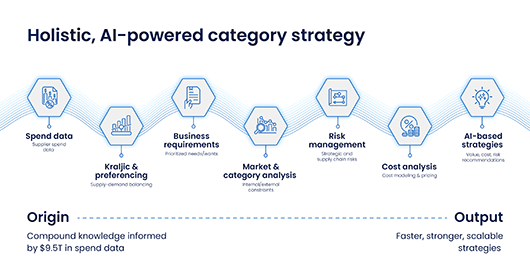
Category strategy transforms fragmented procurement spending into a coordinated plan for delivering total business value and moving beyond simple cost savings to long-term impact.
But developing an effective category strategy doesn’t happen all at once. It unfolds over a series of clearly defined phases, designed to help procurement teams make confident, informed decisions.
At a high level, category strategy development follows four interconnected phases:
This blog post focuses on Phase 1: Internal Analysis. Before looking outward at suppliers and market dynamics, it’s essential to turn inward and get a clear picture of what your business actually needs. This first phase sets the direction for everything that follows — and lays the foundation for a mature, data-driven approach to category management. In future posts, we’ll dive into the subsequent three phases to provide a complete roadmap for your category journey.
In Coupa’s guided approach to category strategy, Phase 1 focuses on internal analysis — because each ensuing step depends on a clear understanding of business requirements. This phase helps procurement teams take stock of internal demand, strategic objectives, and operational realities in an intentional way. The result is a clear baseline that informs external market analysis (Phase 2) and, ultimately, strategic category decisions (Phase 3).
These internal insights are critical. When business needs are misunderstood — or only partially captured — any subsequent analysis is built on shaky assumptions. That disconnect can lead to strategies that look good on paper but fail to deliver value or manage risk effectively. Starting with a thorough internal analysis ensures the entire strategy development process is business-led and outcome-focused.
A thoughtful internal analysis requires more than just gathering data. It demands structure, prioritization, and collaboration. Here are five practical steps designed to ensure that no critical information is missed.
The first step is deciding exactly what the strategy will — and will not — cover. Scope is defined by the products, services, or commodity codes that will be included, along with the relevant geographic region or business units. Being explicit about what is “in scope” automatically defines what is “out of scope” — which helps to prevent unnecessary complexity and establishes boundaries for data collection.
A well-defined scope also sets clear expectations for all impacted teams. This clarity matters because business needs and market conditions can vary significantly by country, region, or business unit.
With the scope established, the next step is understanding how money has been spent in the past. Spend data can be viewed by region, business unit, supplier, transaction value, frequency, or other relevant filters. Mature organizations leverage AI and automated taxonomy to normalize spend data, ensuring they aren’t making strategic decisions based on unreliable inputs.
This analysis highlights where spend is concentrated, uncovers potential inefficiencies or risks, and helps to identify opportunities the strategy should address. It also reveals which stakeholders have a vested interest in each category — information that’s essential for later steps in the internal analysis.
Armed with insights on past spending, it becomes easier to identify key stakeholders for each category. It’s important to clearly understand not only who the relevant stakeholders are, but also how much influence they have over procurement decisions and how they’re impacted by those decisions. Stakeholder mapping helps to clarify levels of influence and interest, often using a simple 2x2 matrix to determine how closely they should be involved.
Because many teams are not accustomed to structured strategy development, it may be valuable to secure a senior sponsor from outside the procurement team. Ideally, this sponsor would come from the functional area most involved with the category.
Effective category decisions are rarely made in isolation. Building a cross-functional team of relevant stakeholders ensures a holistic view of the category, including technical requirements, commercial considerations, and operational constraints. This collaborative approach is a hallmark of high-maturity procurement organizations, evolving the function from a transactional checkpoint into a primary driver of integrated business value".
Depending on the category, this team may include representatives from sales, marketing, operations, legal, finance, R&D, or other functions. Broad representation ensures a variety of perspectives, increases credibility, and improves the quality of final outcomes. For global categories, including participants from key markets is also important.
The final requirement-gathering step is translating inputs into clearly defined and prioritized business requirements. Category strategies aim to align internal expectations with what the external market can realistically deliver — and that alignment starts here.
Frameworks such as RAQSCI (and the enhanced GRAQSCIED) provide a structured way to capture requirements across multiple dimensions. Requirements should be weighted and clearly distinguished between needs (non-negotiable) and wants (nice-to-have). Because different parts of the business may have different priorities, this step also helps to create alignment, surface trade-offs, and build a shared understanding that can guide nuanced decisions.
Coupa Category Strategy empowers your team to build holistic, value-driven category strategies that deliver real business impact. A proven methodology guides every decision to ensure that category insights are actionable — maximizing value, not just cost savings.
This post is the first in a four-part series on category strategy development. Next up in Part 2, we’ll turn outward to examine supply markets, risks, and opportunities that shape strategic options. Get started with a 4-Step Roadmap to Building an Effective Category Strategy.
Oh! It looks like you opted out from using the needed cookies. If you are interested in using the AI Agent, then please opt-in to the cookies in the preference center.
Update preferences