Volatile news. Stable spend.
Read the latest in the Coupa Business Spend Index™ Quarterly Update.
Get the Report





The market winced. Business spend held firm.
The Coupa Business Spend Index™ Quarterly Update

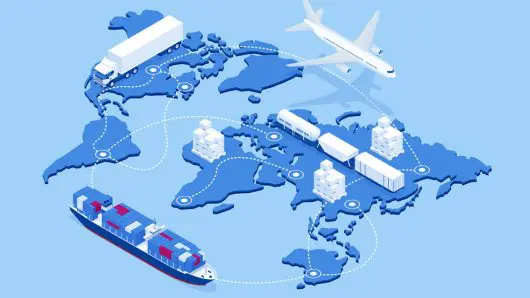
A Gartner survey of more than 500 supply chain leaders found that only 19% of organizations fully integrate scenario planning into their supply chain strategies. The problem isn't a lack of data, but a lack of actionable visibility. Supply chain visibility has become a strategic imperative, but most companies are still catching up.
From sourcing raw materials to delivering finished goods, companies that can see every location of their supply chain are better equipped to anticipate disruptions, optimize costs, and satisfy customers by solving issues before they impact the bottom line. This article explains what supply chain visibility means, what it encompasses, and how to achieve it.
Supply chain visibility is the ability of organizations to track, monitor, and access real-time or near-real-time data on the movement of goods, materials, information, and finances throughout the supply chain. It spans from raw-material suppliers to end customers. In practice, it means having an accurate and current picture of what is happening at every stage so that decision-makers can respond quickly and intelligently.
It is worth distinguishing supply chain visibility from several related concepts that are often used interchangeably but carry distinct meanings.
Supply chain visibility is not a single technology or capability. It is made up of several distinct components, each addressing a different layer of the supply chain.
| Supply chain visibility component | What it covers | Example |
| Supplier visibility | Real-time insight into supplier capacity, lead times, performance, and financial health | A manufacturer monitors a Tier 1 supplier’s production schedule and receives an alert when output falls below agreed thresholds, allowing early re-sourcing. |
| Inventory visibility | Accurate, real-time view of stock levels across all locations — warehouses, distribution centers, in-transit, and in-store | A retailer uses a centralized inventory platform to see safety stock levels at each distribution center and automatically triggers replenishment orders. |
| Shipment & transportation visibility | End-to-end tracking of shipments across all modes — road, ocean, air, and rail | A logistics manager tracks a sea freight container in real time and proactively notifies customers of a 48-hour delay caused by port congestion. |
| Demand visibility | Insight into current and future customer demand patterns, including seasonal shifts and promotional lifts | A consumer goods company uses AI-powered demand modeling to anticipate a 30% spike in demand ahead of a promotion and pre-positions inventory accordingly. |
| Production visibility | Real-time data on factory output, machine utilization, and work-in-progress status | A semiconductor manufacturer integrates machine-level sponsor data to flag capacity bottlenecks before they affect downstream delivery commitments. |
| Financial visibility | Clarity on supply chain costs, including cost-to-serve, landed costs, and tariff impacts, across all tiers | A procurement team uses cost-to-serve analysis to understand profitability by customer segment and renegotiate freight contracts that erode margins. |
| Sustainability visibility | Tracking of carbon emissions, energy use, and ESG compliance across Scope 1, 2, and 3 | A global manufacturer tracks transportation-related Scope 3 emissions and models alternative routing scenarios to reduce its carbon footprint by 15%. |
When organizations gain a clear view across their supply chains, the benefits extend well beyond operational efficiency. Supply chain visibility creates value across multiple strategic dimensions.
Leaders who can see real-time data across their supply chain can make faster, evidence-based decisions rather than relying on intuition. This shift — from guesswork to data-driven action — compounds over time into a meaningful competitive advantage.
Customer satisfaction is directly tied to delivery reliability. Visibility enables companies to provide accurate order status updates and catch potential delays before they reach the customer. Meeting On-Time In-Full (OTIF) performance targets consistently is one of the clearest differentiators between supply chain leaders and laggards.
By integrating inventory management visibility with demand signals, companies can right-size their stock. The result is fewer days of inventory on hand and more working capital freed up for strategic reinvestment. Transportation visibility also contributes by enabling shipment consolidation, eliminating empty miles, and selecting optimal routing modes that reduce logistics spend.
Supply chain resilience depends on knowing where vulnerabilities exist before disruptions occur. With end-to-end visibility, companies can model the impact of potential disruptions — a supplier failure, a port closure, a sudden demand surge — and have contingency plans ready before a crisis hits.
When buyers and suppliers share visibility into orders, forecasts, and capacity, collaboration improves naturally. Supplier reliability increases when expectations are clear, and data flows openly between parties. Additionally, tracing individual batches or products through the supply chain becomes far more feasible when visibility infrastructure spans multiple tiers of the supplier network.
Achieving sustainability goals requires visibility into emissions, energy consumption, and supplier practices. Organizations that can see their Scope 1, 2, and 3 emissions in real time can set meaningful reduction targets and track progress against them. What’s more, they can make data-driven trade-offs between cost and carbon impact, something that is impossible without integrated financial and sustainability visibility.
Most companies are aware that visibility matters. Fewer recognize the full cost of the gaps they are living with. Poor supply chain visibility shows up in several recurring and costly ways.
When transportation teams cannot see where shipments are in real time, delays go undetected until they cause downstream damage. A container sitting idle at a port for several days may not surface until a production line goes short. By then, the cost of expediting and the strain on customer relationships are already locked in.
Without a unified view of inventory, companies routinely overstock in some locations while running short in others. Finance leaders often discover that working capital is tied up in excess inventory in one region, while stockouts are costing revenue in others. Effective inventory management requires accurate, real-time inventory positioning data, not periodic cycle counts.
Companies that lack visibility beyond Tier 1 suppliers are often caught off guard by disruptions originating further down the supply chain. A shortage of a critical component at a Tier 3 supplier can halt production before procurement teams even realize there is a problem.
Shifting tariff policies can dramatically affect landed costs. Companies without financial and trade visibility often discover tariff exposure only after costs have already compounded through multiple stages of production. This layered tariff risk is particularly difficult to manage without sophisticated modeling tools that can analyze the full impact from raw materials through to finished goods.
Supply chain visibility is not binary. Companies do not simply have it or lack it. They exist on a spectrum. Understanding where your company sits on that spectrum is the starting point for building a meaningful improvement roadmap.
A useful framework for thinking about supply chain visibility maturity is through four progressive stages.
| Maturity Stage | Characteristics | Common Pain Points |
| Stage 1: Reactive |
|
|
| Stage 2: Aware |
|
|
| Stage 3: Proactive |
|
|
| Stage 4: Predictive/Adaptive |
|
|
To assess where your organization sits, consider applying supply chain analytics examples as diagnostic tools. A structured assessment might evaluate the following questions:
Improving supply chain visibility is a multi-stage journey that requires both the right technology and the right organizational approach. The following steps provide a practical framework:
Visibility begins with data. The first step is consolidating data from disparate systems — enterprise resource planning (ERP), warehouse management system (WMS), transportation management system (TMS), and supplier portals — into a single, integrated platform. Cloud-native supply chain optimization platforms automate data collection and preparation, reducing the time-consuming manual work required to assemble usable datasets.
You cannot make visible what you have not mapped. Organizations should build a comprehensive map of their supply chain, including Tier 1, Tier 2, suppliers, and, where possible, Tier 3. Beyond the supplier network, the map should capture manufacturing sites, distribution centers, transportation lanes, and customer fulfillment points.
Once data is unified and the supply chain is mapped, the next step is establishing real-time monitoring with intelligent alerting. Rather than having teams manually check dashboards, modern platforms automatically surface exceptions. A shipment deviating from its expected route, inventory falling below safety stock thresholds, or a supplier’s on-time delivery rate deteriorating.
Many supply chain visibility gaps originate on the demand side. Integrating demand signals into supply chain planning, including historical sales data, market intelligence, and external factors like weather and macroeconomic trends, significantly improves forecast accuracy.
The most advanced form of supply chain visibility is the ability to model alternative scenarios and test decisions before committing to them. A digital twin of your supply chain allows teams to run what-if analyses quickly. What happens if we lose our primary supplier in Southeast Asia? What is the cost and service impact of shifting a major land from air to ocean freight? How do proposed tariff changes affect total landed costs across product categories? Getting ahead of these questions — before a decision is forced — is what separates reactive supply chains from resilient ones.
While the core principles of supply chain visibility apply across sectors, the specific focus areas and regulatory requirements differ significantly by industry.
| Industry | Primary Visibility Focus | Key Drivers |
| Pharmaceutical & Life Sciences |
|
|
| Food & Beverage |
|
|
| Automotive |
|
|
| Consumer Electronics |
|
|
| Retail & E-Commerce |
|
|
| Aerospace & Defense |
|
|
| Industrial Manufacturing |
|
|
The following case studies illustrate how leading organizations have leveraged supply chain optimization capabilities to improve visibility and drive measurable outcomes.
Onsemi, a global semiconductor company with over 60 years of experience, faced a significant visibility challenge. Low data visibility across its global manufacturing sites was creating an inefficient and fragmented planning process across four business units. Site-level engineers were involved in every supply chain modeling exercise, making the process slow and resource-intensive. Sales teams lacked the information they needed to make confident decisions about which orders to accept or subcontract.
Onsemi implemented Coupa’s Supply Chain Optimization platform alongside Procure-to-Pay, integrating machine- and tool-level constraint data from all 25 global factories into a single platform. APIs within Coupa now automatically pull data into a reporting repository, dramatically reducing the burden on site-level engineers.
The results were significant. Decision-making became 85% faster. Capital efficiency improved by 10-15%. The sales and operations planning process became standardized and scalable across the organization.
“Coupa has allowed us to achieve the business model we were looking for, where the industrial engineers don’t have to be involved.”
— Paul Stickel, former Global Supply Chain Industrial Engineer, onsemi
Nestlé USA needed to build a more efficient and resilient supply chain rooted in real-time data. The challenge was multidimensional. Managing uncertainty while navigating unplanned disruptions required a fundamentally different approach. Evaluating complex trade-offs across departments required a shared, data-driven view that the organization lacked.
Nestlé’s solution centered on expanding the use of Coupa’s analytics capabilities to support cloud-based planning and cross-departmental decision-making. By building an analytics team within Coupa and grounding supply chain decisions in concrete data, Nestlé created a holistic picture of where products should be positioned at any given time.
“Coupa helps us change the way we do supply chain planning. With Coupa, we have successfully expanded our solution space and our user base.”
— Robert Wang, Principal Supply Chain Optimization, Nestlé USA
Odyssey Logistics, a global logistics provider with $3 billion in spend under management, needed to answer a fundamental visibility question for its customers: Were their distribution sites in the right locations to meet end-user demand? Without a way to model and optimize transportation and inventory simultaneously across customer networks, Odyssey was unable to provide the data-backed answers its clients needed, particularly as capacity shortages and rising freight costs intensified the pressure.
By implementing Coupa’s Supply Chain Optimization platform, Odyssey gained the ability to efficiently solve for network optimization, inventory analysis, and transportation optimization. This enabled rapid, agile supply chain studies rather than slow, resource-intensive modeling projects.
The results were substantial. The platform identified and helped implement more than $90 million in actionable savings for a single customer. Beyond the financial impact, the work contributed to reducing CO2 emissions by 459 million kilograms per year.
“Supply chains are changing faster than ever. Coupa now allows us to conduct quick, agile studies.”
— Bob Boyle, Vice President, Odyssey Enterprise Managed Services
There are many supply chain visibility solutions available today. Some are point solutions focused on specific capabilities, such as shipment track-and-trace or supplier risk monitoring. Others are comprehensive platforms that integrate visibility, analytics, scenario modeling, and AI-driven decision support across the full supply chain. The right choice depends on the scope of your visibility gaps and the level of analytical sophistication your company needs.
The following capabilities distinguish comprehensive platforms from more limited point solutions.
The ability to model the end-to-end supply chain network and evaluate how structural changes affect cost, service, and risk. Strong network optimization capabilities include cost-to-serve analysis, flow optimization, and sustainability modeling. Leading platforms use AI and machine learning to surface prescriptive recommendations and highlight the most impactful scenarios, delivering answers significantly faster than traditional modeling approaches.

Given the volatility of global trade policy, the ability to model tariff impacts has become an essential component of supply chain visibility. Advanced platforms enable organizations to evaluate tariff-optimization strategies and identify duty drawback opportunities. This type of financial visibility is critical for protecting margins in rapidly shifting trade environments.
The ability to determine the most efficient routing, mode selection, and carrier allocation decisions across the transportation network. This spans inbound and outbound optimization, scheduling and backhaul optimization, and fleet sizing. On average, Coupa’s Transportation Optimization customers reduce transportation costs by approximately 9% while achieving a 12% improvement in service levels.
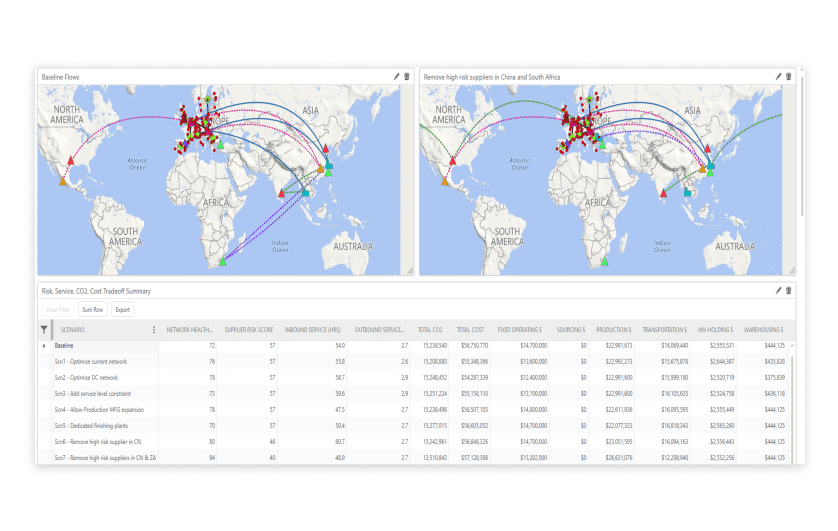
The ability to generate accurate long-term demand forecasts that account for complex causal factors rather than relying solely on historical sales trends. Advanced demand modeling tools use machine learning to identify the underlying drivers of demand, such as regional variations, channel shifts, and promotional effects.
The ability to determine the right inventory levels at each point in the supply chain to meet customer service goals while minimizing working capital. Key capabilities include multi-echelon inventory optimization, which simultaneously evaluates inventory across all supply chain tiers. Customer service level optimization helps balance service targets against cost. Inventory simulation lets teams test policies before implementing them.
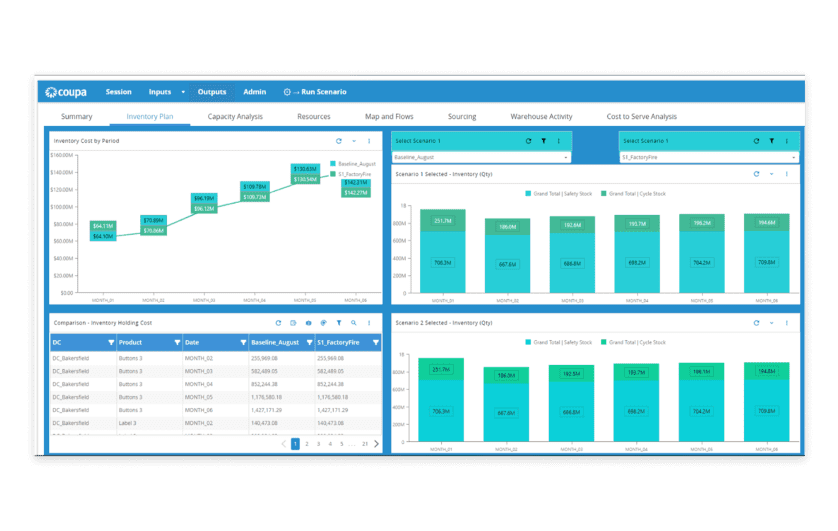
The quality of supply chain visibility depends entirely on the quality and timeliness of the underlying data. Best-in-class platforms automate data collection from ERP, WMS, TMS, and external data sources, reducing manual effort and ensuring models are working from current information.
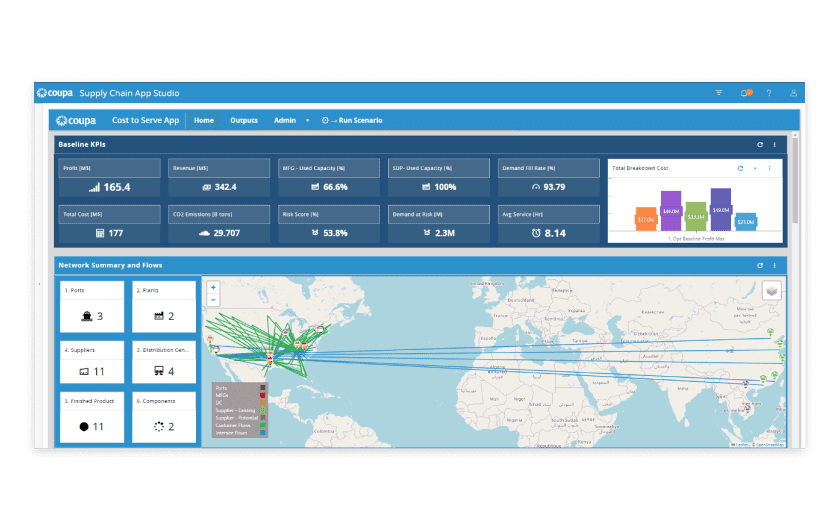
Perhaps the most underappreciated feature of leading supply chain visibility platforms is their ability to make complex analytics accessible to non-technical users. Platforms that offer low-code or no-code interfaces enable planners, finance teams, and operations leaders to run analyses and build visualizations without data science expertise.
Oh! It looks like you opted out from using the needed cookies. If you are interested in using the AI Agent, then please opt-in to the cookies in the preference center.
Update preferences