Volatile news. Stable spend.
Read the latest in the Coupa Business Spend Index™ Quarterly Update.
Get the Report





The market winced. Business spend held firm.
The Coupa Business Spend Index™ Quarterly Update

Supply chain challenges over the past few years have focused on avoiding disruptions. Right now? It’s all about managing shortages and building buffers for hard-to-come-by materials. That’s where supply chain analytics comes in.
Supply chain analytics uses operational data to optimize how goods are sourced, manufactured, moved, and delivered — an increasingly critical capability as tariffs and geopolitical pressure squeeze access to staples such as copper, lithium, and medical supplies across industries.
Yet despite the need to continuously adapt, few companies regularly redesign their networks. Only 30% conduct annual or more frequent network design reviews, according to research from Kearney and Vienna University of Economics and Business. Understanding and acting on supply chain analytics makes the difference between merely surviving and thriving in today’s fast-changing environment.
Most supply chain analytics fall into four categories, each addressing a different business question and enabling strategic decision-making.
| Analytics Type | Question Asked | Supply Chain Example |
| Descriptive | What happened? | A retailer tracks weekly inventory levels and on-time delivery rates to see where stockouts occurred last quarter. |
| Diagnostic | Why did it happen? | A manufacturer analyzes supplier lead-time data to identify which vendors caused repeated production delays. |
| Predictive | What will happen? | A consumer goods company forecasts seasonal demand to anticipate inventory shortages before a peak sales period. |
| Prescriptive | What should we do? | A logistics team uses scenario modeling to reroute shipments and rebalance inventory when a supplier shutdown is predicted. |
Descriptive analytics summarize historical supply chain data to give an overview of what has occurred across key operational levers. This includes reporting on inventory levels, order volumes, supplier performance, transportation costs, and service levels. Teams often use dashboards to integrate ERP and warehouse data.
Example use cases:
Diagnostic analytics dig deeper into data to identify the root cause of past outcomes. Typically, this type of analytics uses supplier-, lane-, or SKU-level data to identify the causes of delays, stockouts, or cost spikes. They help supply chain teams understand why performance changed or where breakdowns occurred.
Example use cases:
Predictive analytics uses historical data, statistical models, and machine learning to forecast future outcomes. Companies use demand forecasting models or digital twins to simulate how shifts in demand, supplier delays, or capacity changes could impact operations. These insights help organizations anticipate risks and demand changes before they occur.
Example use cases:
Prescriptive analytics recommend actions to achieve specific supply chain outcomes. By evaluating multiple scenarios and constraints with a digital twin, decision-makers can choose the best path forward.
Example use cases:
Understanding supply chain analytics is one thing — putting them to work is another. These eight case studies show how companies across industries use analytics to make faster decisions and optimize supply chain performance.
As Microsoft rapidly scaled its global cloud supply chain to support more than 350 data centers, it faced a growing challenge: meeting rising demand while advancing ambitious sustainability goals. Cloud computing isn’t just about non-physical software. Its infrastructure depends on a complex, multitier supply chain of server racks, hardware, and transportation networks. Cargo volumes were growing 40-60% year over year, driving up Scope 3 transportation emissions. Faced with fragmented data and spreadsheet-based planning, Microsoft could not efficiently adjust its network to keep emissions under control while meeting demand.
Microsoft implemented Coupa’s Supply Chain Optimization to explore different strategies in freight consolidation, inventory positioning, and distribution center placement. Supply chain modeling helped leadership understand trade-offs between costs, cycle times, and carbon emissions to make data-driven decisions. With these capabilities, Microsoft reduced emissions by 60% from baseline levels for its outbound trucking network in North America, all while accelerating delivery times and lowering transportation costs.
Read the full story here.
“You need to show how carbon, cycle time, and cost correlate with decisions that you can take. Then you go to leadership and can clearly say — these are the impacts of your decisions. That’s where Coupa helps.”
— Marco Aipur, Senior Director Cloud Logistics, Microsoft
With thousands of products and retail locations worldwide, getting the right inventory to the right place at the right time is a constant challenge for food and beverage powerhouse Nestlé. Frequent transportation disruptions and inconsistent data made it difficult to understand where issues were occurring and how quickly the network could respond.
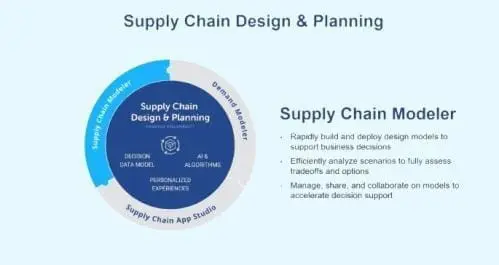
Nestlé uses Coupa’s Supply Chain & Design software and a digital twin to evolve from descriptive and diagnostic insights — such as historical replenishment lead times — into predictive and prescriptive analytics that model capacity shifts and forecast supply constraints. Coupa’s App Studio extends these insights beyond technical teams, too, empowering employees across the organization to use drag-and-drop tools to run scenarios and make faster, data-driven decisions — reducing decision-making time by 60%.
Read the full story here.
Managing a global supply chain across more than 100 distribution centers, Schneider Electric faced growing complexities in both procurement and logistics. The highly manual process spread across 14 tools, making it challenging to gain end-to-end visibility and standardize workflows, especially as strict European ESG requirements increased pressure.
After deploying Coupa across 72 countries and 200 entities, the company integrated sourcing, logistics, and payments into a single, connected platform — enabling a more holistic approach to supply chain planning through predictive analytics. Guided procurement workflows standardize sourcing events and supplier selection, while centralized data flows into a digital twin to model distribution routes, transportation strategies, and emissions impact. By linking sourcing decisions directly to logistics and sustainability outcomes, the company can make responsible decisions at scale to strengthen operational efficiency and advance ESG goals.
Read the full story here.
“We are now able to do our jobs in a much speedier way. We can do things faster and have more reliable outcomes, as well as having greater visibility into our supply chain.”
— Sebastien Riegel, Director Supply Chain Modeling & Logistics Network Design, Schneider Electric
As an intermodal transportation and warehousing leader, Odyssey Logistics faced rising capacity constraints and transportation costs, making it difficult to improve resilience and sustainability for its customers. Teams needed deeper insight into whether distribution sites were optimally located to meet future demand.
After deploying Coupa's Supply Chain Optimization, Odyssey uses predictive analytics to model future volumes and identify potential bottlenecks. The team models alternative routes, or shifts demand to another facility to ensure on-time delivery, all while lowering emissions. Using supply chain modeling and inventory optimization technology that provides prescriptive analytics, Odyssey saved one customer over $90 million.
Read the full story here.
Beauty products company Belcrop manages a highly complex supply chain with nearly 2,000 SKUs manufactured and distributed across multiple regions. Volatile consumer demand, frequent new product introductions, and global sourcing made it challenging to balance inventory, cost, and service levels.
Belcorp adopted Coupa’s Supply Chain Optimization solutions — including a digital twin — to combine supply chain forecasting with AI-driven scenario analysis. By running hundreds of what-if scenarios with AI each year, the team optimizes resource allocation and understands cost-to-serve at the SKU level, enabling data-driven decisions to get to market faster. Belcorp also uses Coupa Supply Chain Collaboration to work directly with key suppliers, helping avoid disruptions before they impact the business.
Read the full story here.
“The world of cosmetics is a blend of complexity and beauty. That’s why you need a solution that not only helps you navigate this complexity but also uncovers opportunities for improvement through a data-driven approach."
— Germán Ricardo Rodriguez, Operations Strategic Planning Senior Manager, Belcorp
Operating one of the world’s most complex semiconductor supply chains, Onsemi faced mounting pressure to make faster, more accurate decisions across capacity-constrained global factories. Production processing included up to 287 steps and 178 tools, making traditional supply chain planning highly manual and requiring multiple cross-team handoffs. Decisions took two to three weeks to make, which limited agility in today’s fast-changing market.
Onsemi switched to Coupa to standardize supply chain planning and enable faster, scalable decision-making across its global network. By running data through a central repository, the team can now model capacity constraints and scenarios directly in Coupa, reducing production decision timelines from weeks to just one to three days. Engineers are now free to focus on factory performance and have improved capital efficiency by 10-15%.
Read the full story here.
Caterpillar needed greater visibility into cost-to-serve to its customers across its existing supply chain network. The company also required a faster way to model production capacity shifts across regions and evaluate how those changes would impact service levels — without slowing down critical sourcing and footprint decisions.
Using Coupa Supply Chain Optimization, Caterpillar ran a complete network optimization and sourcing study for its Undercarriage division, applying diagnostic analytics to pinpoint the true cost-to-serve drivers across its network. The team then used predictive scenario modeling to evaluate how shifts in production capacity across regions would affect costs and service levels. By simulating alternative network configurations and productions, the company reduced cost-to-serve by 15-20% and cut scenario analysis time from months to weeks.
“Coupa gave us a clear picture of our cost-to-serve — and where redesigning our network could unlock massive savings without sacrificing service.”
— Caterpillar Undercarriage Division Team
Global materials leader Saint-Gobain is committed to achieving carbon neutrality by 2050 and has identified transport emissions as a key lever in its value-chain sustainability roadmap. With complex logistics networks spanning thousands of routes and potential configurations across several countries, the company needed a better way to plan and optimize transportation flows to reduce costs and carbon emissions without impacting service levels.
Saint-Gobain used Coupa’s Network Optimization to create a transport control tower that supports end-to-end supply chain planning and identifies opportunities to consolidate transportation across divisions in its LATAM operations. The analyst team conducts scenario analysis to balance costs, emissions, and service goals, providing division leaders with the best options for decision-making. Across more than 60 optimization projects in a single year, Saint-Gobain reduced transport-related emissions by 40-60% for several brands — advancing toward its net-zero objectives while improving operational efficiency.
Hear the full story here.
When material shortages hit or right-sizing inventory becomes critical during economic uncertainty, companies need the right tools to act fast and stay in control. Coupa’s Supply Chain Optimization software combines advanced analytics, scenario modeling, and AI-driven insights to help teams of all sizes make decisions quickly and precisely. With a digital twin and flexible planning and forecasting capabilities, Coupa enables organizations to balance cost, service, carbon, and risk — all in one connected platform. With Coupa, you’ll be able:
Unlock the true power of supply chain analytics with Coupa, named a leader in the IDC Marketscape for Worldwide Multi-Enterprise Supply Chain Commerce Networks analyst report.
Oh! It looks like you opted out from using the needed cookies. If you are interested in using the AI Agent, then please opt-in to the cookies in the preference center.
Update preferences