Volatile news. Stable spend.
Read the latest in the Coupa Business Spend Index™ Quarterly Update.
Get the Report





The market winced. Business spend held firm.
The Coupa Business Spend Index™ Quarterly Update

If you lead finance at a midsize or emerging enterprise, you’re likely operating in an impossible squeeze: expected to deliver enterprise-grade strategy while managing rapid, often unpredictable growth. The defining tension of running finance at this tier is the constant, low-grade pressure of having to compromise. Do these questions sound familiar?
Every strategic decision feels like a trade-off between driving transformation and maintaining momentum.
What if you had the data to guide your path? Data you knew you could trust?
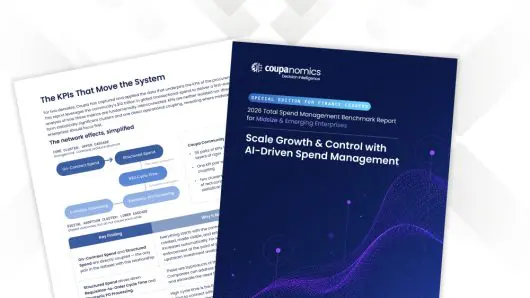
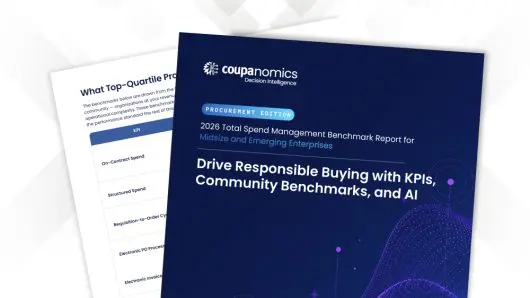
Grounded in Coupa’s world-leading dataset of $10 trillion in verified global transactional spend, the Coupa 2026 Agentic Spend Management Benchmark Report for Midsize and Emerging Enterprises is drawn from the top quartile of companies in the $250 million to $1 billion annual revenue range — organizations navigating exactly this tension. What it reveals challenges three assumptions that are shaping how these finance leaders prioritize their time and resources, and, in many cases, are slowing them down.
Coupa’s 2026 Agentic Spend Management Benchmark Report for Midsize Emerging Enterprises includes 17 KPIs to track right now, community benchmark data that shows what good looks like, and guidance on where to start in your own organization.
Before finance leaders unpack those assumptions, they need a data-driven understanding of what good looks like. Coupa’s benchmark data allows you to directly compare top-quartile performance between midsize and emerging enterprises and larger enterprises on KPIs central to finance operations. These are particularly noteworthy:
| Performance KPI | Midsize & Emerging Enterprise ($250M-$1B) | Large Enterprise (>$1B) |
| On-Contract Spend | 84.8% | 82.7% |
| Structured Spend | 62.0% | 57.8% |
| Requisition-to-Order Cycle Time | 2.8 business hours | 3.4 business hours |
| DPO Uplift Through Virtual Cards | 42.4 calendar days | 41.7 calendar days |
| Suppliers Enabled on Coupa Pay | 98.7% | 95.0% |
Top-quartile midsize and emerging enterprises lead on every metric in this set. The gaps are consistent across operational speed, spend governance, and payment infrastructure. And that isn’t what most finance leaders expect when they compare companies at this revenue tier to much larger organizations.
Now to the story that’s even more interesting: Why do these gaps exist?
The outperformance outlined above points back to a specific set of specific practices and mindsets that challenge widely-held assumptions about what finance transformation requires at this scale:
Assumption: The procurement cascade — on-contract spend, structured spend, requisition-to-order cycle time, electronic PO and e-invoice processing — as a procurement team’s concern. The data says otherwise.
The KPIs that most directly predict cash flow predictability, working capital efficiency, and AP performance are upstream procurement metrics. Coupa’s benchmark data reveals that companies that lead on on-contract spend and structured spend consistently show faster AP cycle times, higher first-time match rates, and more predictable cash outflows. Finance leaders at top-quartile midsize and emerging enterprises are treating those outcomes as finance infrastructure priorities. At many companies this reframe alone changes which investments get backing and which conversations happen between the head of finance and the head of procurement.
Assumption: The payoff from investing in spend management infrastructure grows with company size. It makes more sense to address these challenges once the organization is larger, more mature, or further along its digital transformation journey. A first-ever causal investigation of Coupa’s dataset directly contradicts this.
Our analysis of structured intake and AP efficiency reveals that the efficiency gain from improving how spend enters the procurement system is statistically constant at every stage of organizational growth. Moving from 20% to 40% structured intake coverage delivers exactly the same AP efficiency improvement as moving from 60% to 80%. There is no scale threshold at which this investment becomes more valuable. The best time to act on intake is now.
Top-performing midsize and emerging enterprises in the Coupa community don’t wait. With intake accounting for nearly half of planned AI investments among CFOs in 2026, these leaders are building the upstream process foundation at this stage of growth — while their organizations are lean enough to adopt new practices quickly, and before the complexity of further growth makes it harder and more expensive to do so.
“We needed a system that wouldn’t just get us through today, but could support where we’re headed in the next three to five years ... Coupa is that company.”
— Kris Toth, VP Finance
Assumption: Achieving high digital payment enablement and significant working capital optimization requires enterprise-level resources or years of supplier relationship management. Finance leaders may be surprised by these two community benchmarks: the 98.7% supplier payment-through-Coupa-Pay enablement rate and 42.4-calendar day DPO uplift through virtual cards.
What these achievements do require is speed of action. This includes getting suppliers onto digital payment channels early, before the supplier base fragments and the organizational complexity of managing multiple payment processes sets in. Leading midsize and emerging enterprises lean into a structural advantage here that enterprise organizations have largely lost: less legacy payment infrastructure to replace, fewer internal stakeholders to align, and a supplier base that’s still concentrated enough to move efficiently.
This strategic shift to modern payment channels directly unlocks significant financial flexibility, as reflected in the DPO uplift figure. Retaining an additional 42.4 calendar days of working capital — while suppliers receive immediate, guaranteed digital payment — is the result of a payment infrastructure decision already proven by top performers. And it’s remarkably accessible for any midsize and emerging enterprise to adopt today.
The structural characteristics that produce midsize and emerging enterprise outperformance are specific to a growth stage, and they erode as organizations scale.
Approval chains lengthen. Process ownership becomes diffuse. The organizational habits that made structured spend and fast cycle times achievable at $250 million in revenue start to fragment as headcount grows, new markets open up, and acquired companies are integrated with their own embedded processes. The requisition-to-order cycle time advantage — 2.8 business hours versus 3.4 for enterprise — exists because midsize and emerging enterprises currently have fewer layers between a purchase request and an approval decision. That gap closes with growth unless leaders take deliberate steps to protect it.
Top-performing companies don’t just reap the rewards of structural advantages while expecting them to dwindle. Here, finance leaders are actively reinforcing them by investing in the upstream process foundations that keep spend visible and governed as the business grows. They recognize that establishing these rigorous controls now, while the organization can still move at the speed of business, is exactly what ensures seamless compliance with U.S. SOX, Japan’s J-SOX, and evolving corporate governance mandates across Europe and Latin America, ultimately securing IPO readiness for the regions they need later.
Coupa’s benchmark data reveals that even top-performing midsize and emerging enterprises experience a disconnect between:
Just having contracts in place doesn’t guarantee that employees are buying through the channels that contract governs. An organization can have strong contract coverage and still see significant unstructured spend if employees are purchasing outside those channels, whether because they are unaware of them, because the process is too slow, or because no one has made the structured channel the path of least resistance.
For midsize and emerging enterprises that have already invested in contract lifecycle management, strengthening the link between on-contract spend and structured spend is the highest-return opportunity available right now. And the downstream payoff is clear: A first-ever causal investigation into Coupa’s dataset reveals that capturing purchase requests through structured intake before an invoice arrives reduces manual AP review rates by 19.5 percentage points. For finance leaders managing a growing AP workload without proportional headcount growth, that figure translates directly into capacity, cost, and cash flow timing. By deploying agentic AI and deep learning to handle the heavy lifting of exceptions and routing, this unlocked capacity shifts AP teams away from manual reconciliation and toward active liquidity management. This is the step top performers take to turn the AP their AP function into a strategic working capital engine.

Coupa’s 2026 Agentic Spend Management Report for Midsize and Emerging Businesses reveals that finance teams at top-performing companies in the Coupa community:
And these insights just scratch the surface. This report provides community on 17 KPIs across the source-to-pay lifecycle, drawn specifically from the top quartile of companies at this revenue tier. Finance leaders can assess where their organization stands against peers, not against enterprise organizations operating at twice the scale with twice the headcount.
Coupa’s report also maps each KPI to the five financial challenges most pressing for midsize and emerging enterprises right now:
The report also provides sequencing guidance with levers to improve first and broader metrics to track — without introducing the friction and disruption that every finance leader is trying to avoid.
Coupa’s Agentic Spend Management Benchmark Report for Midsize Emerging Enterprises includes 17 KPIs to track right now, community benchmark data that shows what good looks like, and guidance on where to start in your own organization.
Oh! It looks like you opted out from using the needed cookies. If you are interested in using the AI Agent, then please opt-in to the cookies in the preference center.
Update preferences