Volatile news. Stable spend.
Read the latest in the Coupa Business Spend Index™ Quarterly Update.
Get the Report





The market winced. Business spend held firm.
The Coupa Business Spend Index™ Quarterly Update

Ongoing global events expose the fragility of supply chains that lack visibility. In direct spend, the stakes remain high: If procurement fails, production stops. Every unexpected delay or unmanaged expense creates a damaging ripple effect across the enterprise. While many organizations start in a reactive state, transitioning to Stage 2 enables teams to accelerate their maturity by formalizing sourcing, category management, and supplier oversight.
By establishing centralized data and introducing key performance indicators (KPIs), you move beyond simple survival. This stage builds the foundational framework necessary to scale efficiently and eventually realize the full potential of artificial intelligence (AI).
In our previous post, we discussed how to move away from uncoordinated, manual tasks. Now that your organization is centralizing its data, the focus shifts toward stabilizing operations. The goal is to build a repeatable framework that ensures consistency across every transaction. This will set your organization up for continuous improvement and propel you to Stage 3, where procurement becomes more than a support function — it’s where procurement begins to serve as a strategic partner by coordinating data across the business.
As you formalize your workflows, success becomes measurable through operational benchmarks:
The hallmark of a Stage 2 organization is the deliberate move from reactive problem-solving toward consistent, repeatable workflows. At this level, you establish enough visibility to begin organizing the flow of information across the supply chain. Instead of addressing every supply shortage as an isolated crisis, teams use standardized data to identify and address process delays before they impact production.
By aligning sourcing cycles with production schedules, you begin moving away from spontaneous ordering to create a more predictable environment for your supply base. This stabilization helps information flow more consistently, allowing teams to identify potential delays earlier in the process than in a purely reactive state. Tracking the Average Sourcing Cycle Time highlights specific bottlenecks in the approval or bidding process, even as internal systems remain largely separate. This emerging visibility encourages a shift from ad hoc bids toward a planned sourcing lifecycle that better aligns with your production needs.
In Stage 2, both team structure and technology become more specialized to handle increasing complexity. You are no longer relying on a few individuals to manage every task; instead, specific roles emerge to handle different parts of the procurement lifecycle.
Stage 2 at a glance:
This specialization addresses shadow procurement, where decentralized departments onboard suppliers independently. Such fragmentation acts as a strategic liability, creating duplicate records and obscuring your total exposure to any single vendor. By centralizing supplier data, you eliminate these redundancies and establish a clear record for every vendor in the system.
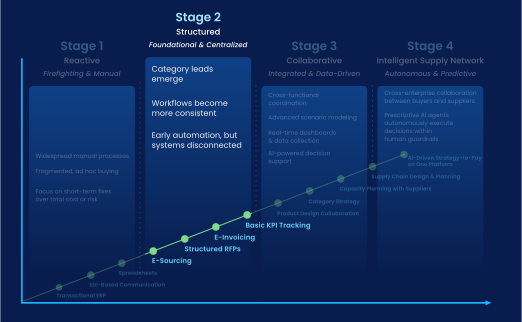
Standardize how you connect with your network to ensure that every transaction is accurate, compliant, and easy to audit. Implementing a formal approval process is not about adding bureaucracy. It is about ensuring your records are reliable enough for advanced analysis and strategic decision-making.
Practical AI Use Case: Automated PO-to-Invoice Matching
At this stage, early automation reduces friction in the design-to-pay process. For instance, Automated PO-to-invoice matching removes the need for manual data entry, which shortens approval cycles and allows your team to capture early payment discounts.
Additionally, AI-powered spend classification automatically groups data into categories like raw materials or components, revealing consolidation opportunities that manual spreadsheets often hide. Alastair Smith, Procurement Director at AstraZeneca, notes that removing manual questions around invoicing and poor data puts procurement in a much stronger position to act as a strategic partner.
Structured procurement shifts the focus from simple unit pricing toward identifying broader cost consolidation opportunities. At this stage, organizations introduce standardized RFP/RFQ templates to ensure suppliers are compared consistently across basic factors like lead time and quality. This transition allows teams to move away from isolated transactions and toward a more organized approach that captures better value through volume and process consistency.
Tactical consolidation becomes a priority here. By unifying fragmented data, you identify where multiple departments buy from the same supplier, allowing you to leverage that collective volume for better pricing and terms. On the engineering side, this stage moves from simple notification to the use of a preferred parts and supplier list. This guides design teams toward reliable, readily available options early in the development cycle, which prevents reactive scrambling that can occur when sourcing implications are ignored during product design.
True relationship building in Stage 2 begins with operational excellence. By moving away from the ad hoc spending of Stage 1, you establish the professional baseline necessary for long-term partnerships.
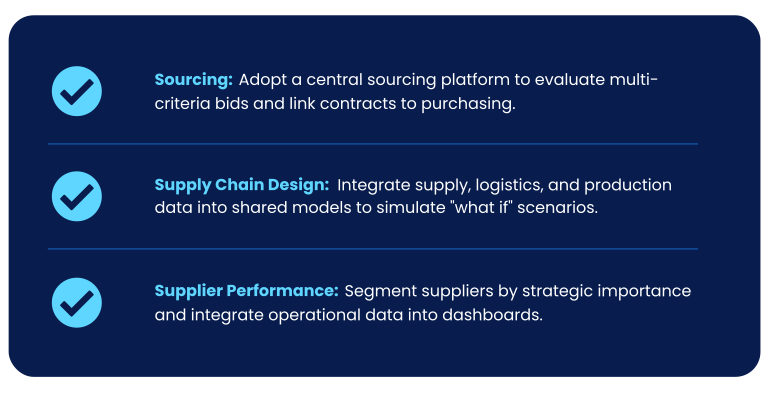
To progress to Stage 3, you must move from managing individual events to managing broader category strategies. This requires moving your data into a unified platform where sourcing, contracts, and purchasing link together in a single ecosystem.
The next steps include:
Transitioning from foundational automation to integrated, data-driven collaboration requires a disciplined focus on immediate, high-impact changes.
This series explores the Direct Spend Procurement Maturity Model, a framework to help your organization evolve from manual operations to a more connected and efficient model. We are looking at the specific process steps — from design to payments — that enable you to improve ROI and reduce costs.
Explore the full series to track your path toward an AI-powered supply network:
Oh! It looks like you opted out from using the needed cookies. If you are interested in using the AI Agent, then please opt-in to the cookies in the preference center.
Update preferences