Volatile news. Stable spend.
Read the latest in the Coupa Business Spend Index™ Quarterly Update.
Get the Report





The market winced. Business spend held firm.
The Coupa Business Spend Index™ Quarterly Update

In our previous post, we explored how organizations find their footing by stabilizing data and standardizing sourcing workflows. Now, we move to Stage 3: Collaborative Procurement, where the focus shifts from internal structure to external integration.
At this level, procurement transitions from a purely transactional department into a strategic partner. Using a unified platform, teams can connect sourcing, contracting, and purchasing in real time. This shift is powered by augmented intelligence — using AI as a co-pilot to enhance human decisions with predictive insights rather than just automating everyday tasks.
But structure alone can only take you so far. If your data flows are still one-way and your systems remain disconnected from your suppliers' operations, your supply chain is still vulnerable to sudden market shifts. To build true supply chain resilience, procurement moves from a purely transactional department to a strategic collaborator, working hand-in-hand with internal teams and external partners.
By tapping into the power of a global community dataset representing $10 trillion in transactional spend, category managers can look past basic price tags. Instead, they can act as strategic advisors who protect margins and build deep, mutually beneficial networks with suppliers.
At the collaborative stage, success is evaluated through integrated dashboards that track end-to-end reliability and strategic alignment:
| On-Time-In-Full (OTIF) Delivery This metric measures supplier reliability and fulfillment accuracy across the entire network. |
Inventory Turns High-performing teams use collaborative forecasting to manage inventory levels more efficiently. |
| Percentage of Spend Under Category Strategy This tracks how much of your total spend aligns with long-term strategic goals rather than ad hoc buying. |
Invoice Match Rate and Early Payment Discount Capture These indicators signal financial optimization and high levels of supplier satisfaction. |
In Stage 3, procurement professionals transition from tactical buyers to cross-functional, strategic leaders, blending category strategy with broader business goals and contributing to product design much earlier in the lifecycle. This evolution is powered by the integration of category strategy with sourcing optimization. The resulting alignment ensures that supplier choices reflect current demand, cost structures, and risk exposure simultaneously.
Effective leadership at this stage requires viewing sourcing as a relationship design process rather than an isolated transaction. Because direct spend disruptions can stop revenue cold — Stage 3 teams prioritize collaboration between engineering, finance, and operations. By breaking down internal silos, you ensure that every procurement decision supports the organization's resilience and growth targets.
Mathematically linking strategic goals, like improving resilience or sustainability, directly to sourcing execution, enables teams to successfully bridge the gap between high-level planning and daily purchasing decisions.
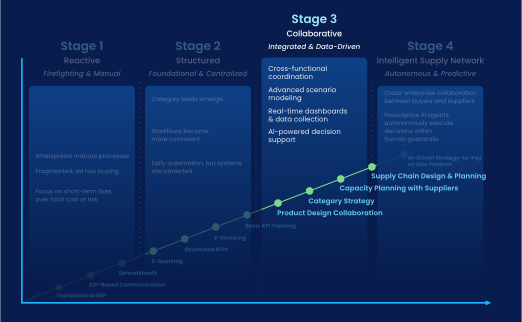
A Stage 3 organization operates as a fully integrated, data-driven community. Processes are connected through a single ecosystem that provides two-way visibility between buyers and suppliers.
Stage 3 at a glance:
To successfully move your operations from a structured framework to a truly collaborative network, you must change how you view and manage suppliers. True collaboration requires moving past a static list of preferred vendors and treating key suppliers as integrated partners in your sourcing pipeline. When a single missing component — even a tiny, low-cost part — can cause a line-down crisis and halt a multimillion-dollar product shipment, building deep supplier alignment isn't optional.
Evolving your supplier intelligence in Stage 3 relies on four foundational capabilities:
One of the most powerful tools in Stage 3 is the Supply Chain Digital Twin. This technology enables your team to model the entire supply network and evaluate cost structures with precision. For instance, Belcorp uses digital twins to analyze over 200 scenarios annually, gaining cost-to-serve insights down to the SKU level. This granular data allows them to pinpoint and act on specific cost drivers with incredible precision, facilitating faster and more strategic executive decision-making.
Digital twins allow you to move from broad savings targets to SKU-level precision. By pinpointing cost drivers at the component level, you identify exactly where a design change or a logistics shift impacts the bottom line. Additionally, this visibility extends into risks in deeper tiers. Because a disruption at a Tier 3 facility can stop a production line just as easily as a Tier 1 failure, Stage 3 organizations use these shared models to map deeper dependencies and pre-build alternative sourcing strategies.
Collaboration in Stage 3 is a two-way street. Suppliers no longer just receive purchase orders; they actively view demand projections and provide feedback on capacity within a shared portal.
This shift toward synchronized demand signals ensures that both parties stay aligned on production needs. When suppliers provide capacity feedback on your demand projections, you significantly reduce the need for safety stocks and emergency freight. Effective PO and forecast collaboration reduces inventory carrying costs by 2-10% and decreases expediting costs by 10-30%.
Quality assurance also matures; suppliers perform pre-shipment inspections and share certifications directly within the unified platform, ensuring that quality standards remain consistent across the network.
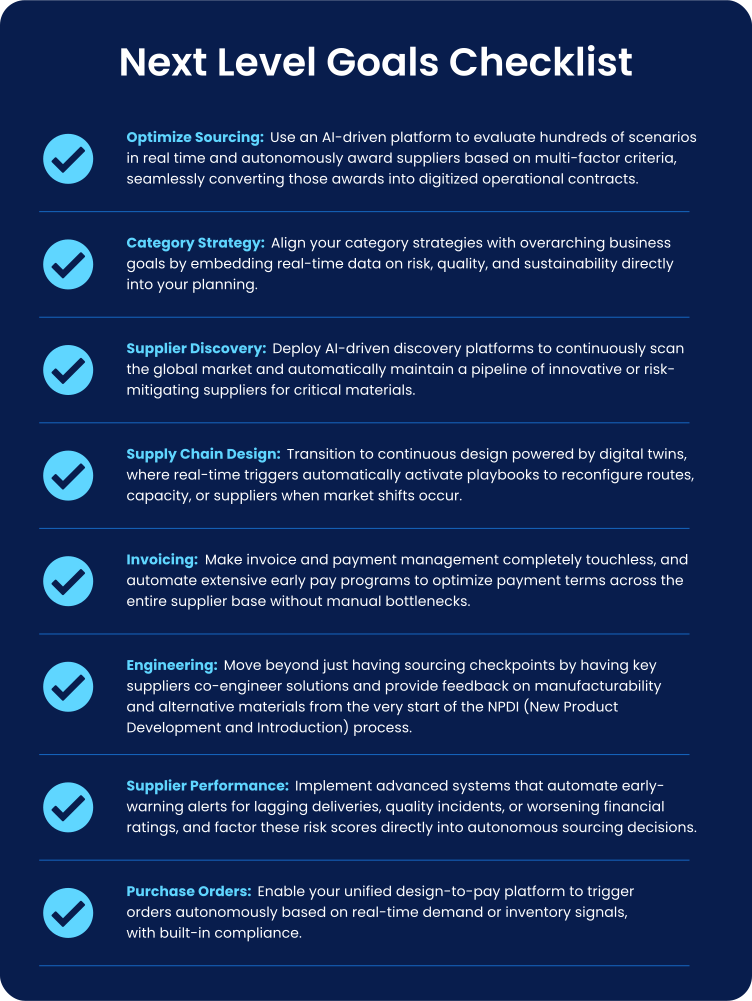
To reach Stage 4: The Intelligent Supply Network, you must transition from augmented decision support to Autonomous Spend Management. In this ultimate stage, AI agents independently execute routine decisions within human-defined guardrails.
The next steps include:
Advancing to a fully predictive network requires integrating your logistics, production, and financial data into a single, adaptive system.
High-impact actions to move from collaborative to intelligent procurement:
This series explores the Direct Spend Procurement Maturity Model, a framework that helps your organization move past manual firefighting to build an autonomous, AI-powered advantage. We examine the specific dimensions — from supply chain design to supplier collaboration — that turn your daily operations into a permanent competitive edge.
Explore the full series to track your path toward an AI-powered supply network:
Oh! It looks like you opted out from using the needed cookies. If you are interested in using the AI Agent, then please opt-in to the cookies in the preference center.
Update preferences