Volatile news. Stable spend.
Read the latest in the Coupa Business Spend Index™ Quarterly Update.
Get the Report





The market winced. Business spend held firm.
The Coupa Business Spend Index™ Quarterly Update

Throughout this series, we have tracked the progression across the direct spend maturity model. We started in Stage 1 by moving away from manual spreadsheets and disconnected tasks. In Stage 2, we built a foundation of structured workflows to stabilize daily operations. Most recently, in Stage 3, we looked at how to scale collaboration and share real-time visibility with suppliers. The final step in this model is Stage 4: The Intelligent Supply Network. At this stage, your operations move from human-led collaboration to automated execution.
Instead of teams manually managing every transaction, advanced systems handle routine activities. By connecting your suppliers, data, and processes into a single network, the system automatically spots problems and adjusts plans to keep production lines moving.
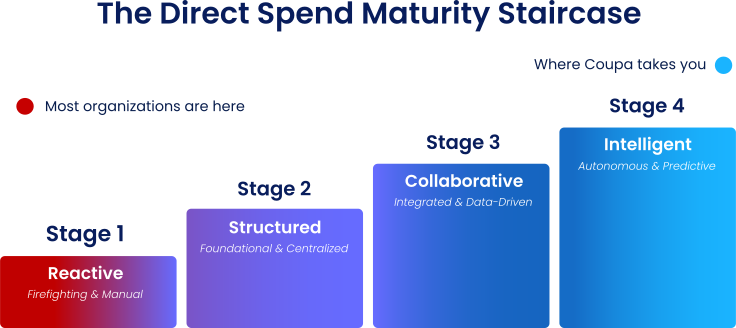
Climbing this maturity staircase brings significant advantages to an organization. Research from The Hackett Group shows that companies at peak maturity achieve 2.6 times greater return on investment, operate with 31% fewer full-time employees, and lower their costs as a percentage of spend by 19%. Moving through these stages requires more than just updating an isolated tool; it requires an integrated system designed to build long-term operational resilience.
As organizations achieve peak maturity, leadership evaluates success by how well the system automates routine tasks and mitigates risks before they impact production. Key operational benchmarks include:
| Touchless purchase order rate The percentage of direct spend orders generated, verified, and sent to suppliers without requiring manual human intervention. |
Automated exception resolution rate The frequency with which pre-set response playbooks successfully resolve minor supply chain disruptions, such as transport delays or quantity mismatches. |
| Disruption response time The speed at which the system identifies a global disruption, evaluates alternative options, and reconfigures supply routes. |
Predictive risk detection rate The percentage of supplier delivery delays or material shortages that the system successfully anticipates and flags before they affect your production schedule. |
An intelligent network enterprise operates an adaptive system that balances automated efficiency with strategic human oversight.
Stage 4 at a glance:
The human role does not disappear in Stage 4. Instead, your team members become strategic orchestrators of the strategy-to-pay lifecycle. By transitioning to Agentic Spend Management, humans define the high-level business rules, establish the guardrails, and manage the exceptions while prescriptive AI agents handle routine execution.
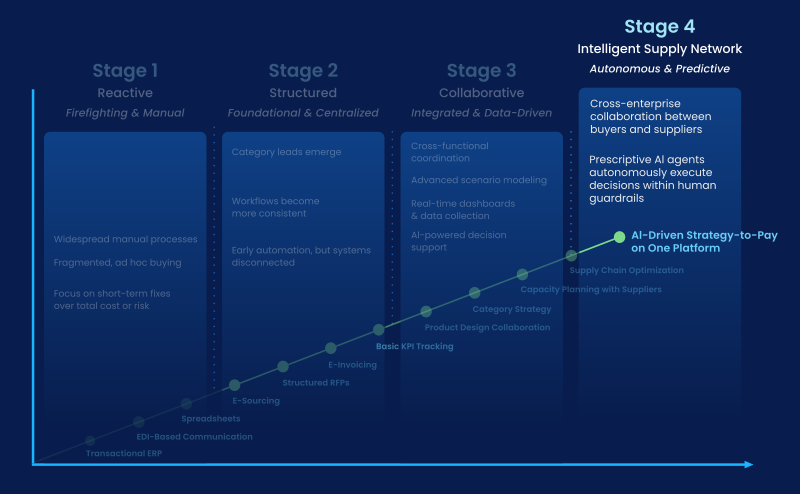
Achieving this level of maturity requires your supply chain, procurement, and finance teams to work from the same data. When these three functions operate together on a single platform, it creates a steady operational advantage that makes the entire business more resilient. This level of coordination is supported by a unified platform that uses community spend data to make more informed, accurate decisions.
Here is how this shared system changes the daily work for each team:
Companies that shift from simply sharing data to allowing systems to act on data realize an operational leap across core processes:
In Stage 3, procurement teams manually participate in the New Product Development and Introduction (NPDI) process to review supplier options. To reach Stage 4, this workflow must be integrated at the system level. When an engineer introduces a new part or a change to a bill of materials (BOM), the sourcing system automatically scans the digital twin to check for supply risk, lead times, and financial impact. The system flags alternative materials or capacity constraints instantly, ensuring every new product is optimized for the supply chain before it ever enters production.
Collaborative companies use sourcing platforms to collect multi-factor bids from global suppliers. Reaching an intelligent state means setting strict mathematical constraints within that platform. You define your rules for risk tolerance, carbon caps, and supplier diversity. The system then evaluates hundreds of potential award combinations simultaneously and awards the contracts autonomously based on those rules, seamlessly converting the choice into a digitized operational contract.
Instead of accounts payable teams manually managing payment terms and cash flow schedules, Stage 4 introduces dynamic, automated early payment programs. The system integrates payment schedules directly with corporate cash flow planning. When an invoice is verified through digital matching, the system automatically offers the supplier a sliding-scale early payment option at a discount. This strengthens supplier liquidity during market volatility while automatically improving your company's operating margins.
The foundational hurdle in moving to Stage 4 is breaking down the walls between different software systems. Advancing requires connecting your enterprise resource planning (ERP), transportation management system (TMS), and warehouse data into a single operational view. This unified data layer is what enables prescriptive AI agents to safely trigger orders, adjust logistics routes, or reallocate inventory without manual human intervention.
An intelligent network uses live data and digital supply chain models to run smoothly without constant human intervention. Two primary capabilities define this stage:
At peak maturity, daily purchasing decisions align directly with the company's long-term financial goals and environmental targets. When sourcing materials, the system automatically calculates the total cost of ownership alongside risk factors and carbon emissions.
Instead of forcing your team to manually evaluate these variables across hundreds of suppliers, the system uses multi-constraint optimization to find the best balance. This ensures that every purchase order complies with company policy and supports your broader business margins.
Reaching Stage 4 means your supply chain is never static. The network constantly learns from historical transactions, current market data, and supplier performance to refine its own recommendations. This predictive approach helps you anticipate disruptions before they happen, turning your supply chain into a distinct competitive advantage.
Identify the core actions needed to keep your automated network aligned with business goals:
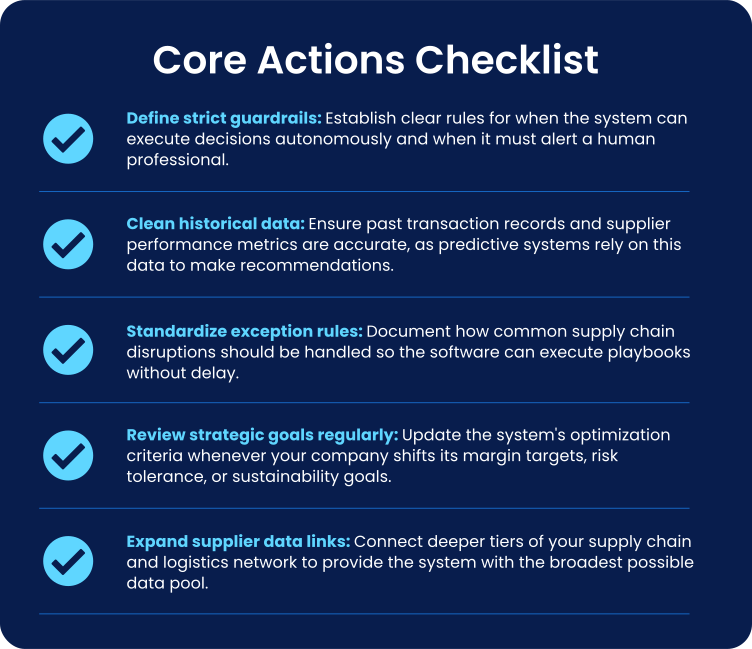
Moving up the direct spend maturity staircase is a deliberate shift in how your company operates. By moving away from reactive firefighting, standardizing daily processes, and opening clear communication channels with suppliers, you build a foundation that makes automated execution possible.
Reaching the level of an intelligent supply network ensures that your daily purchasing decisions directly protect your production lines and your profit margins. With your supply chain, procurement, and finance teams working from the same live data, your organization can anticipate disruptions and adapt to market changes automatically.
Explore the full series to track your path toward an AI-powered supply network:
Oh! It looks like you opted out from using the needed cookies. If you are interested in using the AI Agent, then please opt-in to the cookies in the preference center.
Update preferences