Volatile news. Stable spend.
Read the latest in the Coupa Business Spend Index™ Quarterly Update.
Get the Report





The market winced. Business spend held firm.
The Coupa Business Spend Index™ Quarterly Update
For a long time, CFOs faced a binary choice: Focus on profitability or growth. AI promises to shatter this old trade-off by handling the massive data crunching required to pursue both simultaneously. Finance leaders agree — 60% are investing in AI to boost profitability, and 58% are using it to fuel growth. However, AI is only as smart as the data it works with.
The true value of benchmarks built on a foundation of actual transactions, not subjective surveys or high-level estimates, has never been more clear. These metrics, derived from a globally standardized, pre-cleansed pool of verified spend, provide the "ground truth" that agentic AI requires to accurately identify leaks, automate controls, and drive value. A dataset of this unprecedented scale provides an unfiltered, aggregate view of performance across the entire source-to-pay (S2P) process. Instead of telling you what companies say they do, it reveals exactly how the top quartile of global businesses actually manage their operations to master simultaneous cost control and growth. This transactional data acts as a connective tissue, eliminating friction between the historically separate mandates of the CFO (cash flow, working capital) and the CPO (sourcing efficiency, risk mitigation). It provides a single source of truth across the S2P process, showing both finance and procurement exactly how operational efficiency directly fuels financial performance.
Procurement benchmarks are S2P and finance key performance indicators (KPIs) that help organizations evaluate how their procurement and spend management workflows stack up against peers and industry standards. They provide critical insight into how internal processes directly impact liquidity, compliance, and operational efficiency. While these metrics do not encapsulate every aspect of organizational maturity — such as internal departmental costs, category management maturity, or supply chain inventory velocity — they provide a comprehensive baseline across six primary categories of the spend lifecycle:
Strong benchmarking doesn’t just improve performance — it enables smarter, end-to-end decision-making. Companies with mature benchmarking capabilities are better positioned to understand the path they’re on right now, which areas need the next layer of prioritization, and how their AI investments should be structured to deliver the highest leverage as quickly as possible.
Most progressive procurement and finance leaders follow an integrated, cross-functional benchmarking lifecycle that includes:
A continuous process of measurement, comparison, and improvement sharpens procurement’s performance and makes it easier to collaborate with finance and other stakeholders on shared goals.
To maximize the value of benchmarking, organizations need more than just numbers, requiring a strategic, repeatable process rooted in high-quality data. The following best practices guide procurement teams toward achieving this.
The first step is determining core objectives. Whether addressing data quality and readiness or mitigating integration complexity, defining the objective allows teams to select the most relevant KPIs to track and benchmark.
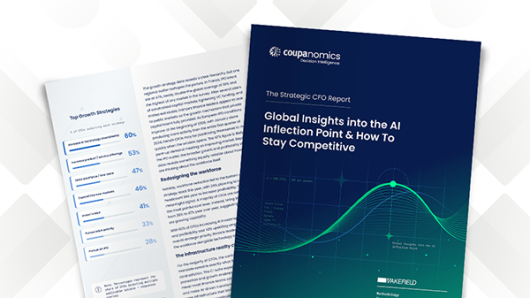
* Source: The Strategic CFO Report, Coupa Software, 2026
Having the right benchmarking data makes all the difference. Public data and survey-based benchmarks from third-party firms often rely on outdated or self-reported metrics. In contrast, the benchmarks in this report are calculated from $10 trillion in global transactional spend, ethically sourced, by a network of more than 11 million buyers and suppliers. But size alone doesn’t explain why leaders trust our view on performance. Coupa is the only organization that can show how procurement KPIs can impact the profit and loss statement through:
Benchmarking well starts with accurate and complete internal data. That means establishing definitions for metrics across teams and ensuring data is collected uniformly. The challenge: Most procurement teams rely on multiple systems and point solutions, which makes data fragmented and disconnected. Getting a true picture of organizational spending and processes is nearly impossible. (From Coupa’s 2026 Strategic CFO Report: Only 5% of CFOs can access all of their spend data instantly in a single, unified system while nearly half (49%) can’t see all of their spend data.)
A centralized database or Agentic Spend Management platform is needed to track and analyze both direct and indirect procurement spend across regions and business units. This kind of centralized visibility ensures benchmarking is against a true view of an organization’s procurement performance. Without it, teams risk comparing incomplete data and missing critical opportunities for improvement.
Benchmarks aren’t just for comparison anymore. They can be used to orchestrate outcomes. With the shift toward agentic AI, procurement and finance leaders can move beyond static charts to a proactive digital workforce.
Today, companies can deploy persona-based, zero-code AI agents (like Coupa Navi™) that both surface performance gaps against industry standards and actively execute the workflows to close them. For instance, if benchmarking data flags a lag in requisition-to-order times, specialized agents can automatically generate standardized RFPs from natural language or resolve math-heavy supplier cost scenarios.
When process intelligence (such as from Celonis) is integrated directly into the platform, AI agents are fed complete operational context across an entire software ecosystem. This eliminates enterprise blind spots and allows autonomous agents to seamlessly execute real-time ERP updates, harmonize payment terms, and prevent value leakage the moment a benchmark anomaly is detected.
When margins are tight and uncertainty is the norm, procurement and finance leaders must deliver on a seemingly paradoxical mandate: contain costs while funding growth and scaling AI. Benchmarking is the essential foundation for aligning these goals, offering a clear view into how top-performing companies achieve rigorous cost control and profitable growth as a single, integrated result.
Leaders must ensure the use of accurate benchmarks, specifically those powered by Coupa's data.
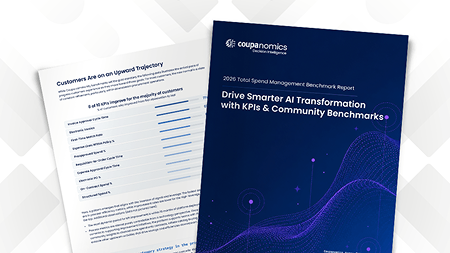
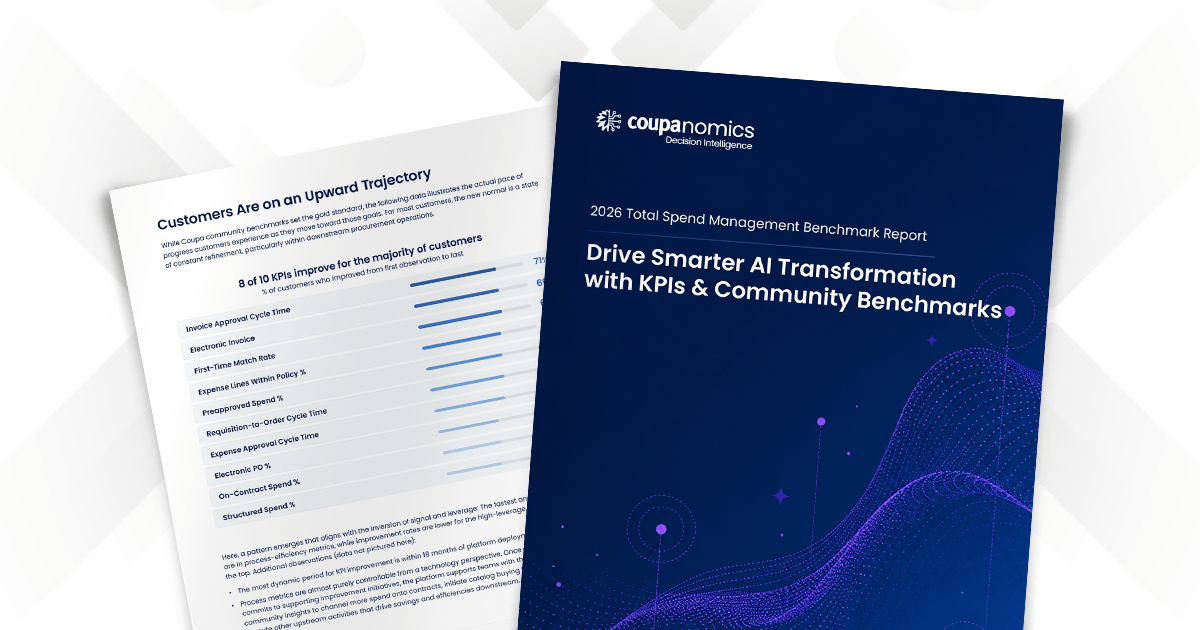
Previous editions of this annual report focused on showcasing individual performance metrics across the S2P process. This year, the report moves beyond standalone benchmarks to deliver a first-ever, statistical analysis that:
Based on the computation of 800+ variables and millions of monthly observations as well as 20 years of continuous measurement, these findings confirm why finance and procurement teams must look beyond individual metrics to guide their transformation efforts.
Oh! It looks like you opted out from using the needed cookies. If you are interested in using the AI Agent, then please opt-in to the cookies in the preference center.
Update preferences