Volatile news. Stable spend.
Read the latest in the Coupa Business Spend Index™ Quarterly Update.
Get the Report




Coupa named a Leader
in the Forrester Wave™: Supplier Value Management (SVM), Q4 2026

Source-to-pay (S2P) is the end-to-end operational process that unifies upstream strategic sourcing with downstream procurement and payment operations. By connecting spend analysis, supplier contracting, purchasing, and invoicing into a continuous workflow, source to pay ensures that the terms negotiated with suppliers are the terms actually paid.
Yet in most organizations, these functions operate in isolated silos, leaving finance leaders in the dark. According to Coupa’s 2026 Strategic CFO Report, only 5% of CFOs can access all of their spend data instantly in a single system, while nearly half (49%) can’t see all of their spend data at all. This visibility gap directly impacts the bottom line: Even well-managed global enterprises still lose about 18% of their purchases to off-contract, unmanaged spend.
Today’s finance and procurement leaders are prioritizing the way they close this visibility gap and stop value leakage. Whether the immediate focus is eliminating maverick spend, accelerating invoice cycles, or bringing cash flow into focus, mastering the complete source-to-pay process provides the operational foundation to turn negotiated savings into realized value. That foundation matters more as AI-powered intake tools promise to replace the traditional stack. A front door for requesters governs spend only when it ties natively to the supplier master, contract pricing, and item catalogs behind it.
Understanding the source to pay process requires looking past individual software tools and examining the entire transaction chain. An end-to-end source-to-pay process seamlessly connects strategic decision-making upstream with daily financial execution downstream. By establishing clear cross-functional ownership and automated handoffs across all seven stages, organizations build a disciplined approach to holistic spend management that prevents margin leakage.
For midsize and emerging enterprises without a dedicated procurement department, source-to-pay is a highly effective way to build and maintain a responsible buying culture. Rather than requiring a large team to manually review every purchase, a unified source-to-pay workflow embeds preapproved catalogs and automated approval chains directly into daily buying, so finance gets instant control without added operational friction.
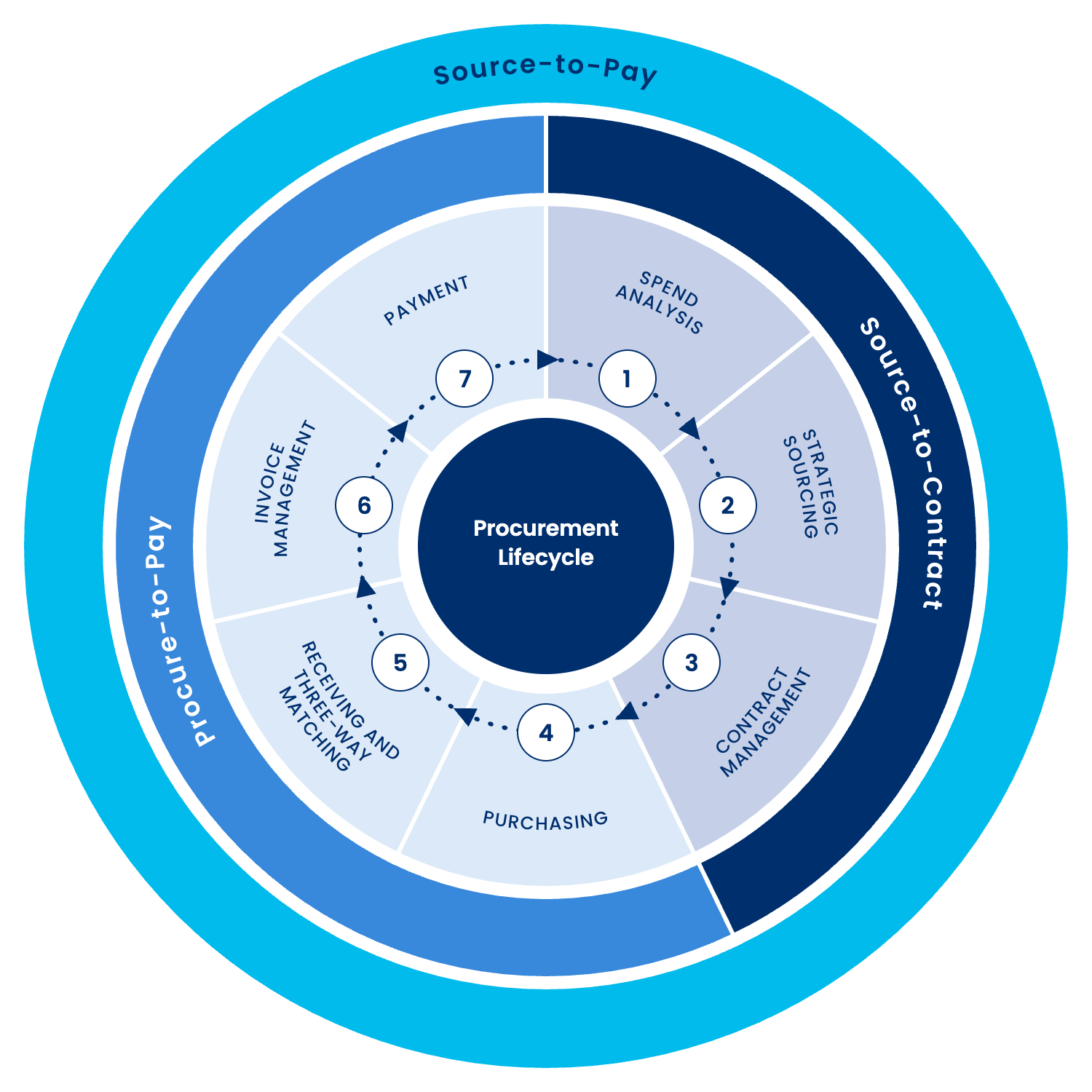
The seven lifecycle stages apply to all corporate purchasing, but each spend type stresses them differently. Indirect procurement (goods and services for internal operations) relies on catalog adoption, user compliance, and automated invoice clearance. A weak front door leaks money, though it rarely stops a production line.
Direct procurement (materials tied to finished products) runs under tighter constraints. Multilevel Bills of Materials (BOMs) link each finished product to components spread across several tiers of suppliers. Engineering changes alter those components mid-contract. Plant capacity limits how much any one supplier or site can deliver. A late or mispriced component halts production, so supply continuity matters as much as price, and buyers back it with strict supplier audits and direct synchronization with ERP and Material Requirements Planning (MRP) production schedules.
An intake form or chatbot in front of the ERP can’t carry that load. Direct spend needs a transactional engine that:
Indirect procurement benefits from a strong core. Direct procurement can’t function without one.
This foundational stage aggregates, cleans, and categorizes historical operational and financial expenditure to identify unmanaged spend, supplier consolidation opportunities, and cost reduction targets across direct and indirect categories. Procurement analysts, category managers, and finance teams review this spend analysis data to establish baseline performance metrics and compliance gaps. The resulting strategic spend insights are handed off directly to the sourcing team to prioritize upcoming sourcing events.
In this stage, category leads and strategic sourcing teams draft RFXs (RFIs, RFPs, RFQs) and evaluate competitive bids to select optimal suppliers based on price, performance, quality, and risk. Indirect sourcing focuses on preferred supplier lists and negotiated rate cards, while direct sourcing requires rigorous supplier factory auditing, capacity testing, and BOM specification alignment. Once a winning supplier is awarded, the finalized terms, pricing structures, and commitments hand off to legal and procurement specialists for formal contracting.
Procurement contract specialists, legal counsel, and supplier executives collaborate to draft, negotiate, and execute legally binding agreements that establish concrete SLAs, volume pricing tiers, and penalty clauses. Centralizing these documents in a shared repository ensures that negotiation parameters are recorded rather than lost in email threads. Once executed, active contracts are published directly into the downstream purchasing engine as operational catalogs, preapproved rate cards, or active line items. Learn more about contract lifecycle management in our comprehensive guide.
Employees and inventory managers initiate purchase requisitions against these pre-negotiated catalog items (indirect) or MRP inventory schedule triggers (direct), which automatically route through preset management approval workflows. Buyers and procurement admins oversee high-value exceptions, ensuring that compliant requests automatically convert into formal POs. The approved PO is then automatically transmitted to the supplier while simultaneously logging line items into the internal tracking system for downstream receipt validation.
Warehouse managers, facility leads, or project owners receive the ordered goods or services and record a digital goods receipt note (GRN) or service entry sheet detailing item quantities and acceptance status. Receiving teams log partial deliveries, damaged shipments, or line-item discrepancies directly against the original PO line items. Verified receiving records and accepted quantities are immediately handed off to accounts payable to prepare for invoice reconciliation.
AP specialists and automated ingestion engines capture incoming vendor invoices via electronic portals or OCR scanning technology. The system automatically executes a three-way match, validating the line-item prices, quantities, and payment terms against the corresponding purchase order and goods receipt. Exception-free invoices pass through touchlessly for payment approval, while line-item mismatches are automatically flagged and routed to buyers or approvers for rapid exception handling.
Treasury and financial controllers review approved invoices and schedule electronic disbursements (ACH, virtual card, or wire transfer) according to contract terms. AP managers leverage this centralized workflow to capture early payment discounts and balance working capital needs without risking late payment penalties or supplier relationship strain. Completed payment confirmation records feed directly back into spend analysis reporting, closing the complete lifecycle loop and providing real-time data for future negotiation cycles.
Coupa unifies sourcing, procurement, and payment on one platform, so the savings you negotiate actually reach the bottom line.
While these acronyms are frequently conflated, understanding the difference between source-to-pay and procure-to-pay comes down to overall scope. Comparing source-to-pay to procure-to-pay is the difference between governing the complete end-to-end expenditure lifecycle versus managing only downstream purchasing execution. Evaluating source-to-contract vs procure-to-pay splits that lifecycle into its strategic upstream preparation and its transactional downstream fulfillment.
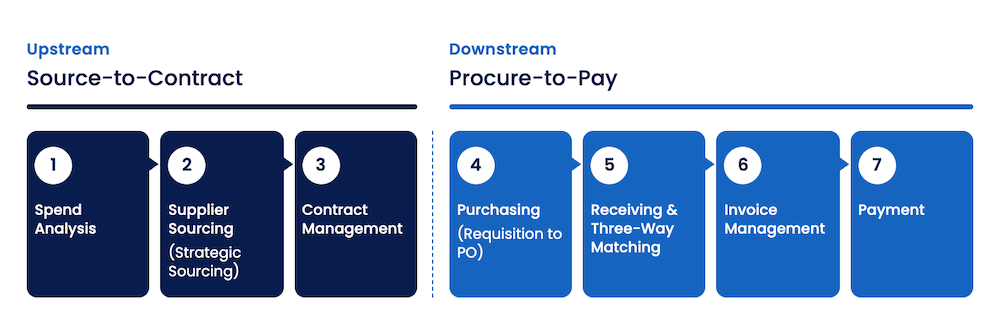
To evaluate how these frameworks differ across scope, ownership, metrics, and spend categories, review the side-by-side comparison below:
| Feature / Dimension | Source-to-Contract (S2C) | Procure-to-Pay (P2P) | Source-to-Pay (S2P) |
| Lifecycle scope | Upstream: Stages 1-3 (Spend analysis, Sourcing, Contracting) | Downstream: Stages 4-7 (Purchasing, Receiving, Invoicing, Payment) | Full chain: Stages 1-7 (Spend analysis through Payment) |
| Operational focus | Strategic: vendor discovery, market evaluation, pricing negotiation, legal alignment | Transactional: buying execution, requisition approvals, receiving, invoice matching | Unified: bridging upstream terms with downstream spend to prevent savings leakage |
| Primary owner | Strategic Sourcing, Category Managers, Legal | Purchasing Admins, Accounts Payable, Requisitioners | CFO, VP of Procurement, Head of Supply Chain |
| Primary metrics | Negotiated savings percentage, contract cycle time, supplier risk coverage | Cost per invoice, three-way match rate, PO-to-invoice cycle time, early-pay discount capture | Realized savings, total spend under management, maverick spend percentage |
| Direct vs. indirect focus | Negotiating direct BOM pricing vs. enterprise indirect rate cards | Auto-generating direct POs via MRP vs. employee indirect catalog ordering | End-to-end visibility and controls across both direct and indirect expenditure |
Source-to-contract (S2C) represents the strategic upstream half of spend management, spanning spend analysis, supplier sourcing, and contract execution. It focuses on aggregating organizational demand, evaluating vendor supply chain risks, negotiating volume pricing structures, and establishing legally binding agreements. Source-to-contract lays the structural groundwork before a single purchase order is placed.
Procure-to-pay (P2P) represents the transactional downstream half of spend management, covering purchase requisitioning, purchase order generation, goods receiving, invoice three-way matching, and payment disbursement. Procure-to-pay focuses on day-to-day operational efficiency, touchless invoice automation, catalog compliance, and enforcing the commercial terms negotiated during the upstream sourcing phase.
It can be tempting to tackle procurement transformation in phases, focusing either solely on strategic sourcing (upstream) or transactional purchasing (downstream). New research from Coupa Spend Lab reveals that upstream (source-to-contract) and downstream (procure-to-pay) activities can improve independently of one another. While this isolated progress might sound like a win on the surface, it ultimately means companies are missing out on the maximum financial impact from their digital technology investments.
The reality is that these two halves are deeply interdependent. Investing exclusively in upstream activities means companies eventually lack the downstream operational data required to actually enforce those negotiated terms or measure realized value. Conversely, investing only in downstream execution inherently limits the amount of strategic value and savings teams can create in the first place.
For digital transformation to be truly successful, finance and procurement leaders must invest in building a strong, intentional link between upstream strategy and downstream execution. That connective bridge doesn’t just emerge on its own. The companies that intentionally move high-impact spend categories rapidly through the complete, unified source-to-pay cycle are the ones who will see the biggest financial wins.
The primary benefits of source-to-pay stem from connecting all seven lifecycle stages onto a single, unified operational platform. When sourcing, procurement, and accounts payable operate in separate software tools or spreadsheets, critical contract data gets lost in transit. Unifying the entire process unlocks operational leverage, enabling global enterprises to scale transactional volume without linearly adding administrative headcount.
Savings negotiated upstream during strategic sourcing only reach the P&L if downstream buyers actually purchase against those contracts. A unified source-to-pay engine enforces negotiated pricing at the point of purchase so hard-won discounts hit the bottom line.
Consolidating direct and indirect purchasing into a single portal gives finance leaders complete operational line-of-sight, automatically flagging noncompliant or off-contract purchases before money leaves the building.
Automating invoice intake, line-item data extraction, and three-way matching eliminates manual data entry, dramatically shortening the requisition-to-payment lifecycle while driving down cost-per-invoice.
Centralizing contract terms and embedding real-time supplier monitoring ensures purchases align with internal governance policies and regulatory mandates while flagging third-party supply chain risks early.
Maintaining a single, collaborative supplier portal simplifies order tracking and ensures predictable, on-time payments, allowing finance teams to capture early payment discounts without straining cash flow.
For growing companies establishing their first formal procurement function, a unified source-to-pay system provides the policy guardrails, approval workflows, and contract repositories out of the box. This enables a single procurement manager or a multitasking finance team to effectively manage corporate spend with the capability and control of a mature enterprise department.
When technology enterprise Ping Identity evaluated its procurement operations, disconnected point solutions and fragmented workflows hid critical expenditure data and slowed down purchasing execution. By unifying its end-to-end source-to-pay process onto Coupa, Ping Identity eliminated disparate purchasing silos and achieved 100% spend visibility across its entire organization. This complete connectivity ensured that every negotiated contract term directly governed downstream purchasing and payment execution, providing the operational scale needed to expand the business efficiently.
The work of digital transformation doesn’t stop at unifying the source-to-pay workflow. Companies must also plan how to prove its financial and operational return. Here, performance is tracked across the entire procurement lifecycle. Without clear metrics, leakage re-emerges undetected through maverick buying, delayed invoice processing, and missed discount windows.
By monitoring key performance indicators (KPIs) across the full source-to-pay spectrum, organizations isolate operational bottlenecks and quantify total value realization:
Traditional source-to-pay processes relied heavily on manual data entry, rigid document templates, and backward-looking spreadsheets. This created operational friction, data silos, and human error at nearly every stage. Incorporating agentic source-to-pay capabilities transforms procurement from a slow, reactive administrative function into an automated, growth-driver.
Rather than treating AI as a buzzword or replacing human judgment, agentic source-to-pay technology acts as an intelligent decision-support layer, making a company’s core procurement engine work the way sourcing and procurement practitioners have always wished it would. By combining intelligent document processing, real-time market signals, and predictive agents, AI keeps clean data moving seamlessly across the entire lifecycle:
For lean or newly formed procurement teams, AI serves as an operational force multiplier. Intelligent automation auto-classifies spend categories, screens supplier risk, and checks invoice accuracy, allowing a single procurement lead to govern hundreds of millions in spend without drowning in manual line-item reviews.
Streamlining source-to-pay requires unifying upstream strategic sourcing and downstream purchasing on a single platform to eliminate siloed manual handoffs. Organizations can accelerate cycle times by automating invoice three-way matching, enforcing on-contract buying through pre-approved catalogs, and establishing real-time spend visibility across all departments.
Spend management is the overarching business discipline and financial strategy focused on managing, controlling, and optimizing all corporate expenditures. Source-to-pay is the operational process and end-to-end workflow — from spend analysis through vendor payment — used to execute that spend management strategy in practice.
Ultimate ownership of the source-to-pay process lies jointly with the CPO and CFO. While procurement category managers typically own upstream sourcing and contract negotiations, accounts payable and finance teams govern downstream purchasing execution, invoice reconciliation, and disbursements.
Yes, modern cloud source-to-pay platforms are designed to integrate seamlessly with core ERP systems like SAP, Oracle, and NetSuite. Source-to-pay software enhances your ERP by capturing preapproved spend data at the point of origin, synchronizing purchase orders, master vendor data, and general ledger accounts in real time.
No. While legacy source-to-pay deployments were historically built for global conglomerates, modern cloud source-to-pay solutions are heavily leveraged by fast-growing midsize and emerging enterprises ($250 million to $1 billion in annual revenue). Implementing unified source-to-pay allows procurement and finance teams at companies of this size to eliminate maverick spend, protect operating margins, and scale transaction volume efficiently without linearly adding administrative headcount.
No. In fact, fast-growing midsize and emerging enterprises often implement source-to-pay precisely because they don’t have a large procurement staff. Source-to-pay software embeds policy controls, pre-approved supplier catalogs, and automated invoice matching directly into everyday employee workflows, allowing finance and operations leads to maintain total control over cash flow without needing a dedicated procurement department. Awarded pricing from sourcing events also flows into ERP purchasing records without manual re-keying, so the price negotiated is the price on the purchase order.
A front door is only as good as the transactional engine behind it. The procurement spotlight for our September 2026 product release explores Coupa’s new autonomous sourcing agents are turning spend data into automated action, consolidating direct materials catalogs, and flowing negotiated rates directly into downstream agreements without manual data entry.
Oh! It looks like you opted out from using the needed cookies. If you are interested in using the AI Agent, then please opt-in to the cookies in the preference center.
Update preferences