Volatile news. Stable spend.
Read the latest in the Coupa Business Spend Index™ Quarterly Update.
Get the Report





The market winced. Business spend held firm.
The Coupa Business Spend Index™ Quarterly Update

Spend analysis reveals where your money goes and where it shouldn’t. For procurement and finance leaders navigating margin pressure, supply chain unpredictability, and cost volatility, understanding spending patterns isn’t optional. It’s essential for survival.
Yet nearly 40% of business leaders lack full visibility into their spend data. Procurement spend analysis addresses this gap by unifying and transforming raw transaction data into strategic intelligence. Without this visibility, organizations miss savings opportunities, struggle with supplier management, and make conclusions based on incomplete information. The gap between knowing what you spent and discerning why you spent it can cost millions annually.
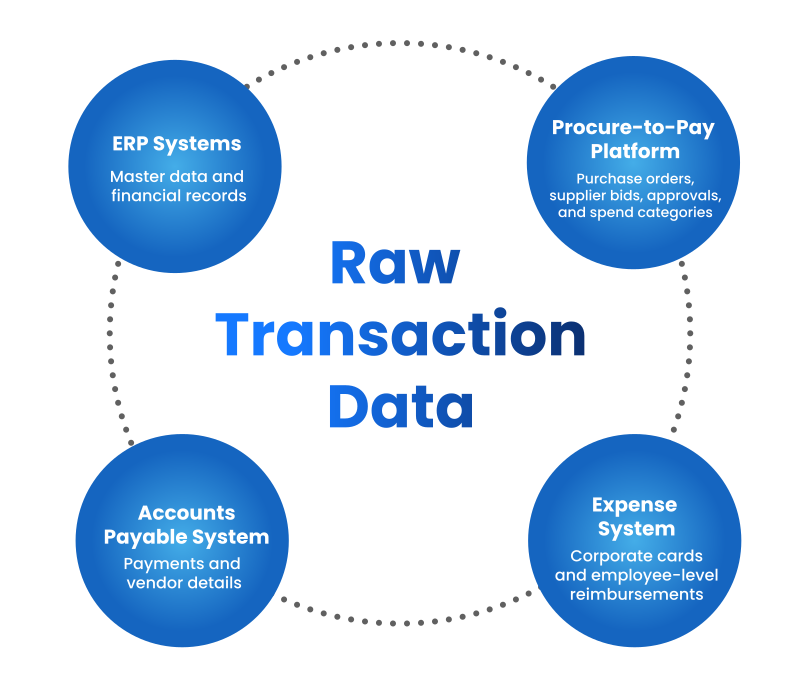
Spend analysis in procurement is the systematic examination of procurement data to understand purchasing patterns, identify cost-saving opportunities, and improve process efficiencies. It transforms raw transaction data into strategic intelligence that drives better business decisions. Raw transaction data can originate from various sources, including ERP systems, supplier bids from digital auctions, accounts payable systems, or corporate credit cards.
At its core, spend analysis answers critical questions that shape procurement strategy:
Effective spend analytics relies on clean spend data organized into meaningful spend patterns. Ideally, all raw transaction data is consolidated on a single, unified spend management platform to make this clean data approach possible. When done right, it reveals duplicate suppliers, maverick spending, price variations, and consolidation opportunities that remain hidden in spreadsheets and disparate systems.
Organizations that implement structured spend analysis and a unified Agentic Spend Management approach achieve 8.1% savings on addressable spend, more than double the 2-3% realized through traditional approaches, according to Coupa’s latest Benchmark Report. AI-native Agentic Spend Management platforms like Coupa analyze $8 trillion in transactional data to surface granular cost savings opportunities tailored to each customer’s industry and spend profile.
Top performing companies with spend analysis software experience a 24.4% increase in spend management visibility. More visibility into total spend, including direct and indirect spend, means teams uncover previously hidden opportunities to reduce risk and cost, drive compliance, and manage supplier relationships. Understanding spending across all categories, suppliers, and business units enables better budget allocation and identifies areas where spending exceeds targets before it impacts the bottom line.
Automated spend classification and analysis eliminates weeks of manual data manipulation. Out-of-the-box reports and dashboards allow teams to shift from preparing reports to interpreting insights and taking action. This efficiency gain allows procurement professionals to focus on strategic initiatives rather than data collection.
Detailed spend analytics reveal which suppliers deliver the most value and which create risk. Organizations can consolidate purchasing with top performers, negotiate better terms based on actual volume, and proactively address supplier concentration issues before they disrupt operations.
Both vendor spend analysis and supplier spend analysis reveal performance patterns, price competitiveness, and risk indicators. Understanding which vendors deliver value and which create dependencies enables more innovative supplier portfolio management and targeted relationship investments.
Accurate data accelerates strategic decisions. Real-time visibility into spending patterns supports scenario planning, helps evaluate sourcing strategies, and provides the foundation for long-term procurement transformation.
Conducting spend analysis requires a systematic approach that transforms fragmented data into actionable insights. The process involves six key steps that build upon each other to deliver comprehensive visibility into organizational spending.
Gather spending data from all sources across your organization — ERP systems, procurement platforms, credit card statements, and invoicing and expense systems. The goal is complete coverage of both direct and indirect spend.
Data capture challenges often stem from decentralized, disconnected purchasing processes or multiple legacy systems. Organizations must extract transaction records, supplier information, contract details, and payment histories to build a complete picture. The best way to avoid endless manual integration is to switch to a single AI-native Agentic Spend Management platform, where all processes and data flows are consolidated in one place.
Quick tip: Use a single platform with legacy ERP integration built in to reduce technology debt or third-party automation data feeds from separate source systems.
Raw data contains inconsistencies and errors that undermine analysis accuracy. Data cleansing standardizes formats, removes duplicates, and corrects inaccuracies to create a reliable foundation.
AI data cleansing tools automate tedious manual processes that previously made continuous data maintenance impractical. Modern systems detect formatting issues, standardize supplier names, validate tax codes, and flag anomalies for review, all at scale and with minimal human intervention.
Quick tip: Don’t treat data cleansing as a one-time implementation task. Organizations with dynamic spend patterns benefit from quarterly cleansing cycles that prevent data degradation and maintain classification accuracy.
Classification organizes spend into logical categories and subcategories based on what’s being purchased. Proper categorization reveals spending patterns, enables category-level analysis, and supports strategic sourcing decisions.
Manual classification is time-consuming and inconsistent. AI-powered tools like Coupa’s AI Classification automatically categorize transactions using machine learning trained on insights from $8 trillion in global spend data, achieving up to 95% category coverage within 30 days, a process that would take months manually.
Quick tip: Start with industry-standard taxonomies but customize categories to match your business needs. The right classification structure balances granularity with usability, detailed enough for insights but not so complex that it becomes unmanageable.
Combine internal spending data with external information such as market pricing, supplier risk scores, and industry benchmarks. This context transforms spend analysis from backward-looking reporting to forward-looking, strategic intelligence.
External data sources include market indexes, supplier financial health indicators, sustainability ratings, and community intelligence from peer organizations. Merging these data sets reveals whether you're paying competitive prices and identifies suppliers that may pose performance or compliance risks.
Quick tip: Leverage platforms that provide built-in access to community benchmarking data. Comparing your spend patterns against industry standards quickly highlights outliers and opportunities.
Transform cleansed, classified data into insights through analysis and visualization. Look for spending concentration, price variations, contract compliance, and savings opportunities across categories and suppliers.
Effective visualization makes complex spending patterns immediately apparent. Dashboards should highlight key metrics like spending by category, supplier concentration, maverick spend percentage, and contract utilization rates in formats that enable quick understanding and action.
Quick tip: Focus on actionable KPIs rather than vanity metrics. The best spend analysis solutions provide actionable recommendations and dashboards that answer specific questions — “Where can we consolidate suppliers?” or “Which categories show the highest price variance?” — not just display data.
Analysis only creates value when it drives action. Use insights to renegotiate contracts, consolidate suppliers, enforce compliance, and implement sourcing strategies that reduce costs and manage risk.
Successful organizations treat spend analysis as a continuous cycle rather than a periodic project. As you implement changes, measure results, refine your approach, and repeat the process quarterly to maintain data quality and capture new opportunities as business conditions evolve.
Quick tip: Establish clear ownership for acting on spend analysis findings. Assign specific savings targets to procurement category managers and track progress against benchmarks to ensure insights translate into measurable results.
Visibility of managed spend represents the percentage of total company spend that is captured within the procurement system. Top-performing organizations with spend analysis software experience a 24.4% increase in visibility of managed spend using AI tools that automatically categorize transactions, normalize supplier data, and surface spending patterns hidden across disparate systems. More visibility into total spend means teams uncover previously hidden opportunities to reduce risk and cost, drive compliance, and manage supplier relationships more effectively.
Tail spend is the portion of a company’s total spending that is low in value but high in volume. Low-value transactions with numerous suppliers often represent 20% of total spend but 80% of suppliers. Tail spend analysis reveals opportunities to consolidate purchases, reduce supplier counts, and automate low-value buying through catalogs or purchasing cards.
Supplier spend analysis measures vendor concentration, identifying dependencies and consolidation opportunities. If 80% of spend goes to 20% of suppliers, you likely have leverage for better pricing. If spending is too fragmented, consolidation can reduce complexity and improve efficiency.
This shows not just who money is being spent on (supplier-level) but also what it’s being spent on (line-item level). Granular analysis by category or SKU reveals price variations, volume discounts you're missing, and categories where specifications can be standardized. This detail supports targeted sourcing strategies rather than broad-brush approaches.
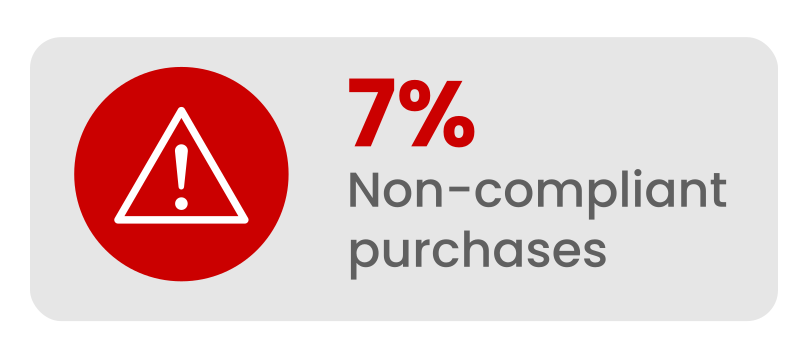
Maverick spend refers to purchases made outside of approved procurement processes, systems, or supplier contracts. Off-contract or non-compliant purchases undermine negotiated agreements and create compliance risk. Tracking maverick spend as a percentage of total spend highlights process gaps and helps quantify the value of improving compliance through better user experiences.
Traditional approaches to establishing clean, mature, and trusted data that mainly rely on human involvement often fail to deliver the classification, normalization, and enrichment of spend data needed for insightful analytics. Organizations face several key obstacles when conducting effective spend analysis.
Spend data scattered across multiple systems, inconsistent supplier names, and missing transaction details make analysis nearly impossible. When data quality is poor, teams spend more time consolidating information, fixing errors, and cleansing data than generating insights.
How to overcome it: Deploy a spend management platform that automates data aggregation, classification, and reporting. Consolidating data and processes on one platform with automated workflows also frees procurement teams to focus on strategic analysis and execution rather than preparation.
Extracting data from multiple sources, manually categorizing transactions, and building reports in spreadsheets can take weeks or months. By the time analysis is complete, the data is outdated, and opportunities have passed.
How to overcome it: Deploy a spend management platform that is equipped with out-of-the-box dashboards and implement AI-powered classification tools that automatically standardize supplier names, categorize transactions, and flag data quality issues. Coupa’s AI Classification reduces analytics effort by 50% while achieving enterprise-grade accuracy at scale.
Without consistent categorization schemes, different business units classify the same items differently. This inconsistency prevents organization-wide visibility and makes benchmark comparisons meaningless.
How to overcome it: Establish enterprise-wide taxonomy standards that balance granularity with usability. Modern spend analysis solutions build custom taxonomies automatically based on your actual spending patterns while maintaining industry-standard compatibility.
Internal data alone can’t tell you whether your costs are competitive. Without external benchmarks, organizations struggle to identify whether spending levels represent opportunities or already reflect best-in-class performance.
How to overcome it: Select spend analysis tools with built-in community intelligence. Platforms analyzing trillions in global spend provide objective benchmarks showing how your costs compare to peers in your industry, revealing specific opportunities for improvement.
Even excellent analysis creates no value if stakeholders don’t act on insights. Procurement teams often struggle to drive change when business units resist new processes that would capture identified savings.
How to overcome it: Make compliant purchasing easy through guided buying experiences and pre-negotiated catalogs. When the right choice is also the easiest choice, adoption improves naturally without heavy enforcement.
Look for platforms that connect seamlessly to your ERP and legacy systems, automatically extracting and standardizing spend data without manual intervention. Built-in cleansing capabilities should handle supplier normalization, duplicate detection, and data validation at scale.
AI-powered classification augments human expertise to deliver exceptional accuracy when categorizing spend. Modern solutions combine machine learning with procurement knowledge to provide deeper insights into spend, revealing not just what purchases are made, but from whom, where, when, and why. This context enables teams to identify savings opportunities, spot spending irregularities, and make decisions that manual analysis would miss.
Look for platforms with comprehensive AI capabilities beyond classification, including fraud detection, anomaly identification, prescriptive recommendations, and intelligent insights that continuously learn from community data. The best spend analysis solutions embed and leverage AI across the entire procurement lifecycle — from intake and requisitions to payments — to deliver faster, more accurate insights with less manual intervention.
These days, static monthly reports are insufficient. Choose solutions that provide real-time dashboards and customizable reports, allowing you to monitor spending as it occurs and respond quickly to emerging trends, disruptions, or other issues.
The best spend analysis platforms compare your performance against real-world data from peer organizations, not just generic survey responses. Community-driven benchmarks reveal whether your costs are competitive and where specific opportunities exist.
Your spend analysis solution should handle growing data and transaction volumes as your organization expands while remaining accessible to users across procurement, finance, and business units. Intuitive interfaces drive adoption and ensure insights reach decision-makers.
Spend analysis delivers maximum value when connected to the entire procurement lifecycle. Look for platforms where insights flow directly into sourcing events, contract management, and procurement workflows, seamlessly turning analysis into action.
Successful spend analysis initiatives require support from finance and procurement leadership. Executive alignment secures resources, removes obstacles, and drives organization-wide adoption of spend analysis software, insights, and recommendations.
Set specific targets for what you want to achieve, whether it’s 5% cost reduction, 90% contract compliance, or 30% supplier consolidation. Clear goals focus efforts and provide measurable criteria for evaluating processes.
Rather than analyzing everything at once, begin with categories representing significant spend or known challenges. Early wins build momentum and demonstrate value that supports broader rollout across the organization.
Schedule regular data cleansing cycles — quarterly is optimal for most organizations — rather than treating it as a one-time effort. Continuous data maintenance ensures analysis accuracy and prevents costly actions based on outdated information.
Break down silos between procurement, finance, IT, supply chain, and business units. Regular meetings to review spend analysis findings and coordinate action plans ensure insights translate into measurable results across the organization.
Modern spend analysis platforms offer powerful AI capabilities. Use them. Automated classification, intelligent insights, and prescriptive recommendations dramatically reduce manual effort while improving accuracy and identifying opportunities humans might miss.
Track results from implemented changes, measure savings realization, and refine your approach based on what works. Spend analysis is a continuous improvement cycle, not a one-time project.
Mieti, the UK’s leading facilities management and professional services company, faced a challenge many organizations know well: reliance on manual processes, disconnected systems, and limited visibility into £2 billion in annual spend. By consolidating different systems onto Coupa's AI-native Agentic Spend Management platform, Mitie transformed spend analysis from a time-consuming administrative burden into a strategic advantage. The company now processes over 100,000 electronic invoices, reduced its supplier base by 60%, and achieved 99% PO-backed invoices, giving leadership real-time access to category strategies, pricing analysis, and supplier relationships that maximize margins while minimizing risk.
“We’ve eliminated 10 different systems with Coupa,” says Shaun Carroll, Mitie’s Chief Procurement Officer. “That consolidation has given us better control, better visibility, and a higher level of confidence in the data that we have.”
Every dollar your organization spends represents an opportunity to reduce costs, improve process efficiency, strengthen supplier relationships, and make smarter decisions. But without comprehensive spend visibility, those opportunities remain hidden in spreadsheets, scattered systems, and fragmented data.
Coupa’s AI-native Agentic Spend Management platform transforms spend analysis from a periodic reporting exercise into continuous intelligence that drives measurable results. With access to data insights from $8 trillion in global transactional spend and 10 million buyers and suppliers, Coupa provides the proactive recommendations and automated capabilities that make world-class spend analysis accessible to organizations of any size, from enterprises to public sector organizations.
Stop guessing where your money goes. Discover how Coupa's spend analysis solutions can help you uncover hidden savings, improve supplier performance, and build the data-driven procurement strategy your organization needs to thrive.
Oh! It looks like you opted out from using the needed cookies. If you are interested in using the AI Agent, then please opt-in to the cookies in the preference center.
Update preferences