Drive smarter spend strategies with AI
See what exceptional performance looks like and learn how to close the gaps.
Get the Benchmark Report





Drive smarter spend strategies with AI
The Total Spend Management Annual Benchmark Report

This post is the second in a four-part series designed to help procurement leaders master the art and science of category management.
Category strategy is a framework for aligning sourcing decisions with business priorities. This starts with a clear understanding of the company’s needs, but those insights aren’t enough on their own. To make smart, actionable decisions, procurement also needs to connect internal objectives with the realities of the supply market.
The process of building a winning category strategy includes four interconnected phases:
This blog post focuses on Phase 2: External Market Analysis. Building on the internal insights captured in Phase 1, this phase turns attention outward. Through careful examination of market forces, supplier dynamics, and risks, it empowers procurement teams to determine what’s possible and identify where opportunities truly exist.
Supply markets are influenced by a wide range of forces, including economic volatility, geopolitical events, regulatory changes, technology innovations, and more. These factors are largely outside of an organization’s control, but they have a direct impact on sourcing decisions.
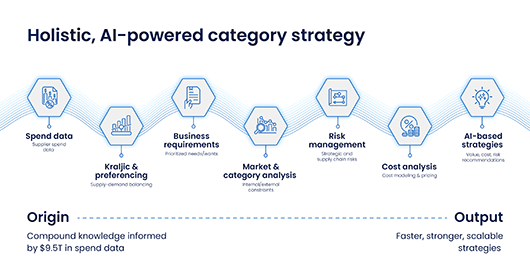
In Coupa’s guided approach to category strategy, Phase 2 is dedicated to understanding these external market dynamics. This phase helps procurement teams develop a holistic, fact-based view of the products and services they buy, by taking a deep dive into the challenges and opportunities that exist across the supply chain.
Paired with the analysis from Phase 1, this external perspective ensures that category strategies reflect both business priorities and real-world market conditions — rather than making decisions in a vacuum.
External analysis can feel complex because it requires looking at many market dimensions — all at the same time. A structured framework helps to make the task more manageable and reduces the risk of missing critical questions.
Following are 10 useful tools for building a well-rounded view of the supply market:
One of the most common frameworks in category strategy development, the Kraljic Matrix helps to determine the category’s strategic impact on the business, using a 2x2 grid with business impact on one axis and supply market complexity on the other. The category’s position on the matrix helps teams understand how critical the category is and how much it relies on the supply market — providing a strong signal of how actively the category should be managed.
This framework examines the competitive dynamics within a market by looking at the relative influence of:
Understanding these five market drivers helps teams recognize where power sits in the market, anticipate competitive pressures, and develop appropriate responses.
Another classic tool, the SWOT analysis highlights strengths, weaknesses, opportunities, and threats related to a specific category. Internal factors (strengths and weaknesses) are considered alongside external market factors (opportunities and threats) to identify ways that procurement can capitalize on advantages and/or address risks.
Breaking a product or service into its individual components — with their respective requirements and specifications — creates transparency into the supply chain that supports it. This level of detail is especially valuable for complex or formulated products, where risks and opportunities often sit several layers below the finished item.
Cost analysis is focused on understanding cost structures, cost drivers, and total cost of ownership. By examining elements like raw material pricing, index movements, foreign exchange rates, and historical price trends, teams can identify cost pressures, forecast changes, and uncover potential levers for negotiation.
Market analysis provides a high-level view of the environment where procurement operates. This includes market size and structure, regulatory considerations, technological innovations, regional variations, and more. It defines the playing field — and constraints — within which the category strategy must work.
As regulatory mandates and stakeholder scrutiny increase, ESG factors become central to effective category strategy decisions. Analyzing sustainability, diversity, and social responsibility requirements allows procurement to factor these priorities into its approach — ultimately reducing environmental impact, supporting sustainable development, and promoting inclusivity within the supply chain.
Risk analysis identifies internal and external risks that could disrupt supply or impact business performance — an important exercise for ensuring organizational resilience. By evaluating the likelihood of these risks and visualizing them in a risk matrix, a risk profile emerges and targeted risk mitigation plans can be developed.
Understanding the supply market means understanding its players. Supplier profiles capture information on current and potential suppliers, including capabilities, offerings, performance, and relevant public data. These insights help procurement assess market maturity and identify realistic value opportunities.
Supplier preferencing is a framework for examining how attractive the buying organization is to its suppliers and how important the business relationship is to them. Using a 2x2 grid adapted from the Kraljic Matrix, this tool helps procurement understand relationship dynamics and use those insights to improve negotiations, collaboration, and risk management.
Taken as a whole, external analysis gives procurement a clear view of how a given supply market works — its rules, its players, and its drivers. Combined with the internal insights gathered in Phase 1, it enables teams to move into the strategy phase with confidence.
By grounding strategic choices in both business needs and market realities, procurement can define value levers that are both ambitious and achievable. Skipping this step — or relying on market insights that are outdated or incomplete — increases the risk of strategies that look good on paper but fail in execution.
While external analysis may begin with internal expertise and “desk research,” it becomes much more powerful when enriched with external market intelligence and data feeds. These inputs help keep insights current, surface emerging risks or opportunities, and ensure that category decisions remain relevant as market conditions evolve.
Navigating the complexities of the supply market is no small task. But Coupa Category Strategy is designed to help category managers view the market from all angles and answer the most important questions about market drivers.
This powerful platform empowers procurement teams to build holistic, value-driven category strategies that deliver real business impact. Using a proven methodology to guide every decision, this AI-native technology makes category insights actionable by putting business requirements and deep market insights at the core of strategy development.
For a quick overview of category strategy development, download 4 Step Roadmap to Building an Effective Category Strategy. You can also get more insight on procurement maturity and AI readiness in our e-book, Preparing for the Future of Global Trade: A Roadmap for Procurement.
This post is Part 2 of a four-part series on category strategy development. In Part 1, we explored how internal analysis lays the foundation. In Part 3, we’ll learn how to translate internal and external insights into a clear strategic vision.
Oh! It looks like you opted out from using the needed cookies. If you are interested in using the AI Agent, then please opt-in to the cookies in the preference center.
Update preferences