Volatile news. Stable spend.
Read the latest in the Coupa Business Spend Index™ Quarterly Update.
Get the Report





The market winced. Business spend held firm.
The Coupa Business Spend Index™ Quarterly Update

This post is the last in a four-part series designed to help procurement leaders master the art and science of category management.
A strong category strategy only creates value when it is put into action. Too often, well-designed plans stall after approval. Without clear ownership, consistent follow-through, or visibility into results, it’s easy to lose momentum. Unless you turn your strategy into clear, day-to-day projects, even the best plan will quietly fade away without delivering on its promise.
At a high level, developing an effective category strategy requires four interconnected phases:
This blog post focuses on Phase 4: Turning Strategy into Action. Building on the strategic direction defined in Phase 3, this final stage is all about putting your plans into motion — translating your strategy into specific projects, managing your delivery, and tracking the real value you create along the way.
By the time procurement teams reach Phase 4, the hard thinking has already been done. Business priorities are clear, market dynamics are well understood, and strategic value levers have been selected and validated. Now the focus shifts to execution.
In Coupa’s guided approach to category strategy, this phase centers on implementation and value tracking. The two go hand in hand: You need to actively manage your projects to succeed, and their impact must be visible to maintain momentum and business confidence. Without discipline, even the strongest strategy will end up gathering dust in a metaphorical drawer.
The execution phase also serves as the natural transition into long-term management of category spend — where all the hard work of category strategy development really pays off.
Even strategies that align with business needs and market realities can fall short if execution isn’t a core part of the process. Phase 4 brings structure and accountability to the final stretch, ensuring your strategy translates into real outcomes.
The execution phase includes four essential elements:
The first task is consolidating the strategy into a clear, compelling summary. You want to bring together key inputs like your business requirements, market drivers, and the reasons behind your chosen projects into a concise narrative tailored for your leadership team. An effective summary creates a clear line of sight between business goals and your category approach. Ideally, it tells the story in a format that’s easy to reference — often on a single page.
To move from intention to action, the strategy must be broken down into discrete, manageable activities. Each project needs clearly defined objectives, tasks, timelines, and owners. This is where strategy meets project discipline. Applying familiar project management practices — like task planning, mapping out who is responsible and accountable, tracking milestones, and setting up communication plans — keeps execution on track. Your projects could include anything from cutting costs and streamlining processes to collaborating with suppliers on new innovations.
Not all initiatives are designed to drive cost savings. Some are focused on reducing exposure to supply, operational, or compliance risks. Treating these risk-mitigation efforts as critical projects — rather than secondary activities — helps you demonstrate procurement’s broader value to the organization. Managing risk-focused initiatives alongside your commercial ones enables you to maintain a balanced view of performance and resilience across the category.
Execution doesn’t end when projects are launched. To demonstrate the strategy’s impact, you must estimate, monitor, and report your expected benefits over time. Tracking savings and value creation brings transparency to procurement, finance, and your executive leadership team. It also enables you to stay agile by highlighting delays, catching issues early, and identifying opportunities that exceed expectations. This visibility is critical for building trust and proving your role as a value-driving partner. The execution phase lets you transform your strategic category plans into actionable steps for driving value. It both completes the category strategy development process and transitions into the ongoing job of managing your spend category. Once established, you can easily track implementation progress, update spend data, and refine both internal and external insights.
The execution phase is where procurement teams often encounter peak complexity. Multiple initiatives run in parallel, stakeholder scrutiny is high, and market conditions continue to evolve. Having the right structure — and the right technology — makes all the difference.
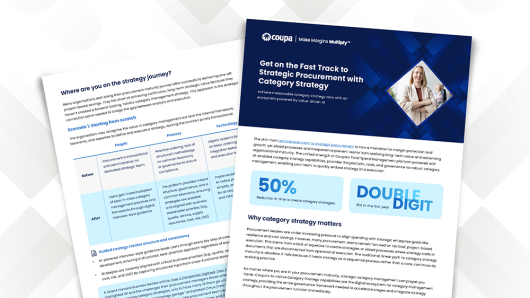
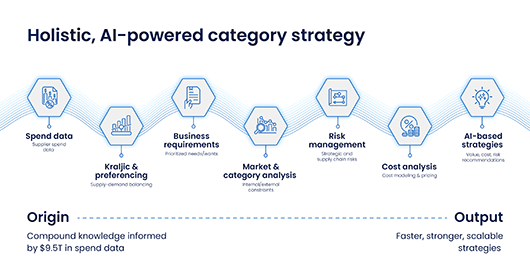
Coupa Category Strategy is designed to pull your plans out of static documents and embed them directly into your daily work. The platform automatically translates your validated strategy into real, trackable initiatives — such as targeted sourcing pipelines, supplier action plans, and embedded savings tracking.
This single digital ecosystem helps you move seamlessly from a completed strategy into execution. By automating how your sourcing awards convert into contracts and purchasing catalogs, you can accelerate your sourcing speed and maximize compliance. With AI-driven value orchestration, the system continuously tracks your financial and non-financial wins — like risk reduction and sustainability metrics — ensuring your category strategies continuously evolve and deliver maximum value over time.
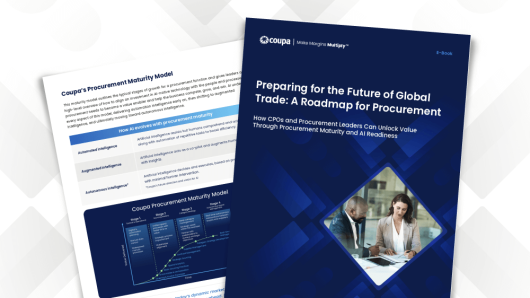
For a quick overview of category strategy development, download 4 Step Roadmap to Building an Effective Category Strategy. You can also get more insight on procurement maturity and AI readiness in our e-book, Preparing for the Future of Global Trade: A Roadmap for Procurement.
This post is Part 4 of a four-part series on category strategy development. In Part 1, we explored internal analysis. Part 2 focused on understanding the market. Part 3 examined how to define a clear strategic direction. Part 4 completes the journey, turning strategy into action and measurable results.
Oh! It looks like you opted out from using the needed cookies. If you are interested in using the AI Agent, then please opt-in to the cookies in the preference center.
Update preferences