Volatile news. Stable spend.
Read the latest in the Coupa Business Spend Index™ Quarterly Update.
Get the Report





The market winced. Business spend held firm.
The Coupa Business Spend Index™ Quarterly Update

If you feel like your procurement team is caught in a reactive cycle, you’re not alone. Many procurement organizations struggle to move from a strict focus on cost savings, to an approach that aligns with critical enterprise priorities and achieves strategic value.
Even as your procurement organization matures, you might still be missing a critical piece of the puzzle: a forward-looking, insight-driven category strategy.
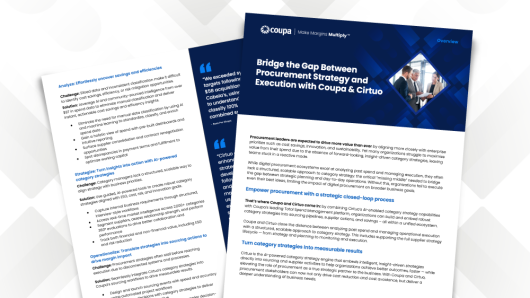
A robust category strategy is the essential bridge between procurement analysis and execution, empowering teams to drive holistic business impact and solidify procurement’s strategic value at the executive table.
This article will guide you through the basics of category strategy, including:
Category strategy serves as a north star in driving long-term, sustainable value across key spend categories. By aligning procurement strategies with business objectives, organizations benefit from direction, structure, and a clear plan of action to make informed decisions.
Category strategy offers a systematic way to evaluate and capture business requirements while creating category plans for goods and services. The goal is to help companies harmonize business needs with market conditions, helping them optimize costs, discover purchase opportunities, and generate business value.
Unlike traditional category management, category strategy encompasses the complete strategic scope of work, including the development, validation, and execution of comprehensive category plans.
Modern category management strategy also benefits from AI technologies that act as co-pilots to improve efficiency and drive outcomes that help elevate procurement’s strategic role. According to Kearney’s 2026 CPO Agenda, the focus will shift from experimenting with AI to proven implementation. This means category managers and procurement leaders should prioritize building AI directly into core category activities — such as data normalization, market analysis, and strategy development — rather than treating it as a standalone tool. Doing so enables sharper demand and market intelligence, along with the agility to respond quickly to supplier and sourcing shifts.
Category strategies help procurement shift away from a reactive mindset that prioritizes prices above all else, which can hinder sustainable growth and profitability. A well-rounded category strategy supports growth and profitability by:
Without a robust category strategy, your organization might end up reducing decision-making quality and risk falling short of broader business objectives, ultimately undermining procurement’s potential for strategic impact.
Category strategy is not limited to large enterprises with complex procurement functions. In reality, companies of all sizes and industries can benefit from a structured approach to category planning. While global organizations may apply it across hundreds of spend categories, mid-sized and growing companies often see outsized value by introducing category strategy early — before spend becomes fragmented or inefficiencies take hold.
As procurement functions mature, category strategy can evolve alongside them. Modern digital ecosystems and AI-enabled tools lower the barrier of entry, making it easier for teams to access insights, structure their spending, and think more strategically from the outset. Take Walmart, which uses AI for category strategy to not only ensure consistent execution across global markets, but also to transfer critical knowledge to new procurement team members quickly.
“The AI helped eliminate human error, inconsistency, and biasness, which generated actionable insights and objective strategies. It has also enabled more rapid onboarding of new Walmart Associates through knowledge preservation of existing categories managed by other sourcing professionals.”
— Travis Johnson, former Senior Director, International Procurement & Technology Enablement, Walmart
Organizations don’t need to wait until they are “fully mature” to adopt category management strategies. Building these capabilities early helps accelerate value and set a stronger foundation for long-term growth.
Before we dive into how to develop a strategy, let’s define our terms:
Categories are groups of goods and services companies purchase to optimize spend and maximize business value. Companies often define categories based on their most critical and strategic areas of spend across the business, such as raw materials, suppliers, technology, etc. Categories help procurement teams understand where costs are coming from, identify areas that need improvement, and manage spend effectively.
For example, a steel company might have categories such as:
Identifying categories and organizing them into a business-aligned category taxonomy helps clarify what you have, the impact that spend has on your business, and where you might need to invest more resources. A good taxonomy ensures every item of spend is in its proper place, making it easier to analyze, manage, and leverage for optimal value creation.
Category strategy is about understanding the business’s long-term vision, unique challenges and opportunities, then designing a comprehensive plan that balances cost, quality, sustainability, and risk to ensure the final product delivers maximum value and meets all business requirements.
A good category strategy is a holistic one and typically involves:
Many companies are stuck in a tactical (rather than strategic) phase of procurement maturity. This often means their category management might consist of basic supplier segmentation and a high level framework for matching spend activities with a set of suppliers. They’re likely primarily looking for cost reduction. A more developed approach to category management will address a broader range of business requirements and embrace a more holistic approach.
We recommend a comprehensive, multifaceted framework for category strategy. The framework should offer a structured process, ensure business objective alignment, and combine best practices and methodologies that make the most sense for your business.
The framework you choose may include a mix of the following:
A holistic approach helps organizations make informed, value-driven decisions that integrate strategic insights directly into sourcing and supplier activities to achieve better outcomes faster.
Effective category strategies depend on clear, accurate visibility into spend data. That data must reveal cost drivers, surface opportunities for savings and efficiency, and support risk mitigation. But to be truly actionable at scale, insights need to be built on structured data and a common taxonomy, ensuring consistency across categories and business units.
Data quality is equally critical. Cleansed and reliable data ensures that insights reflect true operational realities, not assumptions. A connected digital ecosystem — often enabled through a single integrated platform — allows data to be automatically managed and creates actionable insights. This gives procurement a comprehensive understanding of business requirements (growth, ESG costs, risk, and innovation goals) alongside evolving market dynamics, laying the foundation for holistic category strategies.
Now that you know what factors to consider when developing a category strategy, how do you actually implement one?
Most procurement organizations progress through four distinct stages of category strategy maturity. The first step is to determine where your organization sits on the maturity spectrum. Then you can apply technology with intention — addressing the right challenges at the right time. It also lays the foundation for a more advanced category management strategy as procurement evolves.
| Stage 1
Tactical & Operational |
Stage 2
Sourcing Mastery |
Stage 3
Category Strategy |
Stage 4
Agentic Spend Management |
| Reactive ordering
No dedicated strategic category team and limited governance Supported by legacy systems that lack a common taxonomy and analysis capability |
Category managers spend 50% of their time on manual data collection
Inconsistent strategies are siloed from sourcing Some automation for sourcing, but limited tech prevents strategy execution and value tracking |
AI normalizes and classifies data
Category managers focus on value beyond savings and collaborate across the business to strengthen strategy planning A single platform for all activities provides a structured, scalable approach |
AI agents support sophisticated planning by identifying opportunities
Business objectives are integrated into the category strategies automatically Performance tracking across various value categories validates ROI |
A agentic spend management solution provides the foundation for an effective category strategy and embeds AI at core steps. It helps you identify the right opportunities, build out an effective taxonomy, and run optimal sourcing events against those strategies. This integrated approach achieves more savings and value than an isolated category management tool.
To bridge the gap between strategy and execution, solutions that address the following can help:
| Challenge | Technology Bridge |
| Category managers spend excessive time manually collecting and cleansing data, which prevents them from scaling their strategies. | AI-driven normalization and classification automatically structure spend and market data using a consistent taxonomy, ensuring strategies are built on accurate insights. |
| Focusing on tactical results, often overlooking broader business requirements. | AI-guided strategy creation surfaces strategic business objectives alongside category-level data, helping category managers balance short-term wins with long-term business impact. |
| Category managers and senior business stakeholders are not speaking the same language or sharing the same perspective. | Embedded collaboration workflows and interview-style strategy guidance create a shared framework and vocabulary, enabling cross-functional stakeholders to contribute inputs and approve in real-time without relying on static documents or meetings. |
| Strategy feels optional when operational or tactical tasks take priority. The result is that everyone is in constant stress cycles and firefighting modes. | Integrated tools on a single platform embed strategic activities into daily workflows, ensuring strategy is not a one-time effort but a living plan that drives and prioritizes actions. |
| Fragmented sourcing saves money in one area while costs or risks balloon elsewhere, eroding total value. | A unified category strategy and sourcing platform connects category objectives to sourcing pipelines, supplier action plans, and performance metrics — providing visibility into total cost and value while aligning KPIs across departments. |
| Even if a strategy exists, organizations often fail to follow it, and processes can make it difficult to adhere to the strategy when business requirements change. | Dynamic, AI-enabled strategy tools continuously refresh insights using internal data and external market signals, enabling categories to adapt as conditions shift and business needs evolve. |
Taken together, these challenges underscore why category strategy is most effective when supported by connected, end-to-end capabilities across the procurement lifecycle. An integrated approach — where strategy development, sourcing, and execution operate within a shared system — enables category strategies to move beyond static plans toward dynamic, data-driven frameworks that increase efficiency and business value.
As Harvard Business Review reported, BP faced the challenge of procurement managers spending weeks or months developing category strategies that often went unused. To overcome this, BP established a “procurement technology garage” and piloted Coupa Category Strategy (formerly known as Cirtuo) to develop and test new strategies. This initiative resulted in significantly higher-quality strategies with 10 times more insights, a 50% reduction in development time, and increased engagement from category managers, ultimately leading to the global rollout of the tool.
AI-native solutions that are built for procurement organizations to help them analyze, automate, and implement effective categories are game changing. If you’re still trying to understand how AI can best help your procurement strategy, here are some key ways this technology can help:
A focused category management strategy empowers chief procurement officers (CPOs) to enhance the value, reputation, and excellence of procurement. When excellence in sourcing and procurement becomes second nature, category management, driven by a strong category strategy, is the next logical step to unlock the full potential of Agentic Spend Management, leading to:
Coupa Category Strategy enables effective Agentic Spend Management, bridging the gap between analysis and execution with an AI-native category strategy solution. This powerful combination helps organizations build and embed robust category strategies into sourcing pipelines, supplier actions, and effective savings — all within one unified ecosystem.
Oh! It looks like you opted out from using the needed cookies. If you are interested in using the AI Agent, then please opt-in to the cookies in the preference center.
Update preferences