Volatile news. Stable spend.
Read the latest in the Coupa Business Spend Index™ Quarterly Update.
Get the Report





The market winced. Business spend held firm.
The Coupa Business Spend Index™ Quarterly Update

This post is the third in a four-part series designed to help procurement leaders master the art and science of category management.
Category strategy is a framework for turning your insights into clear, prioritized choices. Understanding your business needs and the outer market is a critical start, but those insights aren’t enough on their own. To move from analysis to action, you need to translate what you know into a clear direction that drives real business value.
At a high level, category strategy development unfolds across four interconnected phases:
This blog post focuses on Phase 3: Strategy Development. Building on the internal and external analysis you conducted in the first two phases, this phase helps you develop clear choices and evaluate for both practicality and alignment with your goals. In shaping your final category strategy, you must decide where to focus efforts and which projects will deliver the most value.
Phase 3 is where your preparation turns into planning. This is where you take what you learned about your business priorities and supply market dynamics, and turn those insights into a focused roadmap.
In Coupa’s guided approach to category strategy, this phase is focused on identifying and validating strategic value levers. Think of value levers as the specific strategies or dials you can turn — such as restructuring a contract, consolidating suppliers, or changing product specifications — to achieve your business goals under real-world market conditions. The goal isn’t to brainstorm as many random ideas as possible, but rather to find the few choices that will make the biggest difference and have the highest likelihood of success. This short list of choices becomes the core of your final strategy.
Done well, this phase aligns financial goals, operational improvements, risk management, and broader priorities like sustainability and supplier diversity into a single, focused direction for the category.
To produce a strategy that is supported by the business — and can realistically deliver results — your choices must be grounded in evidence and validated through a structured evaluation process. Phase 3 provides that structure, helping you move confidently from ideas to decisions.
The key steps in this process:
Using the insights gathered during your internal and external analysis, you can map out possible paths for meeting business requirements within current market constraints. These options might focus on lowering costs, improving efficiency, reducing risk, or building better supplier relationships. Only ideas that clearly support the overall business strategy should move forward. This early filtering helps you stay focused and avoid chasing ideas that look attractive but don’t align with your broader goals.
Next, each viable option must be assessed for the potential value it could deliver. This may include savings, productivity gains, shorter lead times, quality improvements, and lower risk. Whenever possible, you should translate these benefits into a clear dollar amount. Assigning hard numbers shifts your conversations from guesswork to clear evidence, making your trade-offs obvious.
Value alone isn't enough; you also need to evaluate how difficult a project will be to execute. At this stage, your team should develop a clear view of what it takes to move from idea to execution, including timelines, resources, and potential roadblocks. This gives you a realistic understanding of whether your organization is equipped to pull it off.
With the impact and effort established, you can compare and rank your options. Often this is done using a simple 2x2 matrix that balances business value against how easy the project is to execute. This step helps you trim a long list down to a tight, focused set of projects that offer the best combination of practicality and reward. Documenting the pros and cons of each option also helps you justify your decisions to others.
For initiatives that depend heavily on supplier capabilities, checking your assumptions with the market can be an important step. Engaging suppliers early helps you confirm if your plan is realistic, flags hidden constraints, and lets you fine-tune your approach. This validation increases your confidence and protects you from unexpected surprises later on.
Once your choices have been refined and prioritized, they are consolidated into your proposed category strategy. At this point, all associated initiatives are defined, and the draft strategy is presented to key stakeholders to get everyone on the same page. Based on their feedback, you can revise, update, and fine-tune the plan. The final category strategy becomes a shared roadmap built on mutual consensus between procurement and the business.
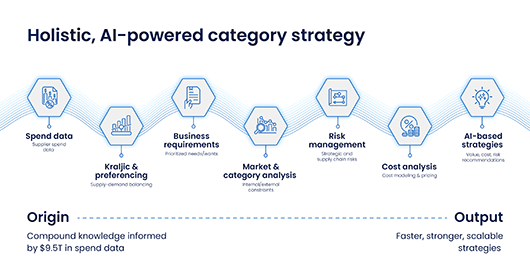
Evaluating your choices and building these strategic frameworks can be time-consuming when relying on manual processes and disconnected presentations. Coupa Category Strategy brings structure, consistency, and scale to this phase of the work, using AI-enabled capabilities to surface relevant value levers, assess trade-offs, and stay aligned with business objectives.
This powerful platform empowers procurement teams to build holistic, value-driven category strategies that deliver real business impact. Using a proven methodology to guide every decision, this AI-native technology automatically suggests relevant value levers, helping teams uncover an additional 3-8% in savings opportunities while balancing risk and sustainability goals. By replacing analog templates with a smart, interview-style digital ecosystem, Coupa cuts category strategy creation time by 50%, giving your team the confidence to make faster, sharper strategic choices.
For a quick overview of category strategy development, download 4 Step Roadmap to Building an Effective Category Strategy. You can also get more insight on procurement maturity and AI readiness in our e-book, Preparing for the Future of Global Trade: A Roadmap for Procurement.
This post is Part 3 of a four-part series on category strategy development. In Part 1, we explored how internal analysis lays the foundation. Part 2 examined how market insights shape what’s possible. In the final post, we’ll look at how to turn category strategy into execution and measurable results.
Oh! It looks like you opted out from using the needed cookies. If you are interested in using the AI Agent, then please opt-in to the cookies in the preference center.
Update preferences