Volatile news. Stable spend.
Read the latest in the Coupa Business Spend Index™ Quarterly Update.
Get the Report





The market winced. Business spend held firm.
The Coupa Business Spend Index™ Quarterly Update

Today's supply chains form a complex web across the globe, connecting multinational buyers in one place with suppliers in numerous others. The result? Cash is often trapped for both parties.
This puts pressure on businesses to tap into their working capital. Economic volatility is now the default condition. Sudden tariff swings and energy-driven price spikes make traditional borrowing much more difficult. Suppliers feel the pressure, too. They need large amounts of funds to produce goods and materials, but slow payments from buyers and expensive short-term loans can prevent them from keeping the cash on hand they need.
Supply chain finance is a solution that frees this trapped cash. Ultimately, supply chain financing works to benefit both buyers and suppliers.
Supply chain finance is a technology-based solution that maximizes cash on hand by enabling businesses to pay balances at a later date while allowing suppliers to get paid faster using an outside financier or bank.
Both parties benefit from this situation. The business — or buyer — optimizes working capital while the supplier gains faster access to funds they are owed, giving everyone more cash on hand to keep operations running smoothly.
In today’s unpredictable economy, maintaining a healthy cash flow is vital. However, inflation has stayed stubborn and volatile — reaccelerating to 4.2% in mid-2026 before cooling. This volatility makes keeping cash on hand a constant challenge.
The cost of producing goods and services is going up. Meanwhile, obtaining a loan is also more expensive than in previous decades. While interest rates have eased from their recent historic peaks, borrowing costs remain elevated, and the rate path is uncertain.
Supply chain financing offers a way for both buyers and sellers to optimize cash flows without relying on high-cost debt. This, in turn, provides both parties with a buffer against financial instability.
In particular, businesses with extensive direct spending can benefit the most from supply chain financing. Since their suppliers provide the mission-critical materials needed to produce their goods or services, they have a vested interest in ensuring a strong relationship.
The ability to offer early payments helps strengthen their relationships by providing more financial stability for their suppliers, which ultimately mitigates risks associated with supplier defaults, late deliveries, or production disruptions.
Let’s say a leading car manufacturer (the buyer) produces electric vehicles and routinely orders electronic chips from a specialized supplier for its vehicles.
The car manufacturer places a large purchase order (PO) with the supplier (the seller) for a significant amount of semiconductor chips needed for its upcoming vehicle production cycle. The supplier needs to start producing the chips immediately to meet the quantity request, but they face a looming cash flow gap.
The supplier has limited capital and is using it all to purchase raw materials and cover the production costs for this order. Once the order is complete, they’ll have no cash on hand to produce more chips.
Recognizing this problem may impact future chip deliveries — the car manufacturer offers a supply chain financing solution in partnership with a financial institution. The supplier accepts, and once they’ve shipped the chips, the financier pays the supplier — minus a small fee.
This immediate payment improves the supplier’s cash flow, allowing them to continue operations without having to wait for the car manufacturer’s payment terms, which is to send a payment 90 days after the chip's delivery.
The car manufacturer then pays the financier back at a later date agreed upon. This enables the car manufacturer to keep more cash on hand and ensures timely delivery of critical components, reducing production delays.
As you can see, there are three main components to know in supply chain financing: a buyer, a supplier, and a financier.
The buyer orders goods and services from the supplier and benefits from an extension of payment terms. Typically, the buyer has a better credit rating than the supplier, which allows the buyer to access capital at a lower cost for the supplier through an intermediary financier.
Buyers sometimes negotiate extended payment terms with suppliers, but this results in liquidity problems for the supplier.
With low cash flow, the supplier then struggles to maintain supply chain reliability, and the quality of the goods and services it provides to the buyer may diminish. Supply chain finance helps by giving the buyer longer payment terms while ensuring the supplier gets paid quickly and isn’t impacted by the buyer's payment extension.
The supplier sells goods and services to the buyer and benefits from receiving early payments on their invoices.
Often, suppliers need to invest significant capital upfront to produce goods or services before receiving payment from buyers, trapping cash in inventory and production. Supply chain financing allows suppliers to access that trapped cash for a small fee, reducing financial strain.
The financier, typically a bank or other financial institution, funds the early payment to the supplier for a small fee or discount on the goods or services. The buyer then pays the financier at a later date. This enables the buyer to negotiate better terms with the supplier and for the supplier to get paid quickly.
Let’s revisit the car manufacturer and semiconductor chip supplier example and break down the process of their supply chain financing. The manufacturer purchases 2,000 chips from the supplier, who then sends the chips and an invoice. The manufacturer approves the invoice, which includes a standard credit term or payment due date of 30 days.
However, the supplier needs cash now and may request immediate payment from the manufacturer’s financier.
If all parties agree to the terms, the financier then issues the payment to the supplier and extends the manufacturer's payback period from 30 days to 60 days. Now, the manufacturer has two months to pay for the chips while the supplier already has the cash it needs due to the financier issuing the funds.
This results in the manufacturer and supplier both having additional cash on hand.
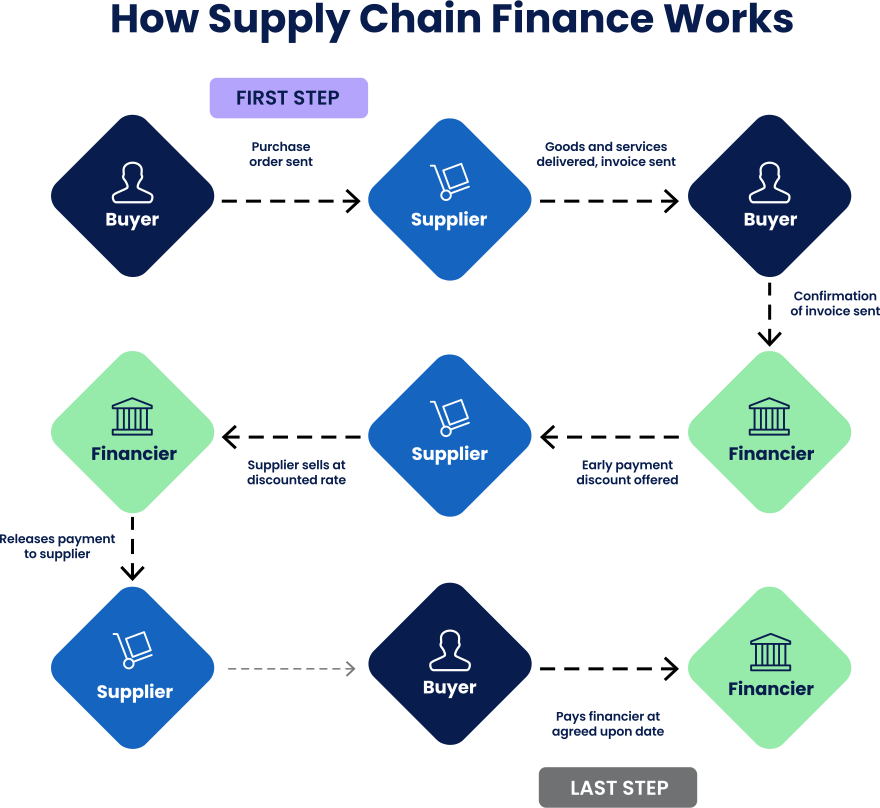
Supply chain financing follows these steps:
It’s important to note that technology plays a major role in the steps above. Cloud platforms and marketplaces automate and handle transactions between buyers, sellers, and financial institutions. An integrated procure-to-pay process is vital to facilitate purchase order, invoice, and payment processes between buyers and sellers and make data from those transactions easily accessible for financiers to review.
Businesses have several options to manage working capital and accelerate payments. Understanding the differences between supply chain finance, traditional factoring, and dynamic discounting helps you choose the right tool for your cash flow strategy.
This approach is buyer-led. A large buyer sets up a program with a financial institution to offer early payments to its suppliers. The cost of financing is based on the buyer's strong credit rating. This setup allows smaller suppliers to access cash at a much lower rate than they could secure independently.
While supply chain finance relies on the buyer, traditional factoring is supplier-initiated. A supplier sells its unpaid invoices to a third party, known as a factor, for an immediate cash advance. The factor charges a fee based on the supplier's credit profile and the risk of the invoice. Traditional factoring often includes recourse, meaning the supplier must repay the advance if the buyer fails to pay the invoice. Because the pricing is based on the supplier's credit and carries higher risk, traditional factoring typically costs much more than supply chain finance.
Dynamic discounting removes the third-party financier from the equation entirely. In this model, buyers use their own excess cash to pay suppliers early in exchange for a reduced invoice total. The discount uses a sliding scale. Paying an invoice 20 days early yields a larger discount than paying it five days early. This gives buyers a risk-free return on their cash while giving suppliers quick liquidity.
As noted in the How supply chain finance works steps earlier, both reverse factoring and dynamic discounting serve as the engine during the financing approval stage. The best option simply depends on whether a buyer wants to leverage their own cash reserves or use a financial partner.
Supply chain finance optimizes cash flows for both buyers and suppliers, creating more resilient supply chains, supporting business continuity, and fostering stronger supplier relationships. Let’s examine the advantages for suppliers and buyers more closely.
While supply chain financing has numerous benefits, it also has risks. When businesses rely too heavily on supply chain financing and invest a lot of money into projects while pushing numerous payments out, they may struggle to pay back financiers and ultimately be forced to shut down.
Some other risks include the following:
The validity of a company’s balance sheet and cash flow statement may be more difficult to determine when using supply chain financing. That’s because buyers can classify the extended payment terms to a financial institution as accounts payable rather than debt. This makes it appear the buyer has more cash on hand than it really does, despite having an upcoming payment due to the financier.
Because of this, regulators now require much more transparency. It is no longer just about the SEC keeping a close eye on programs. Under FASB ASU 2022-04, U.S. businesses must explicitly disclose their supplier finance programs. This includes sharing the key terms, the total outstanding amounts each period, and a year-over-year breakdown of changes. International companies face similar rules under IAS 7 and IFRS 7 amendments that took effect in January 2024.
If you implement a program, it is vital that you use the right technology to gain visibility into your supply chain financing activity and meet these reporting rules. Coupa empowers you to track all invoices in real-time and automatically pull transactions into the appropriate ledgers to produce a traceable audit trail.
Setting up a supply chain finance program can be complex for buyers, requiring significant changes to existing processes and systems. Purchase order and invoice processing workflows must be streamlined and integrated with finance and treasury controls.
Smaller suppliers, in particular, who often need access to this low-cost capital the most, don’t have enough data for financial intuitions to underwrite financing options. There’s also the burden for suppliers to communicate with buyers and financers in separate channels and transactional flows.
With careful consideration of all these factors, supply chain finance programs may be more efficient, timely, and successful. A platform like Coupa’s can help you create a solid foundation for a supply chain finance program by connecting all people and processes throughout the transaction.
You can create, send, and track purchase orders, invoices, and payments to the supplier from one place. Several financers can be integrated directly into the platform, giving you and your supplier direct access to financing options. The supplier, from their portal, can then simply click a button to accept the most attractive finance offer and have the money in their bank account the following day.
Growing geopolitical conflicts, tighter regulations, higher costs, and increased supply chain disruptions all contribute to a tough economic climate. Many CFOs look to new technology to navigate this uncertainty. According to Coupa’s 2026 Strategic CFO report, 85% of CFOs say AI is central to their strategy, yet 92% worry about their ability to implement it (up from 66% the prior year).
Supply chain financing provides a flexible, low-cost way to manage liquidity and support these strategic investments. This can be particularly useful for businesses with stable product portfolios. Knowing demand will likely not dip for these products, businesses can extend payments via a supply chain finance program. This carries fewer risks and provides additional capital to invest in new initiatives, like AI rollouts.
Let’s circle back to our electric car manufacturer as an example. Let’s say the car manufacturer just secured a new semiconductor chip supplier to support production on a brand-new electric truck for an upcoming model launch.
Demand for this product is unknown since it’s a new offering, so the manufacturer decides not to offer supply chain financing to the chip supplier. However, the manufacturer's best-selling sedan has consistently performed well over the past five years. The company decides to offer supply chain financing to their sedan chip supplier since that product carries less holding inventory cost risks. This gives the manufacturer more capital to support investing in the new truck while also strengthening its relationship with its main chip supplier.
With more cash on hand, businesses can build supply chain resilience, adapt to economic fluctuations, ensure operational continuity during disruptions, and future-proof their brand.
Artificial intelligence (AI) is changing supply chain finance. It improves decisions, assesses risk, and automates processes. However, a wide gap exists between expectations and reality. According to the Coupa Strategic CFO Report 2026, 41% of CFOs believe agentic AI will deliver the greatest long-term financial returns. Yet, only 13% have deployed it successfully.
For buyers and suppliers, AI helps:
For financiers, AI helps:
We are already moving beyond basic automation into the era of agentic AI. Today, AI agents do the heavy lifting. Autonomous financial operations are now a reality with tools like Coupa Navi™. These agents actively analyze a buyer’s portfolio to highlight the safest products for supply chain financing. They also manage routine tasks autonomously, such as processing invoices, adjusting credit limits, and optimizing payment schedules. You can explore more of these active workflows in Coupa's AI use case library.
Supply chain finance is a powerful tool for optimizing cash flow, supporting supplier relationships, and enhancing overall resilience. With careful planning and implementation, businesses with considerable direct spend can leverage supply chain finance to navigate economic uncertainties and drive long-term success.
Many organizations are already seeing these benefits in action. For example, Vacasa uses Coupa Pay to manage and expedite payments to suppliers of all sizes across more than 400 destinations from a single platform. “Coupa gives us a competitive advantage because we can pay our vendors in a more efficient manner,” says Jenny Langager, Senior Director of Accounting Operations at Vacasa.
Coupa gives you the tech foundation you need to create a safe and successful program. Automate your procure-to-pay process, gain access to some of the world’s leading banks and payment partners, and create a traceable audit trail with the leading Agentic Spend Management platform.
Oh! It looks like you opted out from using the needed cookies. If you are interested in using the AI Agent, then please opt-in to the cookies in the preference center.
Update preferences