Volatile news. Stable spend.
Read the latest in the Coupa Business Spend Index™ Quarterly Update.
Get the Report





The market winced. Business spend held firm.
The Coupa Business Spend Index™ Quarterly Update

The pressure on finance and procurement leaders to deliver full spend visibility has never been greater. Organizations face numerous obstacles to achieving this visibility, from manual processes and scattered data sources to outdated information systems. Among these challenges, one of the most fundamental yet often overlooked is maintaining clean, reliable data across their spend management systems.
Most organizations cleanse their data once during implementation to prepare for spend analysis activities, and then never again. This pattern is understandable. After investing significant time and resources into platform implementation, teams naturally want to move forward with analysis and decision-making.
However, this “set it and forget it” approach creates a cascading problem over time, especially when leveraging AI capabilities. While nearly 70% of CPOs prioritize investments in technology, 49% of procurement leaders cite data accuracy and reliability as significant challenges, according to Gartner's "Predicts 2025: Procurement Addresses Data Challenges and Embraces Rapid Change." Perhaps most telling, Gartner predicts that by 2027, 85% of procurement organizations will still be improving data quality to exploit efficiencies from technologies like GenAI. This disconnect highlights a critical gap: Organizations invest heavily in advanced technologies while the underlying data foundation remains problematic.
This data deterioration severely impacts decision-making capabilities and regulatory adherence for mid-to-large enterprises with dynamic spend patterns or complex compliance needs. The risks are particularly acute in today's rapidly shifting markets, where a single sudden change can upend an entire financial strategy. Nearly 40% of finance leaders lack full visibility into spend data, which is further exacerbated by outdated information, leaving them vulnerable when quick, data-driven decisions are critical. With 41% of CFOs at risk of being unprepared to respond due to reliance on outdated data, embracing continuous AI data cleansing has become a strategic imperative rather than a nice-to-have.
Modern enterprises operate in an environment of constant change, making continuous data cleansing essential for optimal spend management. This is due to:
Each change creates discrepancies in spend data that compound over time.
The stakes are particularly high for mid-to-large enterprises with complex spend patterns and large datasets. These organizations often manage thousands of suppliers, multiple procurement systems, and varied compliance requirements across different business units and geographies. When data quality degrades in such environments, the impact ripples through financial reporting, supplier relationship management, and strategic planning initiatives.
Clean data serves as the foundation for accurate spend analysis, enabling organizations to identify savings opportunities, manage supplier risk, and maintain regulatory compliance. Organizations with high-quality data can achieve significant increases in the visibility of managed spend, a key performance indicator that directly impacts bottom-line results. Without continuous data management practices, even sophisticated analytics platforms cannot deliver reliable insights, leaving leaders to make critical decisions based on incomplete or inaccurate information.
“Clean data is the launchpad for AI that actually delivers. When your data is trusted, AI becomes a true partner — revealing insights, accelerating decisions, and unlocking value you didn’t know was possible.”
— Shailesh Bhaskaran, Director of Product - Coupa AI at Coupa
Data integrity represents the accuracy, completeness, and consistency of data throughout its lifecycle. Data cleansing is the primary mechanism for maintaining this integrity, removing errors, inconsistencies, and obsolete information that naturally accumulate over time.
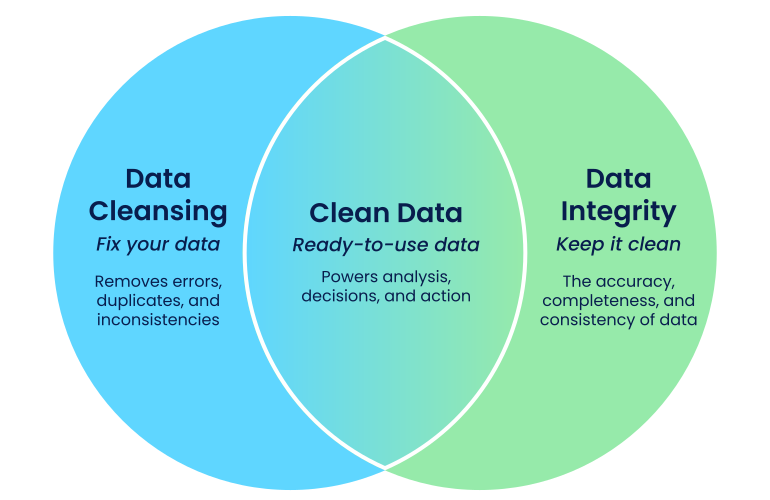
Incorporating data integrity from the start provides critical advantages. It eliminates inaccuracies, duplicate records, and manual effort, giving you clean, reliable data from day one. This foundation enables the quick building of taxonomies tailored to your unique business needs, ensuring spend is assigned to the correct categories. Additionally, leveraging anonymized data from global economic spend enables high-accuracy classification and actionable insights.
To maintain data integrity within existing systems and workflows, consider these actionable steps:
Establish a well-defined data cleansing cadence. Implement quarterly data cleansing cycles rather than treating it as a one-time activity. A regular schedule ensures that data quality issues are addressed before they compound.
Foster cross-functional communication. Break down data silos by establishing clear communication channels between procurement, finance, IT, and business units. Regular data governance meetings help identify and address quality issues — such as mismatched codes between departments or inconsistent product descriptions — before they impact critical business processes.
Leverage AI tools to reduce manual tasks. Deploy automated data cleansing tools that handle routine tasks like duplicate detection, format standardization, and basic validation checks. Understanding these capabilities is essential for leaders new to AI terminology (explore this AI Glossary Guide for comprehensive definitions).
“Data cleansing and transformation during the extract, transform, and load (ETL) process are essential for producing clean data, which enhances the accuracy of downstream processes in AI-powered classification, like category classification and supplier normalization. On the consumption side, clean data is the foundation of reliable and repeatable analytics and KPIs, enabling consistent and trustworthy insights for effective decision-making across the organization.”
— Ashish Pathak, VP of Spend Analytics and Data Foundation at Coupa
Understanding the specific factors that degrade data quality is essential for developing effective cleansing strategies. These challenges are particularly acute for organizations with complex spend patterns and multiple data sources.
Consistent data cleansing becomes even more critical when considering AI adoption. The Hackett Group’s research identifies data quality concerns as the top challenge for AI adoption in procurement, with 73% of organizations rating it as a moderate or major issue. Without thorough data cleansing — including correcting errors, standardizing formats, and unifying supplier records — organizations struggle to leverage AI for spend analytics, risk management, and cost optimization.
The optimal frequency for data cleansing depends on several factors, but quarterly cleansing emerges as the sweet spot for most mid-to-large enterprises. Quarterly cleansing aligns with natural business cycles and prevents the accumulation of data degradation factors that compound over 90-day periods, such as supplier changes, system integrations, and evolving business processes.
| Company Size | Recommended Cleansing Frequency | Why It Matters |
| Small businesses | Quarterly or semi-annually if spending volume is low | Smaller datasets are still prone to accumulating outdated contracts, inventory, and vendor info, especially with smaller teams overseeing all of the company’s data |
| Midsize firms | Quarterly | Prevent buildup and ensure smoother reporting from growing data inputs from multiple systems |
| Enterprises | Monthly or quarterly (most will find quarterly to be sufficient) | Large datasets and complexity across departments mean more room for duplications, errors, and mismatches |
Quarterly cycles strike the optimal balance between maintaining data quality and managing resource requirements while preventing issues from accumulating to the point where they significantly impact business operations. Organizations with extremely dynamic spend patterns may benefit from monthly cleansing, but most enterprises find quarterly cycles provide the consistency needed for long-term data quality success.
The key is consistency rather than perfection. Organizations that establish regular cleansing schedules achieve better long-term data quality than those that attempt more frequent cleansing but lack consistency in execution. Industry experts recommend aligning data cleansing cycles with other business rhythms, such as quarterly business reviews, ensuring that clean data is available when most needed for strategic decision-making.
Artificial intelligence is revolutionizing data cleansing by automating the tedious, manual processes that previously made continuous data maintenance impractical for most organizations. AI in procurement and finance AI applications can handle routine cleansing tasks with greater speed, accuracy, and consistency than human operators.
Modern AI systems excel at pattern recognition, making them particularly effective at identifying and correcting common data quality issues. They automatically detect duplicate records, standardize formats, validate data against external sources, and flag anomalies that require human review.
AI algorithms can detect inconsistencies and missing values at scale faster than manual methods. For example, if tax rates or VAT codes are entered manually, they may vary across invoices, even for the same supplier. Or if line item descriptions are vague, AI classification can catch this error and implement a rule to standardize tax codes or descriptions based on geography or product type.
AI learns formatting patterns over time and applies consistent rules across large datasets — think dates, phone numbers, company names, and more. So if “California” and “CA” are being used inconsistently across datasets, it will automatically correct to the preset coding system put in place.
Machine learning algorithms continuously improve accuracy by learning from historical cleansing decisions and user feedback. This means that AI-powered data cleansing tools become more effective over time, requiring less human intervention and producing better results with each cleansing cycle.
GenAI capabilities add another dimension to data cleansing efforts. AI agents can automatically generate missing information, standardize descriptions, and create enriched data records by combining information from multiple sources.
AI democratizes data cleansing by making it accessible to organizations that previously lacked the resources to maintain clean data. Teams no longer need specialized data management expertise to implement effective cleansing practices. The collective intelligence from AI-powered platforms can turn transactions into intelligent insights, leveraging the power of community-driven data to benefit all users.
The stakes were high when Bass Pro Shops set out to acquire Cabela. Like many large-scale mergers, one of the biggest challenges wasn’t just the financial aspects, but operations. How were they going to integrate two complex spend ecosystems, each with its own structures, suppliers, and systems, to uncover overlap? Traditionally, this kind of data cleansing and classification would take several years of manual effort.
With the help of Coupa’s AI Classification (AIC) tool, the procurement team automated the cleansing process and categorized 100% of the combined spend data. What could have been a data nightmare became a strategic advantage.
“We exceeded synergy targets following our $5 billion acquisition of Cabela’s, using Coupa to understand and classify 100% of combined spend,” said David Elford, Director of Non-Merchandise Procurement.
This clean, automated AI-structured data gave the team immediate visibility into consolidation opportunities, unlocking new buying power and enhancing integration. In fact, the company didn’t just hit its synergy goals in the first two years; it surpassed them.
Coupa AIC represents a mature approach to automated data cleansing that addresses the specific needs of enterprise procurement and finance organizations. AIC follows a systematic four-step process: preparing and organizing data from multiple sources, normalizing suppliers by standardizing nomenclature, classifying spend using AI and human quality assurance, and enabling visualization with full access to cleansed datasets. The tool's scalability and global reach enable it to analyze millions of transactions while adapting to your company's evolving spend patterns and global operations.
What sets AIC apart from competitors is its community-powered, real-time approach to data normalization. The tool's key differentiating advantages include:
Unlike competitor solutions that rely on static, customer-specific datasets, AIC leverages $8 trillion in global economic spend data from over 10 million buyers and suppliers. This community-driven approach and the breadth and depth of this data improves our models, enabling faster and more precise classification.
While competitors require manual, configurable approaches to taxonomy development, AIC automatically generates taxonomies tailored to each organization’s unique business needs, reducing implementation time and ensuring consistency.
AIC provides automated insights with full transparency, unlike competitors that offer automated capabilities with less transparency. Users can understand the reasoning behind classifications while maintaining appropriate governance.
AIC delivers true self-learning capabilities that continuously adapt to changing business needs, while competitors typically rely on manual, periodic updates.
These capabilities deliver measurable business results. Organizations using AIC report 3x faster value realization, 95% category coverage within 30 days, and 50% reduction in analytics effort for deriving insights. By reducing manual work and increasing agility, AIC automates classification and normalization to free your team from repetitive tasks, allowing them to focus on strategic initiatives. Integrating Coupa's comprehensive platform enables organizations to maintain data integrity across all spend management activities, from requisition to payment.
For organizations ready to move beyond ad hoc data cleansing efforts, AIC offers systematic, automated data quality management that scales with business growth and adapts to changing requirements. By leveraging AI to handle routine cleansing tasks, procurement and finance teams can focus on strategic activities while maintaining the data integrity essential for effective spend optimization.
Oh! It looks like you opted out from using the needed cookies. If you are interested in using the AI Agent, then please opt-in to the cookies in the preference center.
Update preferences