Volatile news. Stable spend.
Read the latest in the Coupa Business Spend Index™ Quarterly Update.
Get the Report





The market winced. Business spend held firm.
The Coupa Business Spend Index™ Quarterly Update

Enterprise procurement is about much more than cutting costs. In an era defined by macroeconomic volatility, shifting regulatory landscapes, and fractured global supply chains, procurement has evolved into a core pillar of corporate strategy and margin resilience. For CFOs and CPOs at large, complex organizations, how companies orchestrate spend determines how fast they can scale, innovate, and weather market disruptions.
According to Deloitte’s recent Global CPO Survey, high-performing procurement organizations are delivering significantly higher margin protection by shifting away from manual, reactive buying behaviors, with “Digital Masters” using advanced procurement technology at 1.5x rate more than their peers. Yet, achieving this level of performance requires navigating deep organizational complexities. To move the needle, leaders must look past localized fixes and implement a holistic strategy built for scale.
Enterprise procurement is the strategic, organization-wide process of sourcing, purchasing, and managing goods and services to drive value, efficiency, and compliance across large, complex organizations. Unlike localized purchasing, it functions as an interconnected ecosystem designed to optimize every dollar spent while mitigating multitiered third-party risks.
What truly distinguishes procurement at the enterprise scale is not just the sheer dollar volume, but the multilayered environment in which it operates. Enterprise procurement must balance:
At scale, managing spend demands procurement orchestration. Modern enterprise procurement platforms give employees a simple, user-friendly place to submit their requests. This architecture provides an intuitive intake interface for employees while routing complex validation, security compliance, and budget approvals behind the scenes, eliminating disjointed processes across disparate business units.
To master this complexity, organizations must move beyond disjointed execution and focus on holistic procurement management that unifies strategy, technology, and execution.
Scale changes everything. While small and midsize businesses focus heavily on immediate cash flow and transactional speed, enterprises must balance velocity with strict governance and long-term risk management.
| Operational lever | Mid-market procurement | Enterprise procurement |
| Purchase volume | Lower buying volume, making it easier to track and manage | Massive buying volume, which requires structured plans to get the best prices |
| System complexity | Single accounting system or ERP; minimal integrations | Multi-ERP environments, legacy systems, and disparate business units |
| Sourcing scope | Domestic, transactional, and largely relationship-driven | Multitier, global supplier network with complex logistics and geopolitical risk |
| Compliance and governance | Basic internal approvals and local tax compliance | Strict global audit readiness, Sarbanes-Oxley (SOX), ESG tracking, and automated three-way matching |
| Spend visibility | Generally manageable via spreadsheets or basic software | Fragmented data requiring advanced procurement analytics to combat maverick spend |
| Stakeholder coordination | A few managers make quick decisions together | Many teams like legal, finance, and security must approve purchases |
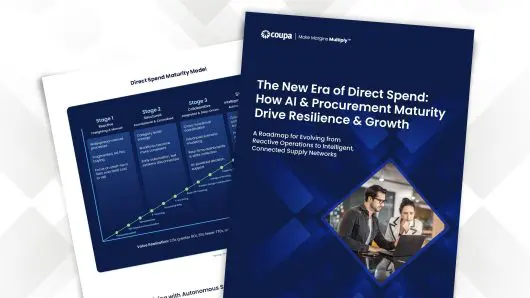
Achieving peak operational efficiency is a progressive journey of scaling capabilities. An organization's procurement maturity typically evolves across four distinct phases:
Understanding where your organization sits on this spectrum allows leadership to target systemic bottlenecks rather than treating isolated symptoms.
While the overarching phases of maturity remain the same, an enterprise must evaluate its maturity along two parallel tracks, as direct and indirect procurement optimize for entirely different business outcomes:
A common point of confusion for scaling enterprises is the division of labor between an enterprise resource planning (ERP) system and a dedicated procurement platform.
An ERP is fundamentally a financial system of record. It is designed to track General Ledger entries, manage inventory values, and hold asset data. It excels at historical logging, but it was never built to optimize user adoption, supplier collaboration, or strategic sourcing.
The core failure of traditional systems is exposed when an enterprise undergoes mergers and acquisitions, resulting in multiple disjointed ERP instances running simultaneously. A dedicated procurement suite acts as an orchestrating overlay across these legacy systems, unlocking the bottleneck that prevents organizations from moving past basic digitization into higher stages of procurement maturity.
By embedding guided buying guardrails, the platform automatically curbs rogue tail spend by steering everyday buyers toward contracted, pre-negotiated supplier catalogs, capturing the advantages of enterprise scale without sacrificing operational agility. While an ERP can log that a purchase occurred, an enterprise procurement platform ensures that the purchase happens with the right supplier, at the negotiated contract rate, with automated risk screening applied before the money ever leaves the business.
To effectively scale operations, organizations categorize their spend management based on the nature of what is being acquired and how it directly impacts the core business.
The modern enterprise source-to-pay loop is a continuous cycle of refinement, optimization, and relationship management. Here is how the end-to-end process works in seven simple steps:
Early in the enterprise journey, procurement teams often overlook category strategy, focusing instead on reactive sourcing. When they finally adopt it, the institutional knowledge and strategic intent typically end up siloed across stakeholders and trapped in static slide decks. Advanced procurement changes this by digitizing and unifying the entire lifecycle.
Through a single, AI-powered platform, category strategy and sourcing optimization are natively linked. This creates a true closed-loop model, where a company's upstream strategy automatically translates into operational guardrails and mathematical constraints for live sourcing events. The optimization engine then evaluates millions of supplier award scenarios while strictly preserving those mandates. Crucially, real-world event data continuously loops back upstream to update the strategy based on actual market capacity, turning category strategy into an active, continuous lever for margin protection.
When done right, enterprise procurement ceases to be a back-office administrative cost center and transforms into an engine for business growth and operational resilience.
Coupa’s procurement software helps large organizations control spend, manage risk, and turn procurement into a strategic function — from intake to payment.
Even the most seasoned enterprise procurement teams run into substantial bottlenecks that erode margins and stall agility.
Operating across global subsidiaries often results in data silos where different ERP systems code the same item in completely different ways. Without an overlay platform to unify this information, CPOs lack a single source of truth for total spend visibility.
How to fix it: Use a single purchasing platform that sits on top of your existing systems to bring all your financial data into one clear dashboard.
When corporate buying software is slow or difficult to use, employees bypass official channels to buy goods independently on corporate credit cards. This maverick spend leads to missed negotiated rates and introduces unvetted third-party compliance liabilities.
How to fix it: Make the buying system as easy to use as popular consumer shopping websites, which naturally guides employees to approved contracts.
Fluctuating geopolitical climates, sudden insolvency, and climate disruptions mean that reliance on static supplier spreadsheets leaves an enterprise vulnerable. Real-time visibility into the health of sub-tier suppliers is mandatory to prevent operational downtime.
How to fix it: Set up continuous supplier monitoring tools that alert you to potential risks before they impact your business.
Deploying a new strategic vision or software package across thousands of distributed global employees often stalls due to user friction. If user adoption fails, the entire business loses out on expected contract efficiencies.
How to fix it: Involve users in the software testing phase early, and provide simple, on-screen training tips rather than long training manuals.
Trying to move quickly while still following strict rules can cause non-compliance. It can take time to get necessary sign-offs from finance, legal, and purchasing.
How to fix it: Automate simple approval steps behind the scenes so standard purchases can clear quickly while higher-risk transactions get flagged for review.
AI is fundamentally altering how global procurement teams execute day-to-day operations and plan long-term strategies. To that end, more than half of leading CFOs are investing in AI to bolster both their growth and profitability strategies.
The evolution of AI in procurement can be seen across three distinct pillars:
AI streamlines the administrative burden of the procure-to-pay cycle. Intelligent software handles automated 3-way matching, categorizes unstructured spend logs into clear taxonomies, and flags anomalies in purchase requests before human intervention is required.
AI engines analyze vast transactional patterns to highlight latent risk or hidden opportunities. For example, machine learning algorithms scan the global market to point out unexpected supplier health declines or reveal contract pricing variations across business silos.
Crucially, these advanced analytical engines rely heavily on clean data models. Using AI-powered data cleansing ensures that disparate transaction logs across multiple global ERP systems are merged, standardized, and normalized. This provides the pristine dataset needed to drive accurate corporate intelligence.
The industry is actively transitioning into the era of autonomous procurement. Powered by agentic AI, modern procurement systems can autonomously monitor external risk signals, initiate sourcing events when safety stock drops, and interact directly with suppliers to finalize standard compliance updates.
This shift is also prompting leading CFOs to consider how they’re upskilling teams across the company and driving workforce transformation. Since procurement professionals will need to spend less and less time manually chasing approvals or reconciling line items, they can engage in more value-added activities that encourage them to consider how to best configure and guide an autonomous AI agent workforce. In this model, agentic loops handle repetitive contract redlining, identify commercial risk anomalies, and automatically execute tactical spot-sourcing events, freeing teams of people to focus entirely on strategic supplier relationships and high-value commercial negotiations.
Enterprise procurement is a specialized pillar within the wider supply chain management ecosystem. Procurement focuses specifically on sourcing, buying, contract negotiation, and spend governance. Supply chain management is broader, governing the logistics, manufacturing, warehousing, and distribution workflows required to transform materials into finished corporate products.
An enterprise requires dedicated procurement technology when its legacy ERP workflows cannot prevent widespread maverick spend, when manual invoice processing triggers persistent payment errors, or when multi-ERP environments leave the executive team blind to overall global spend.
Implementation timelines vary widely based on system complexity and global organizational footprint. While historic on-premise custom integrations could take several years, modern AI-native spend management platforms typically take a fraction of that.
While niche, point-solutions (best-of-breed) address isolated issues like contract storage or sourcing events, they inadvertently perpetuate fragmented data silos. A comprehensive, unified platform balances end-to-end efficiency across the entire source-to-pay spectrum, offering clean data visibility and simpler enterprise software upkeep.
Great enterprise purchasing relies on having the right information at the right time. Coupa’s comprehensive enterprise procurement platform bridges systemic gaps by unifying your entire spend infrastructure into a single, intuitive platform of action.
By sitting seamlessly on top of complex, multi-ERP IT landscapes, Coupa breaks down internal operational silos to provide comprehensive spend visibility. What truly sets Coupa apart: community intelligence. By drawing on actionable, AI-powered insights enriched by a transactional spend dataset of $10 trillion generated by a network of 11 million buyers and suppliers, Coupa supplies predictive prescriptions that help you optimize your supplier network, preempt compliance risks, and maximize cost savings. Transform your procurement function from an administrative requirement into a reliable driver of corporate margin efficiency.
Stop managing administrative hurdles and start driving margin. Discover how Coupa’s AI-powered platform unifies your spend data to provide the agility and oversight your enterprise needs — from intake to payment.
Oh! It looks like you opted out from using the needed cookies. If you are interested in using the AI Agent, then please opt-in to the cookies in the preference center.
Update preferences